119942
论文已发表
注册即可获取德孚的最新动态
IF 收录期刊
- 3.6 Breast Cancer (Dove Med Press)
- 4.3 Clin Epidemiol
- 2.6 Cancer Manag Res
- 3.2 Infect Drug Resist
- 4.1 Clin Interv Aging
- 6.1 Drug Des Dev Ther
- 4.1 Int J Chronic Obstr
- 8.7 Int J Nanomed
- 2.5 Int J Women's Health
- 3.2 Neuropsych Dis Treat
- 2.4 OncoTargets Ther
- 2.6 Patient Prefer Adher
- 2.6 Ther Clin Risk Manag
- 3.1 J Pain Res
- 3.5 Diabet Metab Synd Ob
- 4.5 Psychol Res Behav Ma
- 3.4 Nat Sci Sleep
- 2.4 Pharmgenomics Pers Med
- 2.6 Risk Manag Healthc Policy
- 4.6 J Inflamm Res
- 2.3 Int J Gen Med
- 3.9 J Hepatocell Carcinoma
- 3.3 J Asthma Allergy
- 2.5 Clin Cosmet Investig Dermatol
- 3.0 J Multidiscip Healthc

黄芩素作为一种抗氧化剂,通过调动细胞内铜和产生活性氧来触发 MCF-7 人乳腺癌细胞中的线粒体凋亡
Authors Liu ZH, Yang CX, Zhang L, Yang CY, Xu XQ
Received 11 July 2019
Accepted for publication 28 October 2019
Published 9 December 2019 Volume 2019:12 Pages 10749—10761
DOI https://doi.org/10.2147/OTT.S222819
Checked for plagiarism Yes
Review by Single-blind
Peer reviewer comments 2
Editor who approved publication: Dr Takuya Aoki
Background: Baicalein, a natural flavonoid derived from traditional Chinese herb Scutellaria baicalensis Georg (known as Huang Qin in Chinese), has been reported to exhibit notable antitumor activity in various cancer cells, including breast cancer. However, the detailed mechanisms underlying its induced apoptosis as a prooxidant in breast cancer cells are still unknown.
Materials and methods: In this study, we investigated the effect of endogenous copper on cytotoxic activity of baicalin against human breast cancer MCF-7 cells in vitro.
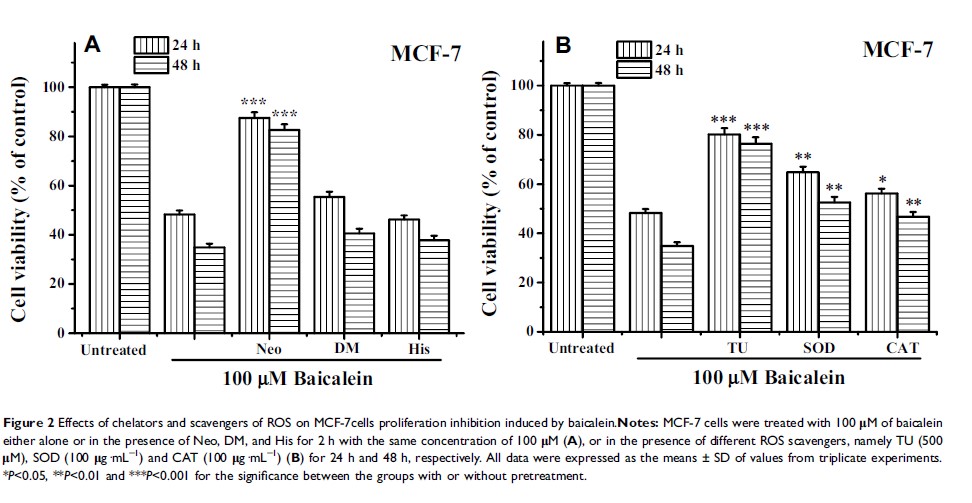
Results: Baicalein could remarkably reduce the cell viability in both dose- and time-dependent manners in MCF-7 cells but with lower cytotoxic effects on normal breast epithelial cells, MCF-10A. Such cell death could be prevented by pretreatment with Cu (I)-specific chelator neocuproine (Neo) and reactive oxygen species (ROS) scavengers. Meanwhile, baicalein could induce MCF-7 cell morphological changes, promote apoptotic cell death and increase the apoptotic cell number. Moreover, DCHF-DA staining, flow cytometry and Western blotting analyses proved that baicalein triggered the mitochondrial-dependent apoptotic pathway, as indicated by enhancement the level of intracellular ROS, disruption of mitochondrial membrane potential (ΔΨm), downregulation of anti-apoptotic protein Bcl-2, upregulation of pro-apoptotic protein Bax, release of cytochrome C and activation of caspase-9 and caspase-3 in MCF-7 cells. The pretreatment with Neo remarkably weakened these effects of baicalein. Furthermore, we confirmed that the prooxidant action of baicalein involved the direct production of hydroxyl radicals through redox recycling of copper ions.
Conclusion: These findings suggested that baicalein, acting as a prooxidant, could trigger apoptosis in MCF-7 cells occurs via the ROS-mediated intrinsic mitochondria-dependent pathway.
Keywords: baicalein, human breast cancer MCF-7 cells, apoptosis, mitochondria-dependent pathways, prooxidant