119661
论文已发表
注册即可获取德孚的最新动态
IF 收录期刊
- 3.6 Breast Cancer (Dove Med Press)
- 4.3 Clin Epidemiol
- 2.6 Cancer Manag Res
- 3.2 Infect Drug Resist
- 4.1 Clin Interv Aging
- 6.1 Drug Des Dev Ther
- 4.1 Int J Chronic Obstr
- 8.7 Int J Nanomed
- 2.5 Int J Women's Health
- 3.2 Neuropsych Dis Treat
- 2.4 OncoTargets Ther
- 2.6 Patient Prefer Adher
- 2.6 Ther Clin Risk Manag
- 3.1 J Pain Res
- 3.5 Diabet Metab Synd Ob
- 4.5 Psychol Res Behav Ma
- 3.4 Nat Sci Sleep
- 2.4 Pharmgenomics Pers Med
- 2.6 Risk Manag Healthc Policy
- 4.6 J Inflamm Res
- 2.3 Int J Gen Med
- 3.9 J Hepatocell Carcinoma
- 3.3 J Asthma Allergy
- 2.5 Clin Cosmet Investig Dermatol
- 3.0 J Multidiscip Healthc

凝血弹性描记法结合血小板映射试验可检测伴有再出血的动脉瘤性蛛网膜下腔出血患者的血小板功能障碍
Authors He Q, Zhou Y, Liu C, Zhang X, Huang N, Wang F, Liu G, Cheng Y, Xie Z
Received 31 August 2019
Accepted for publication 18 November 2019
Published 16 December 2019 Volume 2019:15 Pages 3443—3451
DOI https://doi.org/10.2147/NDT.S229284
Checked for plagiarism Yes
Review by Single-blind
Peer reviewer comments 2
Editor who approved publication: Dr Yuping Ning
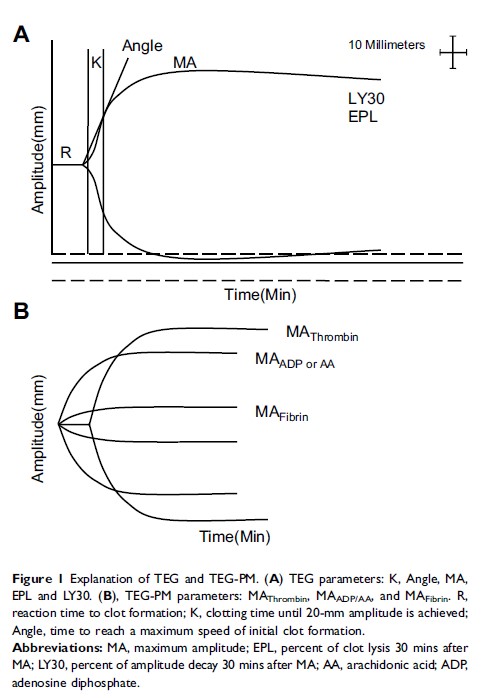
Background: Aneurysmal subarachnoid hemorrhage (aSAH) has high rates of disability and mortality, and aneurysm rebleeding is associated with poor functional outcomes. Thrombelastography with platelet mapping (TEG-PM) measures platelet function; however, it has not yet been researched in aSAH. We aimed to use TEG-PM to detect changes in platelet function in patients with aSAH and the difference in patients with and without rebleeding.
Methods: We retrospectively included patients with aSAH who underwent a TEG-PM test on admission. Rebleeding was diagnosed according to clinical and imaging data. TEG-PM data of patients with unruptured intracranial aneurysms (UIA) were also obtained as controls. Univariate and multivariate logistic regression models were performed to investigate the relationship between the platelet function and rebleeding.
Results: A total of 245 aSAH patients and 32 UIA patients were included in our study. Compared with controls, patients with aSAH demonstrated higher arachidonic acid (AA) and adenosine diphosphate (ADP) inhibition of platelet function (P <0.05). Among them, 27 patients with Hunt-Hess grade IV or V were classified as the severe SAH group. There was a significant correlation between the severe SAH group and the degree of pathway inhibition (P <0.05). Furthermore, AA (Spearman’s r=0.264, P <0.001) and ADP (Spearman’s r=0.183, P =0.004) inhibition were elevated in Hunt–Hess grade-dependent manners. The AA (Spearman’s r=0.169, P =0.008) and ADP (Spearman’s r=0.233, P <0.001) inhibition were also significantly correlated with Fisher grade. Thirty-five patients (14.3%) suffered rebleeding. Rebleeding was significantly correlated with systolic blood pressure (P =0.011), diastolic blood pressure (P =0.008), Hunt–Hess grade (P =0.034), Fisher grade (P =0.015), AA inhibition (P <0.001), and ADP inhibition (P <0.001). Multivariate logistic regression analysis model revealed that both AA (P =0.037) and ADP inhibition (P =0.008) were independent determinants for rebleeding.
Conclusion: TEG-PM may assess platelet dysfunction in patients with aSAH, and the diminished platelet response to ADP and AA may be associated with rebleeding. These findings deserve further investigation.
Keywords: aneurysmal subarachnoid hemorrhage, thromboelastography, platelet function, rebleeding