119661
论文已发表
注册即可获取德孚的最新动态
IF 收录期刊
- 3.6 Breast Cancer (Dove Med Press)
- 4.3 Clin Epidemiol
- 2.6 Cancer Manag Res
- 3.2 Infect Drug Resist
- 4.1 Clin Interv Aging
- 6.1 Drug Des Dev Ther
- 4.1 Int J Chronic Obstr
- 8.7 Int J Nanomed
- 2.5 Int J Women's Health
- 3.2 Neuropsych Dis Treat
- 2.4 OncoTargets Ther
- 2.6 Patient Prefer Adher
- 2.6 Ther Clin Risk Manag
- 3.1 J Pain Res
- 3.5 Diabet Metab Synd Ob
- 4.5 Psychol Res Behav Ma
- 3.4 Nat Sci Sleep
- 2.4 Pharmgenomics Pers Med
- 2.6 Risk Manag Healthc Policy
- 4.6 J Inflamm Res
- 2.3 Int J Gen Med
- 3.9 J Hepatocell Carcinoma
- 3.3 J Asthma Allergy
- 2.5 Clin Cosmet Investig Dermatol
- 3.0 J Multidiscip Healthc

癌相关成纤维细胞中由 NLRP3 炎性小体介导的白细胞介素-1β 产生有助于皮肤鳞状细胞癌的 ALA-PDT 治疗
Authors Nie S, Wang X, Wang H
Received 7 August 2019
Accepted for publication 11 November 2019
Published 11 December 2019 Volume 2019:11 Pages 10257—10267
DOI https://doi.org/10.2147/CMAR.S226356
Checked for plagiarism Yes
Review by Single-blind
Peer reviewer comments 2
Editor who approved publication: Dr Yong Teng
Background: Long-term tumor control following PDT is a result of its direct effect on tumor and vasculature in combination with induction of inflammatory-reactions upregulating the immune system. When PDT induces necrosis of tumors and vascular system, an immune cascade can be initiated to release all kinds of cytokines including IL1β. This further leads to the activation of inflammatory-cells and hence death of tumor cells.
Methods: Ultraviolet irradiation was used to induce cSCC mice model, gene chip was used to screen inflammatory cytokines, qPCR, ELISA and implanted tumor mice model were used to verify the changes and important role of interleukin-1β, and WB preliminarily explored the production mechanism of interleukin-1β.
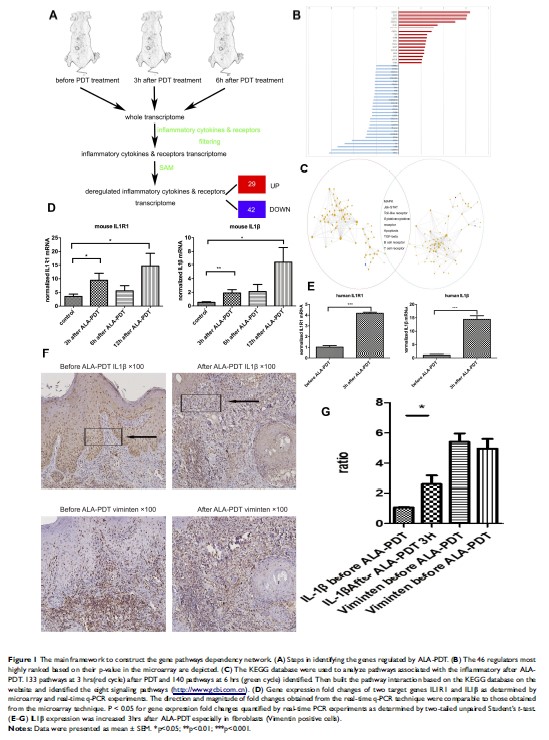
Results: Inflammatory cytokines and receptors transcript screening identify IL1r1 as the top4. After ALA-PDT, IL1r1 and IL1β increased in patients’ biopsies, principally in mesenchymal cells. In vivo, the inhibition of ALA-PDT on tumor growth of cutaneous squamous cell carcinoma (cSCC) mice in the group with intralesional injection of anti-IL1β mAb or caspase1-inhibitor was significantly weaker than the control groups. Furthermore, NLRP3-inflammasome and p-p65/p65 were elevated after ALA-PDT mediated IL1β production in cancer-associated-fibroblasts.
Discussion: By means of activating NLRP3-inflammasome with IL1β production in CAFs, PDT stimulates local acute-inflammatory-response, which further promotes PDT effect for cSCC.
Keywords: cancer-associated fibroblast, photodynamic therapy, interleukin-1β, NLRP3-inflammasome, squamous cell carcinoma