119661
论文已发表
注册即可获取德孚的最新动态
IF 收录期刊
- 3.6 Breast Cancer (Dove Med Press)
- 4.3 Clin Epidemiol
- 2.6 Cancer Manag Res
- 3.2 Infect Drug Resist
- 4.1 Clin Interv Aging
- 6.1 Drug Des Dev Ther
- 4.1 Int J Chronic Obstr
- 8.7 Int J Nanomed
- 2.5 Int J Women's Health
- 3.2 Neuropsych Dis Treat
- 2.4 OncoTargets Ther
- 2.6 Patient Prefer Adher
- 2.6 Ther Clin Risk Manag
- 3.1 J Pain Res
- 3.5 Diabet Metab Synd Ob
- 4.5 Psychol Res Behav Ma
- 3.4 Nat Sci Sleep
- 2.4 Pharmgenomics Pers Med
- 2.6 Risk Manag Healthc Policy
- 4.6 J Inflamm Res
- 2.3 Int J Gen Med
- 3.9 J Hepatocell Carcinoma
- 3.3 J Asthma Allergy
- 2.5 Clin Cosmet Investig Dermatol
- 3.0 J Multidiscip Healthc

外泌体源性长非编码 RNA HOTAIR 通过调节 microRNA-454-3p/E2F2 轴降低喉癌的放射敏感性
Authors Cui X, Xiao D, Cui Y, Wang X
Received 26 July 2019
Accepted for publication 6 November 2019
Published 11 December 2019 Volume 2019:12 Pages 10827—10839
DOI https://doi.org/10.2147/OTT.S224881
Checked for plagiarism Yes
Review by Single-blind
Peer reviewer comments 6
Editor who approved publication: Dr Tohru Yamada
Background: Studies have revealed exosomes are implicated in tumor microenvironment and tumorigenesis. Emerging evidence suggests long non-coding RNAs (lncRNAs) possess pivotal roles in laryngeal cancer progression. For this study, we aimed to find out the mechanism of exosomes and lncRNA HOTAIR in laryngeal cancer.
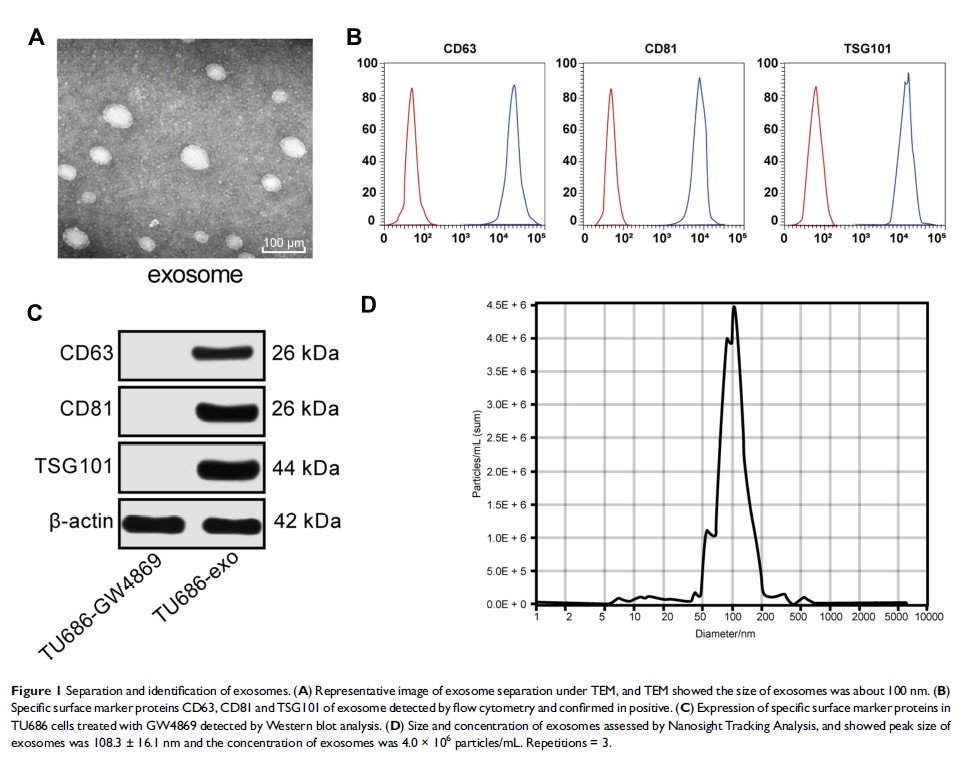
Methods: Laryngeal cancer cells-derived exosomes were initially extracted, separated and identified. Flow cytometry was applied to detect apoptosis to evaluate the effect of exosomes on cell radiosensitivity. Dual luciferase reporter gene assay, RNA pull-down and RNA immunoprecipitation assays were conducted to verify the interactions among HOTAIR, microRNA (miR)-454-3p and E2F2. The gain-and-loss functions of HOTAIR or miR-454-3p were carried out to explore their effects on TU212 and LLN cell viability, apoptosis and radiosensitivity. Levels of HOTAIR, miR-454-3p and E2F2 were detected after different treatments. An in vivo analysis was carried out in mice bearing laryngeal cancer xenografts.
Results: Laryngeal cancer-derived exosomes reduced laryngeal cancer cell radiosensitivity. HOTAIR expression was increased after cells were treated with exosome, and HOTAIR overexpression reduced laryngeal cancer cell radiosensitivity. Besides, HOTAIR worked as a competing endogenous RNA (ceRNA) of miR-454-3p to regulate E2F2 in laryngeal cancer cells. In vivo results were reproduced in in vivo studies, which demonstrated that HOTAIR knockdown reduced laryngeal cancer cell radiosensitivity by sponging miR-454-3p to silence E2F2.
Conclusion: Exosome-mediated HOTAIR acts as a ceRNA of miR-545-3p to regulate E2F2, thereby negatively regulating the radiosensitivity of laryngeal cancer cells. This study may offer novel insight into laryngeal cancer treatment.
Keywords: laryngeal cancer, long non-coding RNA HOTAIR, exosome, E2F2, microRNA-454-3p, radiosensitivity