119661
论文已发表
注册即可获取德孚的最新动态
IF 收录期刊
- 3.6 Breast Cancer (Dove Med Press)
- 4.3 Clin Epidemiol
- 2.6 Cancer Manag Res
- 3.2 Infect Drug Resist
- 4.1 Clin Interv Aging
- 6.1 Drug Des Dev Ther
- 4.1 Int J Chronic Obstr
- 8.7 Int J Nanomed
- 2.5 Int J Women's Health
- 3.2 Neuropsych Dis Treat
- 2.4 OncoTargets Ther
- 2.6 Patient Prefer Adher
- 2.6 Ther Clin Risk Manag
- 3.1 J Pain Res
- 3.5 Diabet Metab Synd Ob
- 4.5 Psychol Res Behav Ma
- 3.4 Nat Sci Sleep
- 2.4 Pharmgenomics Pers Med
- 2.6 Risk Manag Healthc Policy
- 4.6 J Inflamm Res
- 2.3 Int J Gen Med
- 3.9 J Hepatocell Carcinoma
- 3.3 J Asthma Allergy
- 2.5 Clin Cosmet Investig Dermatol
- 3.0 J Multidiscip Healthc

接受腹部大手术的小儿在术中的尿排除量与术后结果有关
Authors Zheng C, Guo C
Received 24 August 2019
Accepted for publication 5 December 2019
Published 18 December 2019 Volume 2019:15 Pages 1453—1460
DOI https://doi.org/10.2147/TCRM.S228528
Checked for plagiarism Yes
Review by Single-blind
Peer reviewer comments 2
Editor who approved publication: Professor Deyun Wang
Aim: Few data support the advantage of confirming a low urine output target during Roux-en-Y hepaticojejunostomy, which was widely used as an indication for fluid administration. We aimed at evaluating postoperative outcomes in terms of urine output in pediatric patients undergoing elective Roux-en-Y hepaticojejunostomy.
Methods: We retrospectively reviewed 689 patients who had undergone Roux-en-Y hepaticojejunostomy between January 2007 and August 2014 at the Children’s Hospital of the Chongqing Medical University. Patients were dichotomized according to the average amount of corrected urine output (6.01 mL/kg*h) as a cut-off point. The primary endpoint was the occurrence of renal complications. The secondary endpoints included prompt postoperative gastrointestinal function recovery, postoperative complications and hospital length of stay.
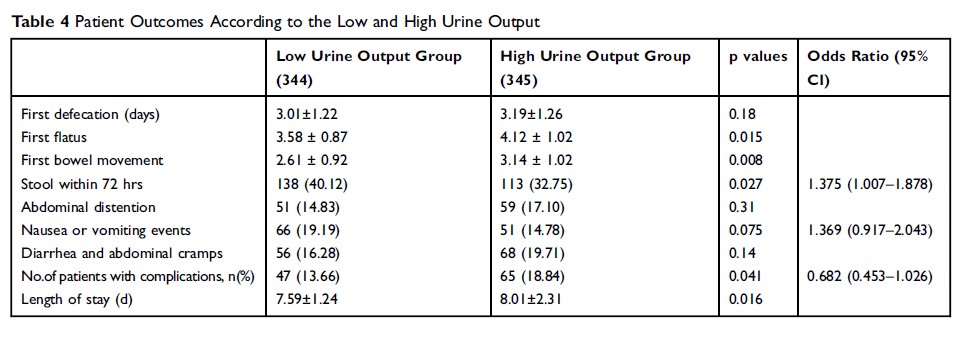
Results: The lower urine output had a proportional association with lesser amounts of crystalloid fluids (12.99±6.52 and 17.36±7.74 mL/kg*h for low and high urine output, respectively, p=0.006). For patients with a lower urine output, there were trends toward lower incidence rates of grade II postoperative complications (OR, 0.68; 95CI, 0.45–1.03; p=0.041) and accelerated recovery of gastrointestinal function, as indicated by the first flatus (p=0.015) and first bowel movement (p=0.008); however, the occurrence of renal complications did not show significant differences between the groups. The total length of hospital stay was shorter in patients with low urine output (7.59±1.24 days) than that in patients with a high urine output (8.01±2.31 days, p = 0.016).
Conclusion: Lower urine output is associated with a lower incidence rate II postoperative complications and accelerated recovery of gastrointestinal function, without increasing the occurrence of renal complications in pediatric patient undergone hepaticojejunostomy. The optimal amount of urine output and associated fluid administration should be further investigated.
Keywords: intraoperative urine output, Roux-en-Y hepaticojejunostomy, postoperative recovery, acute kidney injury