119661
论文已发表
注册即可获取德孚的最新动态
IF 收录期刊
- 3.6 Breast Cancer (Dove Med Press)
- 4.3 Clin Epidemiol
- 2.6 Cancer Manag Res
- 3.2 Infect Drug Resist
- 4.1 Clin Interv Aging
- 6.1 Drug Des Dev Ther
- 4.1 Int J Chronic Obstr
- 8.7 Int J Nanomed
- 2.5 Int J Women's Health
- 3.2 Neuropsych Dis Treat
- 2.4 OncoTargets Ther
- 2.6 Patient Prefer Adher
- 2.6 Ther Clin Risk Manag
- 3.1 J Pain Res
- 3.5 Diabet Metab Synd Ob
- 4.5 Psychol Res Behav Ma
- 3.4 Nat Sci Sleep
- 2.4 Pharmgenomics Pers Med
- 2.6 Risk Manag Healthc Policy
- 4.6 J Inflamm Res
- 2.3 Int J Gen Med
- 3.9 J Hepatocell Carcinoma
- 3.3 J Asthma Allergy
- 2.5 Clin Cosmet Investig Dermatol
- 3.0 J Multidiscip Healthc

宝藿苷 I 通过 mTOR/S6K1-Caspases/Bcl2/Bax 细胞凋亡信号通路抑制胰腺癌细胞的增殖
Authors Ni F, Tang H, Wang C, Zhang H, Zheng C, Zhang N, Chen B, Sun L
Received 27 August 2019
Accepted for publication 6 December 2019
Published 19 December 2019 Volume 2019:11 Pages 10609—10621
DOI https://doi.org/10.2147/CMAR.S228926
Checked for plagiarism Yes
Review by Single-blind
Peer reviewer comments 2
Editor who approved publication: Dr Antonella D'Anneo
Background: Although the incidence of pancreatic cancer has increased markedly, the 5-year survival rate for this disease is considerably low compared with other types of cancer. Moreover, the mortality rate of pancreatic cancer is similar to its incidence rate. Current therapeutic agents exhibit a lack of specificity for pancreatic cancer. Baohuoside I is traditionally used to treat orgasmic disorder and inflammation. However, its role in pancreatic cancer is unknown.
Objective: To explore the effects of Baohuoside I on pancreatic cancer and to study the potential-related molecular mechanism.
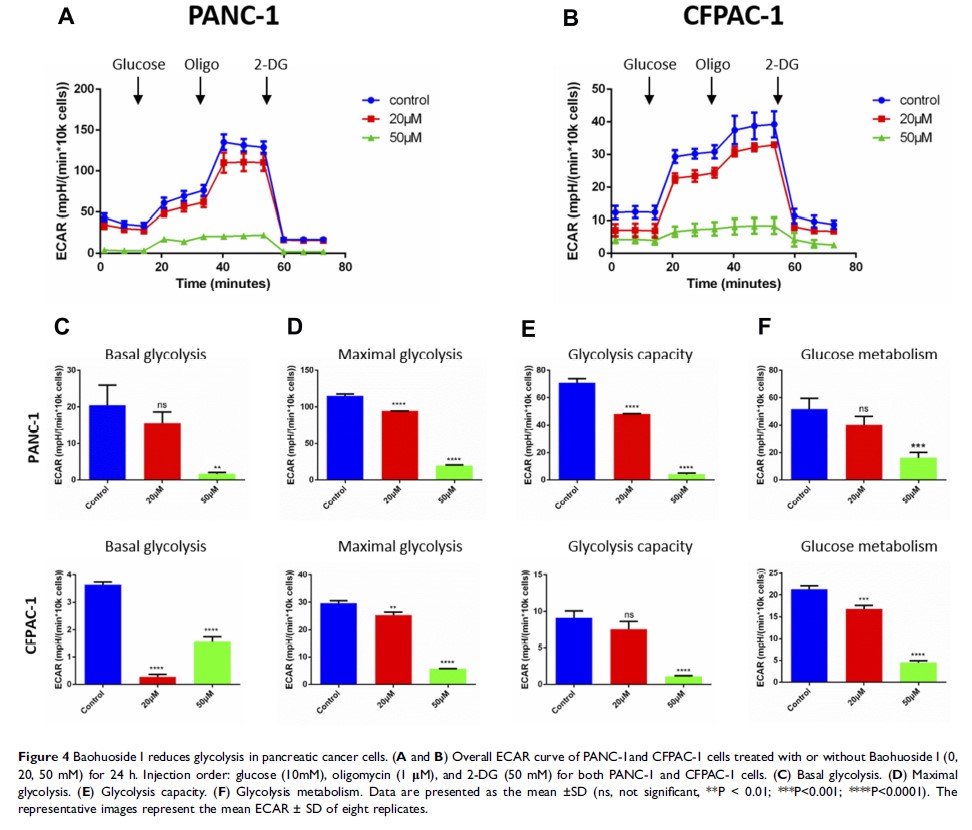
Materials and methods: In the present study, the antineoplastic effect of Baohuoside I was investigated with regard to pancreatic cancer via colony formation, transwell and migration assay. The energy metabolism changes of pancreatic cancer were tested by flow cytometry analysis and oxidative phosphorylation and glycolysis assay. The target signaling members were analyzed by Western blot.
Results: Baohuoside I inhibited the cell growth of pancreatic cancer cells. In addition, it affected intracellular energy metabolism to induce cancer cell apoptosis via the mTOR/S6K1 and the caspase/Bcl2/Bax signaling pathways.
Conclusion: The present data provide further insight into the development of novel drugs against pancreatic cancer.
Keywords: Baohuoside I, pancreatic cancer, apoptosis