119661
论文已发表
注册即可获取德孚的最新动态
IF 收录期刊
- 3.6 Breast Cancer (Dove Med Press)
- 4.3 Clin Epidemiol
- 2.6 Cancer Manag Res
- 3.2 Infect Drug Resist
- 4.1 Clin Interv Aging
- 6.1 Drug Des Dev Ther
- 4.1 Int J Chronic Obstr
- 8.7 Int J Nanomed
- 2.5 Int J Women's Health
- 3.2 Neuropsych Dis Treat
- 2.4 OncoTargets Ther
- 2.6 Patient Prefer Adher
- 2.6 Ther Clin Risk Manag
- 3.1 J Pain Res
- 3.5 Diabet Metab Synd Ob
- 4.5 Psychol Res Behav Ma
- 3.4 Nat Sci Sleep
- 2.4 Pharmgenomics Pers Med
- 2.6 Risk Manag Healthc Policy
- 4.6 J Inflamm Res
- 2.3 Int J Gen Med
- 3.9 J Hepatocell Carcinoma
- 3.3 J Asthma Allergy
- 2.5 Clin Cosmet Investig Dermatol
- 3.0 J Multidiscip Healthc

涎腺小细胞癌的临床病理特征和生存率:一项基于人群的研究
Authors Bai J, Zhao F, Pan S
Received 17 September 2019
Accepted for publication 8 November 2019
Published 24 December 2019 Volume 2019:11 Pages 10749—10757
DOI https://doi.org/10.2147/CMAR.S231446
Checked for plagiarism Yes
Review by Single-blind
Peer reviewer comments 2
Editor who approved publication: Dr Ahmet Emre Eskazan
Background: Small cell carcinoma (SmCC) of the salivary gland is rare, and the characteristics and survival are not well defined due to only case reports or case series being reported. The present study aimed to describe the clinicopathological characteristics and determine the factors associated with survival of this rare cancer.
Materials and methods: A population-based study was carried out to investigate clinical characteristics and prognosis of SmCC of the salivary gland using prospectively extracted data from the Surveillance, Epidemiology and End Results (SEER) database between 1988 and 2016.
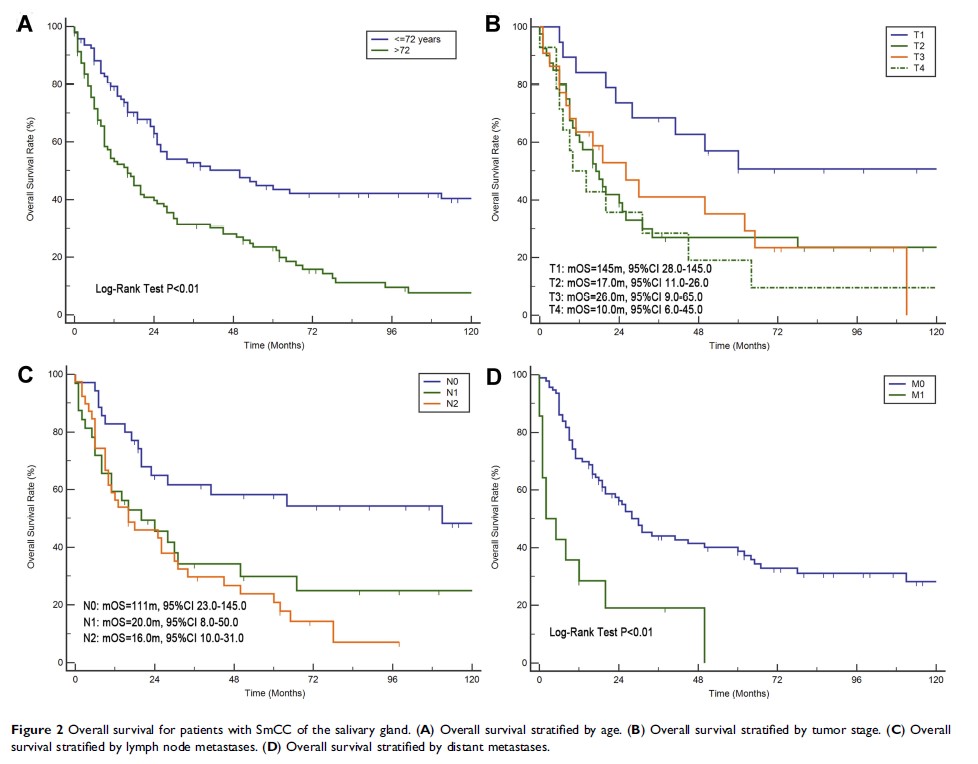
Results: Totally, 198 patients with SmCC of the salivary gland were identified with an average age of 72.6±12.4 and a male to female ratio of 3.4:1. The lesions of most patients (167/198) were located in the parotid gland. The median overall survival (mOS) of all patients is 25.0 months. The 1-, 3-, 5- and 10-year survival rate was 65.7%, 40.9%, 33.0% and 22.7%, respectively. Surgery could prolong significantly the mOS by almost 17.0 months (28.0 months vs 11.0 months; P <0.01). Radiotherapy, as well as radiotherapy after surgery, could prolong the mOS (P <0.01 for both). Patients who received chemotherapy had significantly longer overall survival time than those without chemotherapy (28.0 months vs 20 months; P =0.04). The survival analysis demonstrated that old age (>72 years), lymph node (N3) and distant metastases were independent factors for poor survival, whereas radiotherapy was an independent factor for favorable survival.
Conclusion: Small cell carcinoma of the salivary gland is a rare disease, and old age, lymph node and distant metastases, and radiotherapy were significantly associated with prognosis. In order to understand this disease more thoroughly, more cases with adequate information are required.
Keywords: small cell carcinoma, salivary gland, outcomes, SEER database