119661
论文已发表
注册即可获取德孚的最新动态
IF 收录期刊
- 3.6 Breast Cancer (Dove Med Press)
- 4.3 Clin Epidemiol
- 2.6 Cancer Manag Res
- 3.2 Infect Drug Resist
- 4.1 Clin Interv Aging
- 6.1 Drug Des Dev Ther
- 4.1 Int J Chronic Obstr
- 8.7 Int J Nanomed
- 2.5 Int J Women's Health
- 3.2 Neuropsych Dis Treat
- 2.4 OncoTargets Ther
- 2.6 Patient Prefer Adher
- 2.6 Ther Clin Risk Manag
- 3.1 J Pain Res
- 3.5 Diabet Metab Synd Ob
- 4.5 Psychol Res Behav Ma
- 3.4 Nat Sci Sleep
- 2.4 Pharmgenomics Pers Med
- 2.6 Risk Manag Healthc Policy
- 4.6 J Inflamm Res
- 2.3 Int J Gen Med
- 3.9 J Hepatocell Carcinoma
- 3.3 J Asthma Allergy
- 2.5 Clin Cosmet Investig Dermatol
- 3.0 J Multidiscip Healthc

胸腔放疗有利于发生远处转移的广泛期小细胞肺癌老年患者
Authors Qi J, Xu L, Sun J, Wang X, Zhao L
Received 28 June 2019
Accepted for publication 12 December 2019
Published 24 December 2019 Volume 2019:11 Pages 10767—10775
DOI https://doi.org/10.2147/CMAR.S221225
Checked for plagiarism Yes
Review by Single-blind
Peer reviewer comments 3
Editor who approved publication: Dr Antonella D'Anneo
Purpose: Thoracic radiotherapy (TRT) is the recommended therapeutic regimen for extensive-stage small cell lung cancer (ES-SCLC). Little is known about TRT benefits in elderly populations. The aim of this study was to evaluate TRT effects on the prognosis of elderly patients with ES-SCLC.
Patients and methods: This retrospective analysis reviewed the records of patients over 65 years of age with metastatic ES-SCLC treated between 2010 and 2016. Enrolled patients received standard chemotherapy regimens (etoposide plus cisplatin or carboplatin). A total of 93 eligible patients were subjected to propensity score matching, which led to 40 patients being assigned to the TRT group and 40 to the no thoracic radiotherapy (noTRT) group. The cohort of 80 patients (67 males) had the median age of 69 years (range, 65–85 years), with a median of 4 chemotherapy cycle (range, 1–8 cycles), and a median chest irradiation dose of 50 Gy (range, 30–60 Gy). We analyzed overall survival (OS), progression-free survival (PFS), and local recurrence-free survival (LRFS) as endpoints; survival rates were determined by the Kaplan–Meier method and compared across groups with log-rank tests. Multivariate prognostic analysis was performed with Cox regression modeling, and categorical variables were analyzed with Chi-square tests.
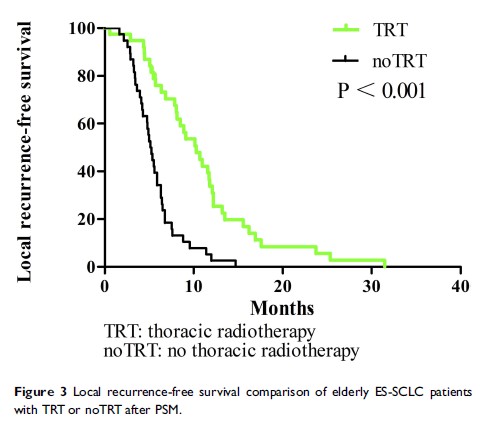
Results: In all patients, the 1-year OS, PFS, and LRFS rates were 38.3%, 16%, and 17.9%, respectively. The TRT group had superior survival outcomes compared to the noTRT group: their 1-year OS, PFS, and LRFS rates were 55% vs. 25% (P < 0.001), 32.1% vs. 0% (P < 0.001), and 31% vs. 2.6% (P < 0.001), respectively. TRT did not increase the incidence of adverse reactions (P = 0.431).
Conclusion: TRT can improve chest tumor control and survival time in elderly ES-SCLC patients. Large-scale studies to further assess the benefits of TRT are warranted.
Keywords: chemotherapy, radiotherapy, prognosis, elderly, small cell lung cancer