119661
论文已发表
注册即可获取德孚的最新动态
IF 收录期刊
- 3.6 Breast Cancer (Dove Med Press)
- 4.3 Clin Epidemiol
- 2.6 Cancer Manag Res
- 3.2 Infect Drug Resist
- 4.1 Clin Interv Aging
- 6.1 Drug Des Dev Ther
- 4.1 Int J Chronic Obstr
- 8.7 Int J Nanomed
- 2.5 Int J Women's Health
- 3.2 Neuropsych Dis Treat
- 2.4 OncoTargets Ther
- 2.6 Patient Prefer Adher
- 2.6 Ther Clin Risk Manag
- 3.1 J Pain Res
- 3.5 Diabet Metab Synd Ob
- 4.5 Psychol Res Behav Ma
- 3.4 Nat Sci Sleep
- 2.4 Pharmgenomics Pers Med
- 2.6 Risk Manag Healthc Policy
- 4.6 J Inflamm Res
- 2.3 Int J Gen Med
- 3.9 J Hepatocell Carcinoma
- 3.3 J Asthma Allergy
- 2.5 Clin Cosmet Investig Dermatol
- 3.0 J Multidiscip Healthc

早期宫颈癌患者行 Q-M 手术分型中 B 型与 C2 型开腹根治性子宫切除术的生存率比较
Authors Chen C, Wang W, Liu P, Li P, Wang L, Jin S, Bin X, Lang J
Received 21 June 2019
Accepted for publication 26 November 2019
Published 31 December 2019 Volume 2019:11 Pages 10909—10919
DOI https://doi.org/10.2147/CMAR.S220212
Checked for plagiarism Yes
Review by Single-blind
Peer reviewer comments 2
Editor who approved publication: Dr Kenan Onel
Purpose: To evaluate the survival outcomes of abdominal Q-M type B and type C2 radical hysterectomy (RH) for early-stage (IA1 (lymphovascular invasion)-IIA2) cervical cancer.
Patients and methods: Based on this multicenter, retrospective cohort study on the clinical diagnosis and treatment for cervical cancer in China (Four C), the survival outcomes of abdominal type B and type C2 RH for early-stage cervical cancer were compared under real-world and matched cohort study conditions.
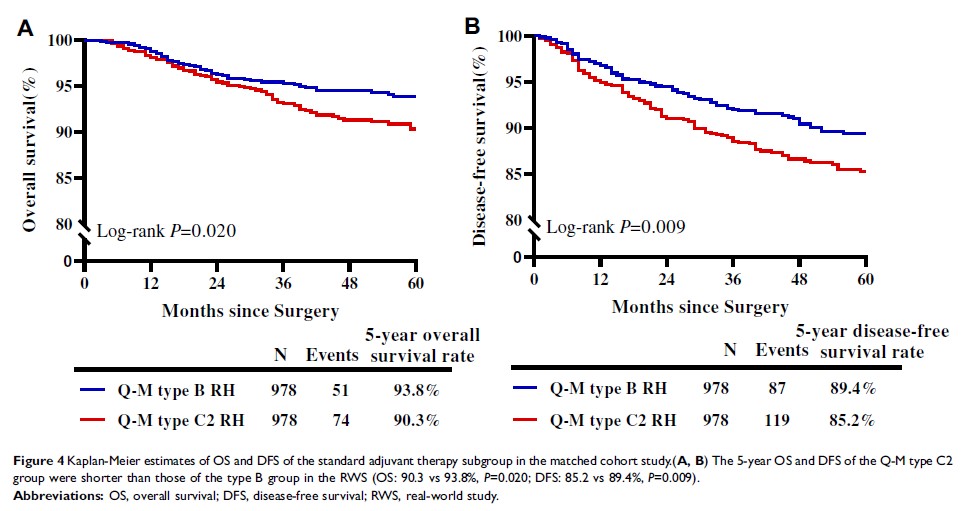
Results: In total, 46,313 cases were included in the Four C database, among whom 20,018 underwent abdominal type B or type C2 RH. In the real-world study, no differences were found in the 5-year overall survival (OS) between the type B group (n=15,471) and type C2 group (n=4547), but the 5-year disease-free survival (DFS) was lower in the type C2 group (82.1 vs 84.8%, hazard ratio: 1.144). Based on the inclusion criteria, 9135 cases were included and the type C2 group (n=1818) was found to have a lower 5-year OS and DFS (OS: 89.5 vs 92.0%, hazard ratio: 1.393; DFS: 84.3 vs 87.4%, hazard ratio: 1.342). Subsequently, 1799 cases from each group were matched and the type C2 group had a lower 5-year DFS (84.6 vs 88.4%, hazard ratio: 1.332). Upon further analysis of the subgroups, the type C2 group had a lower 5-year OS and DFS (OS: 90.3 vs 93.8%, hazard ratio: 1.522; DFS: 85.2 vs 89.4%, hazard ratio: 1.439).
Conclusion: Q-M type B RH could be used for the treatment of stage IA1 (lymphovascular invasion)-IIA2 cervical cancer.
Keywords: cervical cancer, early-stage, Q-M type B, survival outcome