117333
论文已发表
注册即可获取德孚的最新动态
IF 收录期刊
- 3.6 Breast Cancer (Dove Med Press)
- 4.3 Clin Epidemiol
- 2.6 Cancer Manag Res
- 3.2 Infect Drug Resist
- 4.1 Clin Interv Aging
- 6.1 Drug Des Dev Ther
- 4.1 Int J Chronic Obstr
- 8.7 Int J Nanomed
- 2.5 Int J Women's Health
- 3.2 Neuropsych Dis Treat
- 2.4 OncoTargets Ther
- 2.6 Patient Prefer Adher
- 2.6 Ther Clin Risk Manag
- 3.1 J Pain Res
- 3.5 Diabet Metab Synd Ob
- 4.5 Psychol Res Behav Ma
- 3.4 Nat Sci Sleep
- 2.4 Pharmgenomics Pers Med
- 2.6 Risk Manag Healthc Policy
- 4.6 J Inflamm Res
- 2.3 Int J Gen Med
- 3.9 J Hepatocell Carcinoma
- 3.3 J Asthma Allergy
- 2.5 Clin Cosmet Investig Dermatol
- 3.0 J Multidiscip Healthc

病理分期为 Ⅲa(N2)期的非小细胞肺癌患者行完全性切除术后的放射治疗:回顾性分析
Authors Zhu Y, Fu L, Jing W, Kong L, Yu J
Received 6 December 2018
Accepted for publication 12 June 2019
Published 31 December 2019 Volume 2019:11 Pages 10901—10908
DOI https://doi.org/10.2147/CMAR.S197245
Checked for plagiarism Yes
Review by Single-blind
Peer reviewer comments 3
Editor who approved publication: Dr Rituraj Purohit
Introduction: Adjuvant radiotherapy in non–small-cell lung cancer (NSCLC) remains controversial,Whether the mutation status of epidermal growth factor receptor (EGFR) will affect the recurrence and survival of patients with resected NSCLC is rarely reported. Our purpose is to study the effect of postoperative radiotherapy on patients with stage IIIA(N2) NSCLC with EGFR mutation.
Methods: Total of of 115 patients diagnosed with stage IIIA(N2) resected NSCLC were analyzed retrospectively. Their EGFR mutations were detected by real-time quantitative PCR and DNA sequencing technology together.
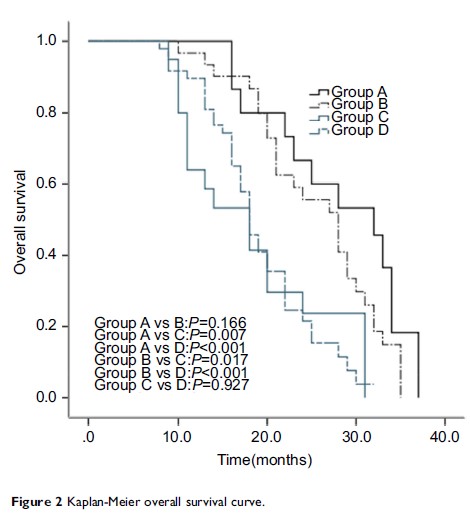
Results: At a median follow-up of 34.2 months for the postoperative adjuvant radiotherapy (PORT) group and 31.0 months for the non-PORT group, PORT group significantly improved progression free survival (PFS) and overall survival (OS). The median PFS and OS in the EGFR mutant group were not significantly longer than those in the EGFR wild-type group. The number of chemotherapy cycles, postoperative radiotherapy and the number of metastatic lymph nodes were independent factors influencing long-term survival.
Conclusion: Our retrospective analysis showed that PORT can improve survival of patients with stage IIIA(N2) NSCLC. EGFR-mutant group with stage IIIA(N2) NSCLC has a tendency of a higher survival than the wild-type EGFR group, but there was no significant difference for both groups. The EGFR mutation status was not associated with PFS or OS of stage IIIA(N2) NSCLC.
Keywords: non-small cell lung cancer, N2-stage, adjuvant radiotherapy, EGFR mutations