119661
论文已发表
注册即可获取德孚的最新动态
IF 收录期刊
- 3.6 Breast Cancer (Dove Med Press)
- 4.3 Clin Epidemiol
- 2.6 Cancer Manag Res
- 3.2 Infect Drug Resist
- 4.1 Clin Interv Aging
- 6.1 Drug Des Dev Ther
- 4.1 Int J Chronic Obstr
- 8.7 Int J Nanomed
- 2.5 Int J Women's Health
- 3.2 Neuropsych Dis Treat
- 2.4 OncoTargets Ther
- 2.6 Patient Prefer Adher
- 2.6 Ther Clin Risk Manag
- 3.1 J Pain Res
- 3.5 Diabet Metab Synd Ob
- 4.5 Psychol Res Behav Ma
- 3.4 Nat Sci Sleep
- 2.4 Pharmgenomics Pers Med
- 2.6 Risk Manag Healthc Policy
- 4.6 J Inflamm Res
- 2.3 Int J Gen Med
- 3.9 J Hepatocell Carcinoma
- 3.3 J Asthma Allergy
- 2.5 Clin Cosmet Investig Dermatol
- 3.0 J Multidiscip Healthc

LncRNA FTX 通过 miR-144/ZFX 轴促进胃癌的增殖和侵袭
Authors Li H, Yao G, Zhai J, Hu D, Fan Y
Received 27 June 2019
Accepted for publication 18 October 2019
Published 31 December 2019 Volume 2019:12 Pages 11701—11713
DOI https://doi.org/10.2147/OTT.S220998
Checked for plagiarism Yes
Review by Single-blind
Peer reviewer comments 2
Editor who approved publication: Dr Federico Perche
Background: Long non-coding RNAs are important regulators in cancer cell tumorigenesis. We have demonstrated in a prior study that lncRNA FTX is dysregulated in gastric cancer (GC). In this study, we aim to report gastric cancer-related lncRNA FTX as a main regulator in GC development and progression.
Methods: In vitro and in vivo assays of FTX alterations have been performed to reveal a complex integrated phenotype affecting cell growth, migration, and invasion. lncRNA FTX expression levels in gastric cancer cells and normal cells were measured by RT-PCR. Luciferase reporter assays, Western blotting, and many immune, microscopy technologies were utilized to investigate the expressions of FTX- related proteins and RNAs. The functional role of FTX in cell growth, migration, and invasion were observed in vitro and in vivo.
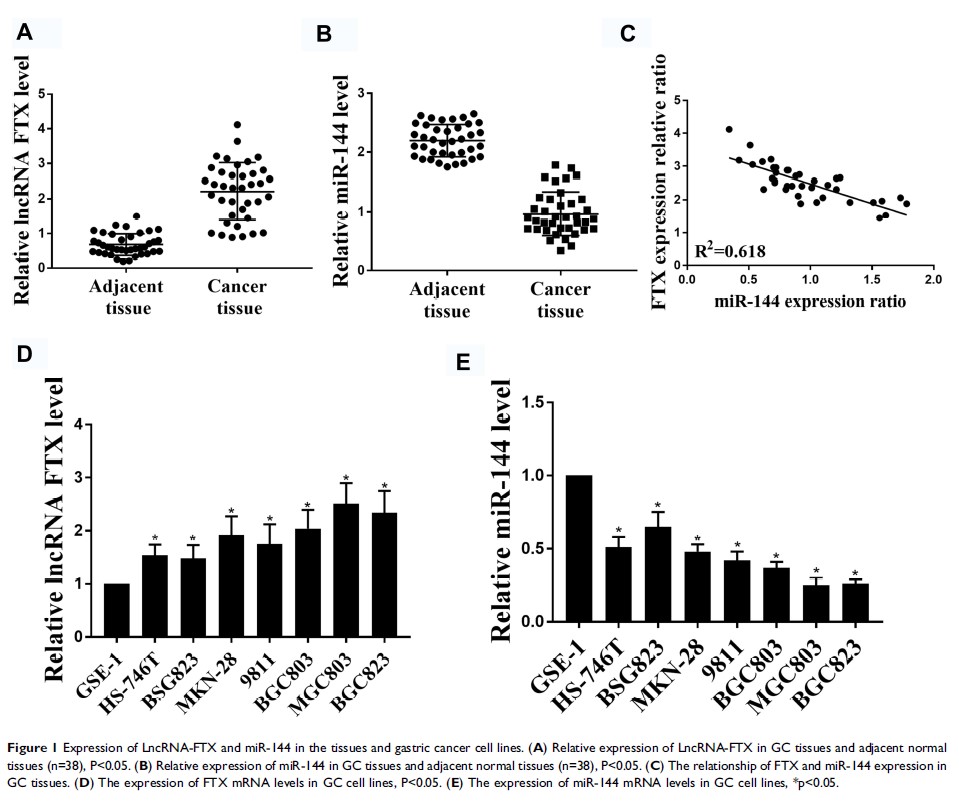
Results: We explored the underlying mechanisms of FTX in GC development, and the microRNAs’ relationship with FTX. We found that FTX promoted cell proliferation, migration, and invasion, as well as tumor growth, and this effect could latterly be attenuated by miR-144. ZFX attenuated the effects of FTX/miR-144 axis by sponging with miR-144.
Conclusion: In summary, the above results support a model in which the FTX/miR-144/ZFX act as important effectors in GC tumorigenesis and progression, indicating new therapeutic methods in GC.
Keywords: gastric cancer, LncRNA FTX, proliferation, invasion, miR-144/ZFX axis