119661
论文已发表
注册即可获取德孚的最新动态
IF 收录期刊
- 3.6 Breast Cancer (Dove Med Press)
- 4.3 Clin Epidemiol
- 2.6 Cancer Manag Res
- 3.2 Infect Drug Resist
- 4.1 Clin Interv Aging
- 6.1 Drug Des Dev Ther
- 4.1 Int J Chronic Obstr
- 8.7 Int J Nanomed
- 2.5 Int J Women's Health
- 3.2 Neuropsych Dis Treat
- 2.4 OncoTargets Ther
- 2.6 Patient Prefer Adher
- 2.6 Ther Clin Risk Manag
- 3.1 J Pain Res
- 3.5 Diabet Metab Synd Ob
- 4.5 Psychol Res Behav Ma
- 3.4 Nat Sci Sleep
- 2.4 Pharmgenomics Pers Med
- 2.6 Risk Manag Healthc Policy
- 4.6 J Inflamm Res
- 2.3 Int J Gen Med
- 3.9 J Hepatocell Carcinoma
- 3.3 J Asthma Allergy
- 2.5 Clin Cosmet Investig Dermatol
- 3.0 J Multidiscip Healthc

急性缺血性中风患者的维生素 D 水平降低与卒中相关性肺炎有关
Authors Huang GQ, Cheng HR, Wu YM, Cheng QQ, Wang YM, Fu JL, Zhou HX, Wang Z
Received 8 September 2019
Accepted for publication 17 December 2019
Published 31 December 2019 Volume 2019:14 Pages 2305—2314
DOI https://doi.org/10.2147/CIA.S230255
Checked for plagiarism Yes
Review by Single-blind
Peer reviewer comments 2
Editor who approved publication: Dr Zhi-Ying Wu
Background and aim: Stroke-associated pneumonia (SAP) is a common complication in patients with acute ischemic stroke (AIS). This study explored the potential relationship between serum vitamin D levels and SAP.
Methods: This study recruited 863 consecutive AIS patients. In-hospital SAP was defined as a complication that occurred after stroke, during hospitalization, that was confirmed radiographically. Serum vitamin D levels were measured within 24 hrs of admission and the patients were divided into vitamin D sufficient (>50 nmol/L), insufficient (25–50 nmol/L), and deficient (<25 nmol/L) groups.
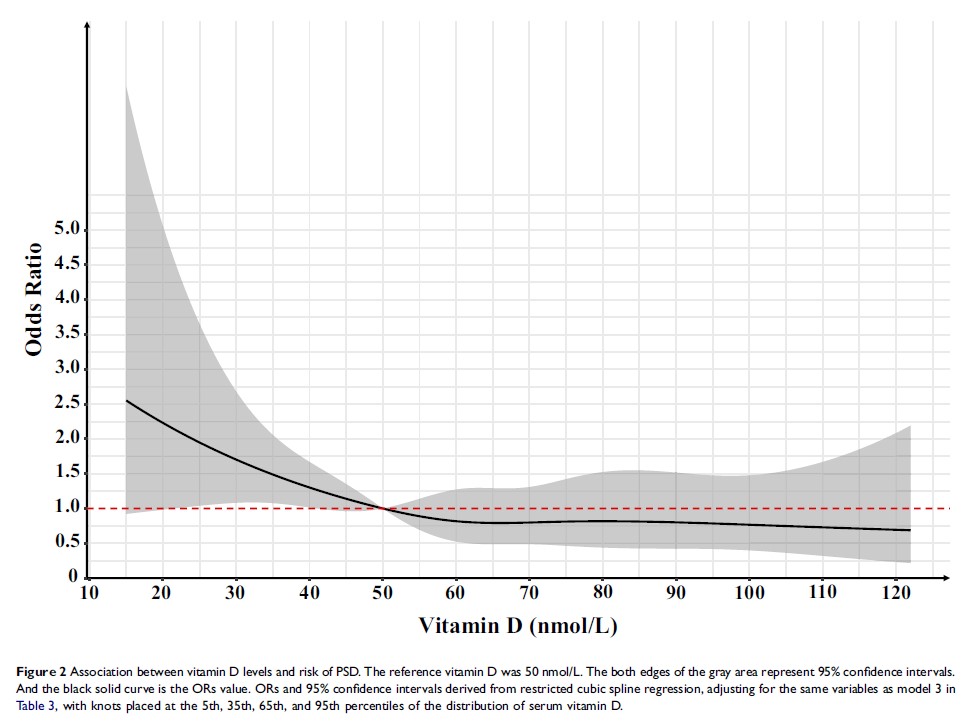
Results: In this study, 102 (11.8%) patients were diagnosed with SAP. Compared to the patients without SAP, patients with SAP had significantly lower vitamin D levels (P = 0.023). The incidence of SAP was significantly higher in patients with vitamin D deficiency than in those with vitamin D insufficiency or sufficiency (21.2% vs 16.2% & 9.5%, P = 0.006). After adjusting for confounders, vitamin D deficiency and insufficiency were independently associated with SAP (OR = 3.034, 95% CI = 1.207–7.625, P = 0.018; OR = 1.921, 95% CI = 1.204–3.066, P = 0.006, respectively). In multiple-adjusted spline regression, vitamin D levels showed a linear association with the risk of SAP (P < 0.001 for linearity).
Conclusion: Reduced vitamin D is a potential risk factor of in-hospital SAP, which can help clinicians identify high-risk SAP patients.
Keywords: acute ischemic stroke, stroke-associated pneumonia, vitamin D