119661
论文已发表
注册即可获取德孚的最新动态
IF 收录期刊
- 3.6 Breast Cancer (Dove Med Press)
- 4.3 Clin Epidemiol
- 2.6 Cancer Manag Res
- 3.2 Infect Drug Resist
- 4.1 Clin Interv Aging
- 6.1 Drug Des Dev Ther
- 4.1 Int J Chronic Obstr
- 8.7 Int J Nanomed
- 2.5 Int J Women's Health
- 3.2 Neuropsych Dis Treat
- 2.4 OncoTargets Ther
- 2.6 Patient Prefer Adher
- 2.6 Ther Clin Risk Manag
- 3.1 J Pain Res
- 3.5 Diabet Metab Synd Ob
- 4.5 Psychol Res Behav Ma
- 3.4 Nat Sci Sleep
- 2.4 Pharmgenomics Pers Med
- 2.6 Risk Manag Healthc Policy
- 4.6 J Inflamm Res
- 2.3 Int J Gen Med
- 3.9 J Hepatocell Carcinoma
- 3.3 J Asthma Allergy
- 2.5 Clin Cosmet Investig Dermatol
- 3.0 J Multidiscip Healthc

使用地屈孕酮与醋酸甲羟孕酮对多囊卵巢综合征妇女进行高孕激素状态下促排卵以施行体外受精的比较:一项回顾性队列研究
Authors Huang J, Xie Q, Lin J, Lu X, Zhu J, Gao H, Cai R, Kuang Y
Received 6 September 2019
Accepted for publication 29 November 2019
Published 3 January 2020 Volume 2019:13 Pages 4461—4470
DOI https://doi.org/10.2147/DDDT.S230129
Checked for plagiarism Yes
Review by Single-blind
Peer reviewer comments 2
Editor who approved publication: Dr Anastasios Lymperopoulos
Purpose: Dydrogesterone (DYG) is an alternative progestin in progestin-primed ovarian stimulation (PPOS) protocol with weaker pituitary suppression than medroxyprogesterone acetate (MPA) in normal ovulatory women. However, the endocrinological characteristics, oocyte retrieval and pregnancy outcomes of DYG application in polycystic ovarian syndrome (PCOS) patients undergoing in vitro fertilization (IVF) remain unclear.
Patients and methods: This retrospective cohort study included 420 PCOS patients who underwent controlled ovarian stimulation with human menopausal gonadotropin (hMG) and DYG (n=105) or MPA (n=315) from January 2014 to December 2017. Baseline characteristics of the two groups were balanced with propensity score matching using the nearest-neighbor random matching algorithm in a ratio of 1:3. The primary outcome measure was the number of oocytes retrieved. Other main outcome measures included the number of viable embryos, incidence of premature luteinizing hormone (LH) surge and live birth rate per frozen-thawed embryo transfer (FET) cycle.
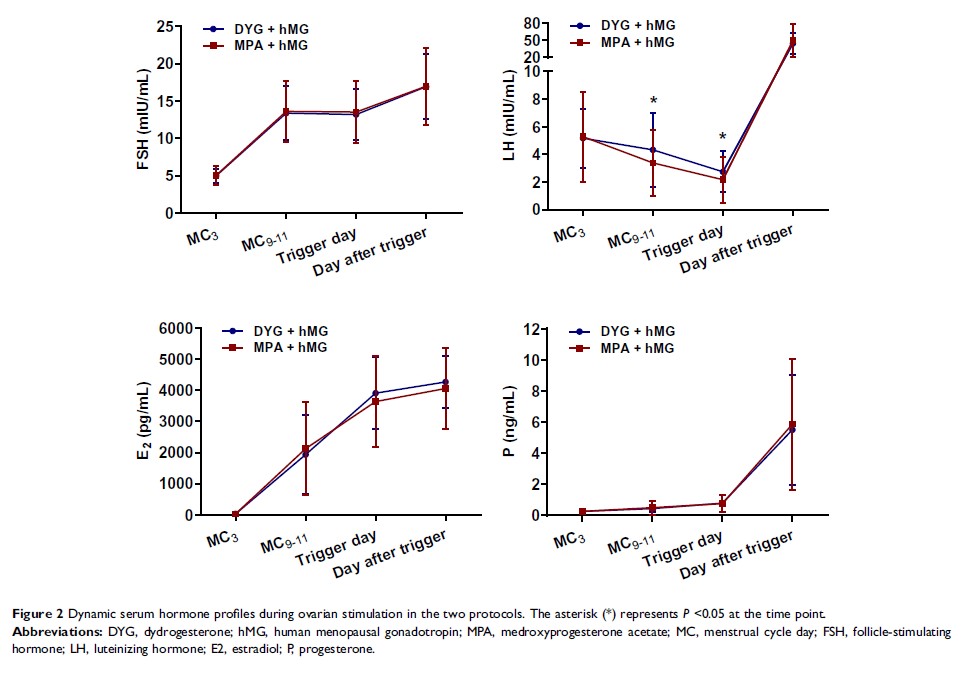
Results: A similar number of oocytes was retrieved in the two protocols (16.1±6.5 vs 15.1±10.0, P =0.342). Patients in both groups achieved consistent LH suppression with no premature LH surge detected. In the DYG + hMG group, the mean LH levels were significantly higher than the MPA + hMG group on cycle day 9–11 and trigger day (all P <0.001), and the dose of hMG was significantly lower (1710.7±431.6 vs 1891.3±402.2 IU, P <0.001). No significant between-group differences were found in the number of viable embryos (5.3±3.1 vs 5.0±4.1, P =0.139) and live birth rate per FET cycle (43.5% vs 47.7%, P =0.383). None of the participants experienced moderate-to-severe ovarian hyperstimulation syndrome in either group.
Conclusion: Our results showed that the application of DYG in PPOS protocol could achieve comparable oocyte retrieval and pregnancy outcomes to MPA, but significantly reduce the consumption of gonadotropins in PCOS women for IVF treatment.
Keywords: polycystic ovary syndrome, dydrogesterone, medroxyprogesterone acetate, progestin-primed ovarian stimulation, in vitro fertilization