119661
论文已发表
注册即可获取德孚的最新动态
IF 收录期刊
- 3.6 Breast Cancer (Dove Med Press)
- 4.3 Clin Epidemiol
- 2.6 Cancer Manag Res
- 3.2 Infect Drug Resist
- 4.1 Clin Interv Aging
- 6.1 Drug Des Dev Ther
- 4.1 Int J Chronic Obstr
- 8.7 Int J Nanomed
- 2.5 Int J Women's Health
- 3.2 Neuropsych Dis Treat
- 2.4 OncoTargets Ther
- 2.6 Patient Prefer Adher
- 2.6 Ther Clin Risk Manag
- 3.1 J Pain Res
- 3.5 Diabet Metab Synd Ob
- 4.5 Psychol Res Behav Ma
- 3.4 Nat Sci Sleep
- 2.4 Pharmgenomics Pers Med
- 2.6 Risk Manag Healthc Policy
- 4.6 J Inflamm Res
- 2.3 Int J Gen Med
- 3.9 J Hepatocell Carcinoma
- 3.3 J Asthma Allergy
- 2.5 Clin Cosmet Investig Dermatol
- 3.0 J Multidiscip Healthc

lncRNA THRIL/TNF-α 信号上调可促进细胞生长并预测骨肉瘤的不良临床结果
Authors Xu B, Jin X, Yang T, Zhang Y, Liu S, Wu L, Ying H, Wang Z
Received 23 October 2019
Accepted for publication 18 December 2019
Published 7 January 2020 Volume 2020:13 Pages 119—129
DOI https://doi.org/10.2147/OTT.S235798
Checked for plagiarism Yes
Review by Single-blind
Peer reviewer comments 2
Editor who approved publication: Dr Federico Perche
Background: The immunosuppressive facet and tumorigenic role of TNF-α have been revealed in osteosarcoma (OS). Long noncoding RNA THRIL is identified to regulate TNF-α expression and participates in immune response. Thus, investigations on the clinical expression pattern of THRIL/TNF-α signal in OS would provide a potential target premise for OS patients.
Methods: We collected OS (n=83), nontumor tissues (n=37) and serum samples (n=83 for OS and n=40 for healthy control) to determine the expressions and clinical significance of THRIL/TNF-α signal. Knockdown of THRIL in OS cell lines MG63 and Saos2 in vitro and in vivo was performed to confirm its function in the development of OS.
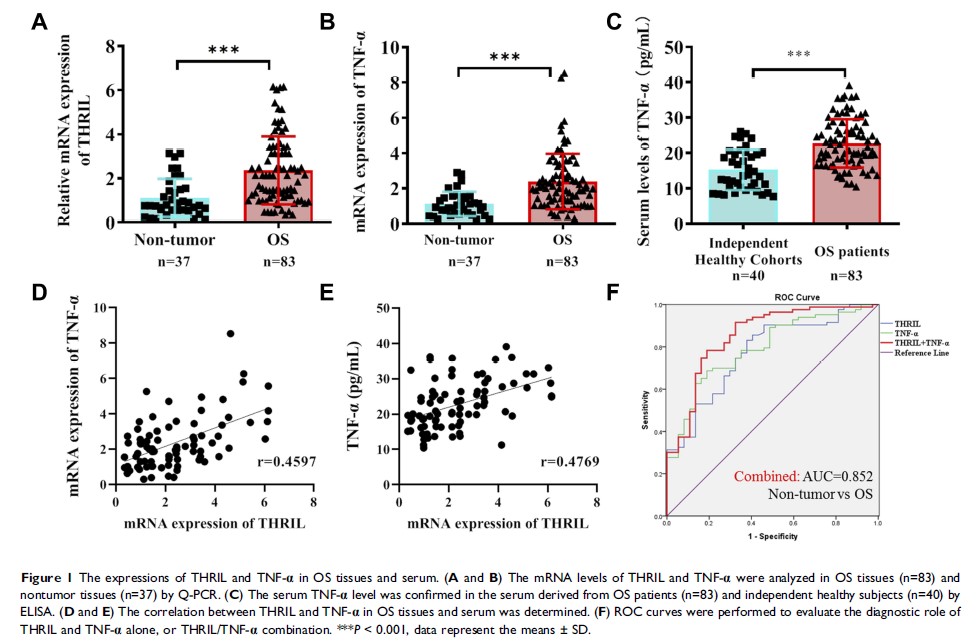
Results: Elevated expression of THRIL was associated with increased TNF-α levels in OS tissues and serum samples. Combination of THRIL and TNF-α in tissues showed a more efficient diagnostic value for OS patients than either of them. Moreover, high-expressed THRIL was associated with larger tumor size, advanced Enneking stage and lung metastasis, whereas high TNF-α expression was found in patients with high histologic grade and patients who simultaneously harbor high THRIL and TNF-α showed the worst overall survival and metastasis-free survival. TNF-α signals increased OS cell vitalities in vitro but knockdown of THRIL inhibited TNF-α expressions, leading to impaired cell vitality, increased apoptosis and also downregulated epithelial to mesenchymal transition (EMT) phenotype and the ability of invasion, but these processes were restored by the treatment of TNF-α. The oncogenic role of THRIL/TNF-α signal was also confirmed in the xenograft model of MG63 cells.
Conclusion: Overexpressed THRIL and TNF-α promoted OS progression with efficient diagnostic and prognostic value. THRIL/TNF-α signal supported cell growth and EMT phenotype of OS cells in vitro and in vivo.
Keywords: lncRNA, THRIL, TNF-α, osteosarcoma, growth