119661
论文已发表
注册即可获取德孚的最新动态
IF 收录期刊
- 3.6 Breast Cancer (Dove Med Press)
- 4.3 Clin Epidemiol
- 2.6 Cancer Manag Res
- 3.2 Infect Drug Resist
- 4.1 Clin Interv Aging
- 6.1 Drug Des Dev Ther
- 4.1 Int J Chronic Obstr
- 8.7 Int J Nanomed
- 2.5 Int J Women's Health
- 3.2 Neuropsych Dis Treat
- 2.4 OncoTargets Ther
- 2.6 Patient Prefer Adher
- 2.6 Ther Clin Risk Manag
- 3.1 J Pain Res
- 3.5 Diabet Metab Synd Ob
- 4.5 Psychol Res Behav Ma
- 3.4 Nat Sci Sleep
- 2.4 Pharmgenomics Pers Med
- 2.6 Risk Manag Healthc Policy
- 4.6 J Inflamm Res
- 2.3 Int J Gen Med
- 3.9 J Hepatocell Carcinoma
- 3.3 J Asthma Allergy
- 2.5 Clin Cosmet Investig Dermatol
- 3.0 J Multidiscip Healthc

宫颈鳞状细胞癌的增生性反应和肿瘤芽殖是远处转移的预后因素:一项回顾性研究
Authors Cao L, Sun PL, He Y, Yao M, Gao H
Received 18 September 2019
Accepted for publication 24 December 2019
Published 8 January 2020 Volume 2020:12 Pages 137—144
DOI https://doi.org/10.2147/CMAR.S231356
Checked for plagiarism Yes
Review by Single-blind
Peer reviewer comments 2
Editor who approved publication: Dr Yong Teng
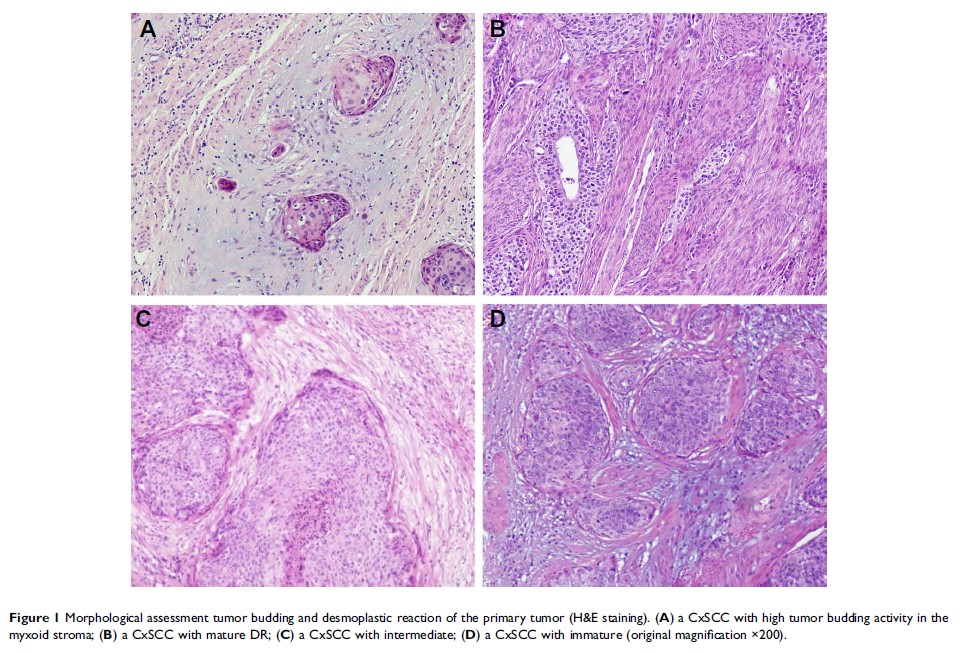
Purpose: An accurate risk assessment system for disease metastasis or recurrence could improve the cancer management practice in cervical squamous cell carcinoma (CxSCC) patients, which has few definite prognostic predictors. Previous studies have indicated the important utility of stromal features in determining cancer biological behavior; however, it lacks histopathologic or morphologic criteria for its evaluation. Therefore, this present study aimed to comprehensively catalog histopathological features of mesenchymal stroma to determine the prognostic value of these features in CxSCC.
Patients and methods: We histologically and immunohistochemically evaluated the stromal features in the primary tumors of 122 CxSCC patients. The follow-up duration was 41.25 months (range: 3–80.77 months). Multivariate proportional hazard regression models were used to identify the top classifier for distant metastasis-free survival (DMFS) prediction.
Results: Lymph-vascular invasion (LVI), lymph node metastasis (LNM), tumor-node-metastasis (TNM) stage and tumor budding were positively correlated with distant metastasis (P < 0.001, P < 0.001, P < 0.001 and P = 0.012, respectively). Distant metastasis was also associated with the immature desmoplastic reaction (DR) (P = 0.002), high level of cancer-associated fibroblasts (P = 0.003), vasohibin-1 (VASH1)-positive microvessels (P = 0.027), and the VASH1/CD31 ratio (P = 0.004). Multivariate COX proportional hazard regression models revealed that LVI, LNM, and DR were independent predictors of poor DMFS in CxSCC patients.
Conclusion: Primary tumor histologic stromal features, especially DR, may be useful in predicting distant metastasis in patients with CxSCC.
Keywords: stromal features, squamous cell carcinoma, distant metastasis, desmoplastic reaction