119661
论文已发表
注册即可获取德孚的最新动态
IF 收录期刊
- 3.6 Breast Cancer (Dove Med Press)
- 4.3 Clin Epidemiol
- 2.6 Cancer Manag Res
- 3.2 Infect Drug Resist
- 4.1 Clin Interv Aging
- 6.1 Drug Des Dev Ther
- 4.1 Int J Chronic Obstr
- 8.7 Int J Nanomed
- 2.5 Int J Women's Health
- 3.2 Neuropsych Dis Treat
- 2.4 OncoTargets Ther
- 2.6 Patient Prefer Adher
- 2.6 Ther Clin Risk Manag
- 3.1 J Pain Res
- 3.5 Diabet Metab Synd Ob
- 4.5 Psychol Res Behav Ma
- 3.4 Nat Sci Sleep
- 2.4 Pharmgenomics Pers Med
- 2.6 Risk Manag Healthc Policy
- 4.6 J Inflamm Res
- 2.3 Int J Gen Med
- 3.9 J Hepatocell Carcinoma
- 3.3 J Asthma Allergy
- 2.5 Clin Cosmet Investig Dermatol
- 3.0 J Multidiscip Healthc

PPEF1 作为有前途的生物标志物的临床意义及其在乳腺癌中的潜在机制
Authors Ye T, Wan X, Li J, Feng J, Guo J, Li G, Liu J
Received 1 September 2019
Accepted for publication 17 December 2019
Published 8 January 2020 Volume 2020:13 Pages 199—214
DOI https://doi.org/10.2147/OTT.S229432
Checked for plagiarism Yes
Review by Single-blind
Peer reviewer comments 2
Editor who approved publication: Prof. Dr. Takuya Aoki
Background: Breast cancer (BC) is the leading cause of malignancy death in females worldwide. While intense efforts have been made to elucidate the pathogeny, the molecular mechanism of BC remains elusive. Thus, this study aimed to investigate the role of PPEF1 in the progression of BC and further explore the better clinical significance.
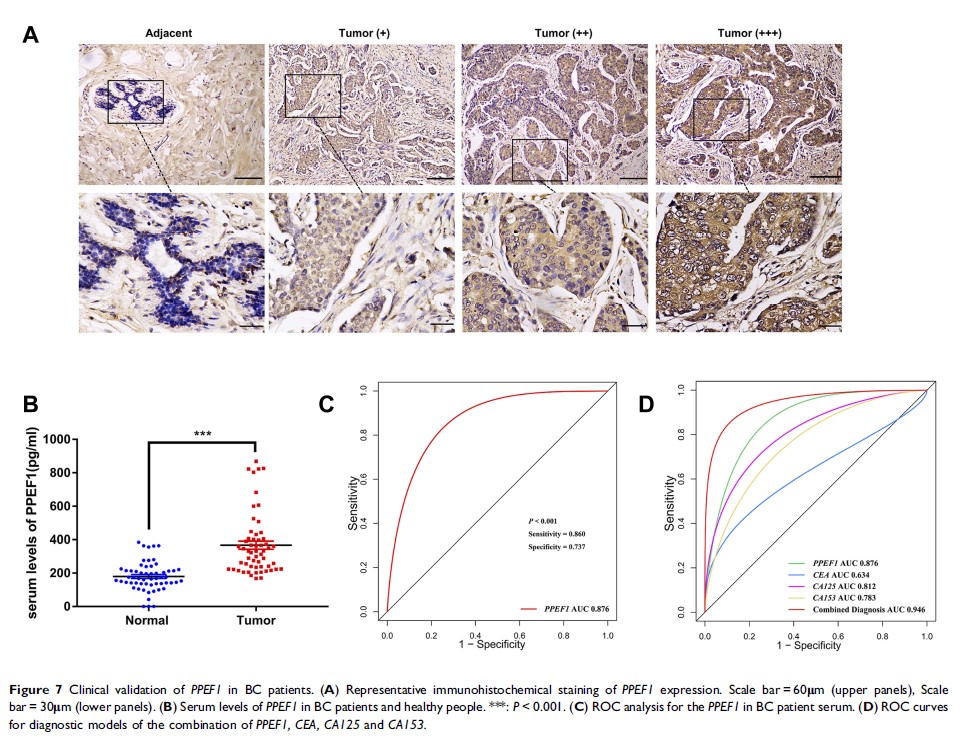
Methods: The diagnostic and prognostic values of elevated PPEF1 expression in BC were unveiled via public databases analysis. In addition, Gene Ontology (GO), Gene Set Enrichment Analysis (GSEA) and Protein–protein interaction (PPI) analysis were performed to explore the potential functions and molecular mechanisms of PPEF1 in BC progression. Experimentally, transwell and CCK-8 assays were carried out to estimate the effects of PPEF1 on the BC metastasis. Meanwhile, the differential expressions of PPEF1 in paraffin-embedded tissues and serum samples were, respectively, analyzed by Immunohistochemical (IHC) analysis and enzyme-linked immunosorbent assay (ELISA) kit.
Results: The transcriptional levels of PPEF1 were higher in BC than in normal breast tissues or adjacent normal tissues. Moreover, survival analysis revealed that higher PPEF1 expression was negatively associated with overall survival (OS), all events-free (AE-free) and metastatic recurrence-free (MR-free) survival, and further was an independent risk factor of unfavorable prognosis in BC patients. Additionally, the present study provided the first evidence that PPEF1 participated in multiple biological processes and underly signaling pathways involving in tumorigenesis and development of BC. Furthermore, PPEF1 promotes the BC progression and can be used as a noninvasive diagnostic marker. Noteworthy, the combined determination of serum PPEF1 and traditional tumor markers can enhance diagnostic accuracy thus is of vital importance in the early diagnosis of BC.
Conclusion: PPEF1 exerted a tumorigenic role and involved in molecular mechanism of tumorigenesis in BC which served as a promising biomarker for prognosis and diagnosis.
Keywords: PPEF1 , breast cancer, biomarker, molecular function, signaling pathway