117333
论文已发表
注册即可获取德孚的最新动态
IF 收录期刊
- 3.6 Breast Cancer (Dove Med Press)
- 4.3 Clin Epidemiol
- 2.6 Cancer Manag Res
- 3.2 Infect Drug Resist
- 4.1 Clin Interv Aging
- 6.1 Drug Des Dev Ther
- 4.1 Int J Chronic Obstr
- 8.7 Int J Nanomed
- 2.5 Int J Women's Health
- 3.2 Neuropsych Dis Treat
- 2.4 OncoTargets Ther
- 2.6 Patient Prefer Adher
- 2.6 Ther Clin Risk Manag
- 3.1 J Pain Res
- 3.5 Diabet Metab Synd Ob
- 4.5 Psychol Res Behav Ma
- 3.4 Nat Sci Sleep
- 2.4 Pharmgenomics Pers Med
- 2.6 Risk Manag Healthc Policy
- 4.6 J Inflamm Res
- 2.3 Int J Gen Med
- 3.9 J Hepatocell Carcinoma
- 3.3 J Asthma Allergy
- 2.5 Clin Cosmet Investig Dermatol
- 3.0 J Multidiscip Healthc

老年人营养风险指数对评估老年大肠癌患者术后并发症风险和长期预后的价值
Authors Tang S, Xie H, Kuang J, Gao F, Gan J, Ou H
Received 15 October 2019
Accepted for publication 11 December 2019
Published 9 January 2020 Volume 2020:12 Pages 165—175
DOI https://doi.org/10.2147/CMAR.S234688
Checked for plagiarism Yes
Review by Single-blind
Peer reviewer comments 2
Editor who approved publication: Dr Sanjeev Srivastava
Purpose: The geriatric nutritional risk index (GNRI) has been reported as a useful tool for predicting the prognosis of many diseases; however, there is currently little research on the relationship between GNRI and outcomes in elderly colorectal cancer (CRC) patients. This study aimed to explore the value of GNRI in evaluating postoperative complication risk and long-term prognosis in elderly CRC patients.
Patients and Methods: The medical records of 230 CRC patients aged≥65 years who underwent surgery between January 2012 and December 2014 were retrospectively analyzed. Patients were divided into abnormal and normal GNRI groups by modified binary classification. Logistic regression analysis was used to evaluate the correlation between GNRI and complication risk. The Kaplan–Meier method with log-rank test was used to construct survival curves. The Cox proportional hazard model was used for univariate, multivariate and subgroup survival analyses to assess the relationship between GNRI and long-term prognosis.
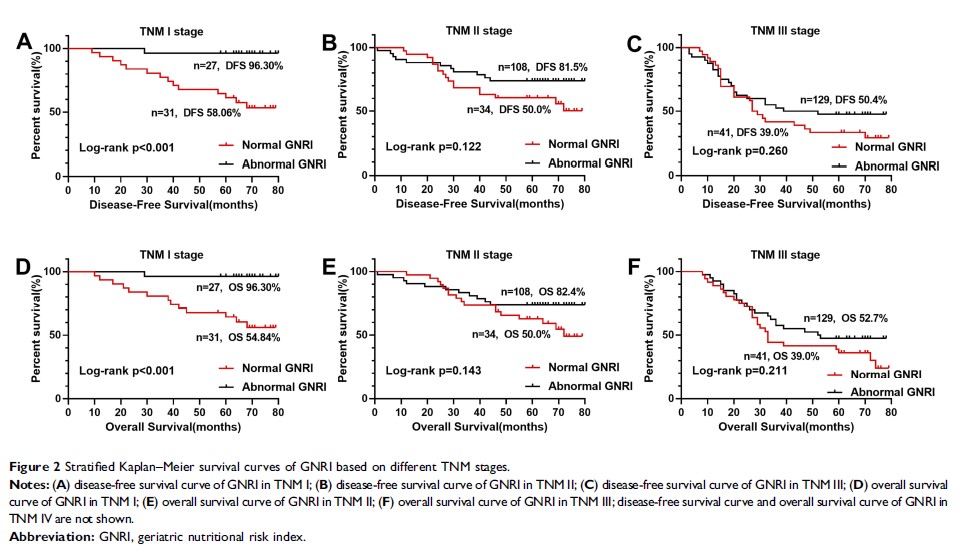
Results: Multivariate logistic regression analysis showed that GNRI (p = 0.009, HR 2.280, 95% CI: 1.224–4.247) was an independent risk factor for postoperative complications in elderly CRC patients. Kaplan–Meier survival curves revealed that the abnormal GNRI group had significantly lower disease-free survival (DFS; p = 0.005) and overall survival (OS; p=0.007) than the normal GNRI group had, especially in TNM I stage. In multivariate survival analysis, GNRI was an independent prognostic factor for DFS (p = 0.003, HR 1.842, 95% CI: 1.229–2.760) and OS (p = 0.003, HR 1.852, 95% CI: 1.231–2.787).
Conclusion: GNRI is a simple and effective tool for predicting the risk of postoperative complications and the long-term prognosis of postoperative elderly CRC patients and can provide a scientific basis for early nutrition interventions in elderly CRC patients.
Keywords: colorectal cancer, geriatric nutritional risk index, prognosis, complication