117333
论文已发表
注册即可获取德孚的最新动态
IF 收录期刊
- 3.6 Breast Cancer (Dove Med Press)
- 4.3 Clin Epidemiol
- 2.6 Cancer Manag Res
- 3.2 Infect Drug Resist
- 4.1 Clin Interv Aging
- 6.1 Drug Des Dev Ther
- 4.1 Int J Chronic Obstr
- 8.7 Int J Nanomed
- 2.5 Int J Women's Health
- 3.2 Neuropsych Dis Treat
- 2.4 OncoTargets Ther
- 2.6 Patient Prefer Adher
- 2.6 Ther Clin Risk Manag
- 3.1 J Pain Res
- 3.5 Diabet Metab Synd Ob
- 4.5 Psychol Res Behav Ma
- 3.4 Nat Sci Sleep
- 2.4 Pharmgenomics Pers Med
- 2.6 Risk Manag Healthc Policy
- 4.6 J Inflamm Res
- 2.3 Int J Gen Med
- 3.9 J Hepatocell Carcinoma
- 3.3 J Asthma Allergy
- 2.5 Clin Cosmet Investig Dermatol
- 3.0 J Multidiscip Healthc

EphB3 和 dysadherin 表达在肝外胆管癌中的预后和临床病理意义
Authors Wu Z, Liu R, Xiong L, Miao X, Li D, Zou Q, Yuan Y, Yang Z
Received 24 September 2019
Accepted for publication 30 December 2019
Published 10 January 2020 Volume 2020:12 Pages 221—232
DOI https://doi.org/10.2147/CMAR.S232278
Checked for plagiarism Yes
Review by Single-blind
Peer reviewer comments 3
Editor who approved publication: Dr Eileen O'Reilly
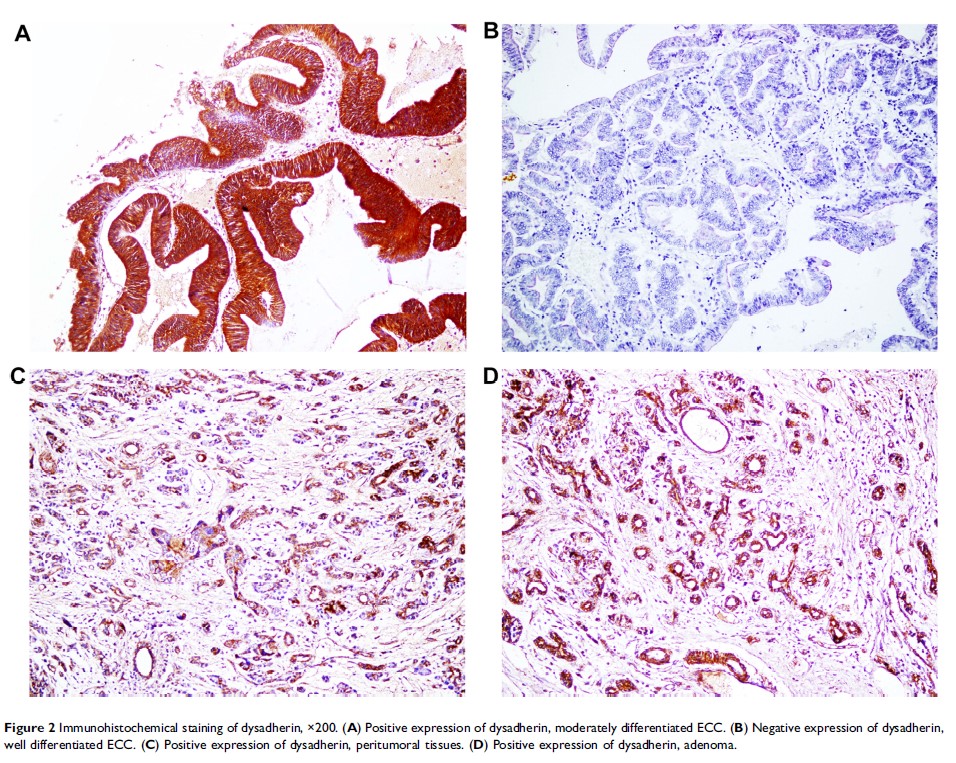
Aim: EphB3 and dysadherin are involved in tumorigenesis and progression of many neoplasms. However, the roles of EphB3 and dysadherin in extrahepatic cholangiocarcinoma (ECC) remain to be revealed. In this study, we aimed to evaluate the expression of EphB3 and dysadherin, and investigate their clinicopathological significance in ECC.
Methods: We examined EphB3 and dysadherin expression in 100 ECC, 30 peritumoral tissues, 10 adenoma and 15 normal biliary tract tissues using EnVision immunohistochemistry. The relationship between EphB3 or dysadherin expression and clinicopathological features was evaluated using the χ 2 test or Fisher’s exact test. The overall survival of ECC patients was analyzed using Kaplan-Meier univariate survival analysis and Log rank tests.
Results: We found that EphB3 expression was significantly down-regulated and dysadherin expression was significantly up-regulated in ECC tissues compared with normal tissues (P < 0.01). EphB3 expression was negatively correlated with dysadherin expression in ECC (P < 0.01). The positive rate of EphB3 expression and negative rate of dysadherin expression was significantly higher in patients with well-differentiated type, no lymph node metastasis, no surrounding tissues and organs invasion, early TNM stages (I + II) and radical resection (P < 0.01). The survival of ECC patients with positive EphB3 or negative dysadherin expression was significantly longer than patients with negative EphB3 or positive dysadherin expression (P < 0.01). Cox multivariate analysis demonstrated that negative EphB3 or positive dysadherin expression were independent poor prognostic factors in ECC patients. The ROC curves suggested that EphB3 and dysadherin combined diagnostic efficacy (AUC=0.688, 95%CI: 0.603-0.772) was significantly higher EphB3 diagnostic efficacy (AUC=0.654, 95%CI: 0.564-0.743) or dysadherin diagnostic efficacy (AUC=0.648, 95%CI: 0.558-0.737) alone.
Conclusion: EphB3 and dysadherin are involved in the carcinogenesis and progression of ECC, and ECC patients with negative EphB3 or positive dysadherin expression have a poor prognosis.
Keywords: extrahepatic cholangiocarcinoma, EphB3, dysadherin, prognosis, clinicopathological significance