117333
论文已发表
注册即可获取德孚的最新动态
IF 收录期刊
- 3.6 Breast Cancer (Dove Med Press)
- 4.3 Clin Epidemiol
- 2.6 Cancer Manag Res
- 3.2 Infect Drug Resist
- 4.1 Clin Interv Aging
- 6.1 Drug Des Dev Ther
- 4.1 Int J Chronic Obstr
- 8.7 Int J Nanomed
- 2.5 Int J Women's Health
- 3.2 Neuropsych Dis Treat
- 2.4 OncoTargets Ther
- 2.6 Patient Prefer Adher
- 2.6 Ther Clin Risk Manag
- 3.1 J Pain Res
- 3.5 Diabet Metab Synd Ob
- 4.5 Psychol Res Behav Ma
- 3.4 Nat Sci Sleep
- 2.4 Pharmgenomics Pers Med
- 2.6 Risk Manag Healthc Policy
- 4.6 J Inflamm Res
- 2.3 Int J Gen Med
- 3.9 J Hepatocell Carcinoma
- 3.3 J Asthma Allergy
- 2.5 Clin Cosmet Investig Dermatol
- 3.0 J Multidiscip Healthc

血红蛋白 Alc、糖化白蛋白和空腹血浆葡萄糖在中国成年人动脉僵硬度预测中的比较
Authors Wen J, Hu F, Yang Q
Received 9 September 2019
Accepted for publication 9 December 2019
Published 10 January 2020 Volume 2020:13 Pages 65—70
DOI https://doi.org/10.2147/DMSO.S230435
Checked for plagiarism Yes
Review by Single-blind
Peer reviewer comments 3
Editor who approved publication: Prof. Dr. Juei-Tang Cheng
Objective: Although diabetes is closely related to cardiovascular disease, there are some disputes whether diabetes can promote arterial stiffness. Therefore, the objective of this study is to compare the predictive abilities of related-glycemic markers including fast plasma glucose (FPG), glycated hemoglobin (HbAlc) and glycated albumin (GA) for the arterial stiffness.
Methods: In the present study, 3640 subjects (2171 men, 1469 women) were enrolled, and anthropometrics, brachial ankle pulse wave velocity (baPWV) and other laboratory data were obtained. Spearman correlation and multivariate logistic regression analyses were used to evaluate the relationships between FPG, HbAlc, GA and baPWV.
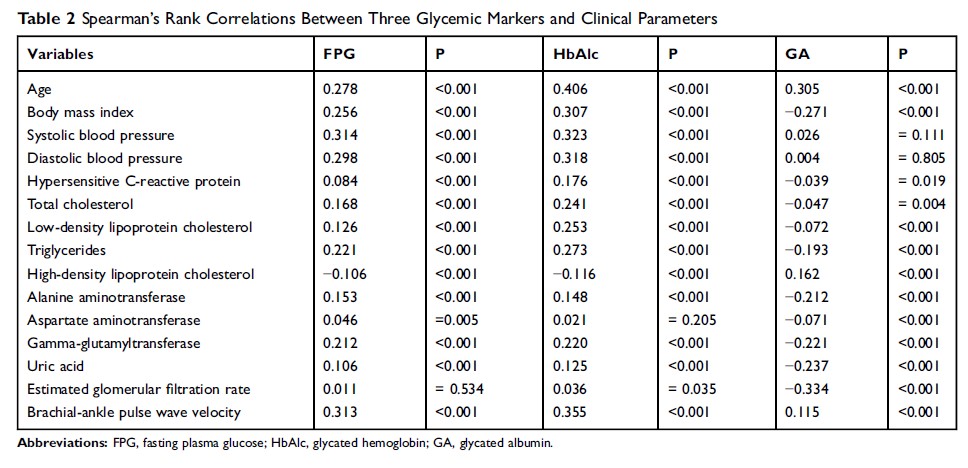
Results: Age, BMI, blood pressure, blood lipids, γ-Glutamyl transpeptidase, uric acid, hypersensitive C-reactive protein, baPWV, FPG, HbAlc, GA, estimated glomerular filtration rate and the incidences of diabetes and hypertension in high baPWV group were much greater than those in control group. Moreover, these above three glycemic markers were positively related to baPWV, and the correlation coefficient of HbAlc was the highest. After adjusting the above factors, HbAlc and FPG, but not GA, were still positively associated with baPWV regardless of diabetes status.
Conclusion: Our data demonstrated that, regardless of diabetes status, HbAlc and FPG were superior to GA for predicting arterial stiffness and HbAlc had the highest correlation with arterial stiffness, revealing that HbAlc may be regarded as an early diagnosis marker for atherosclerosis.
Keywords: diabetes, glycemic markers, cardiovascular disease, brachial ankle pulse wave velocity