117518
论文已发表
注册即可获取德孚的最新动态
IF 收录期刊
- 3.6 Breast Cancer (Dove Med Press)
- 4.3 Clin Epidemiol
- 2.6 Cancer Manag Res
- 3.2 Infect Drug Resist
- 4.1 Clin Interv Aging
- 6.1 Drug Des Dev Ther
- 4.1 Int J Chronic Obstr
- 8.7 Int J Nanomed
- 2.5 Int J Women's Health
- 3.2 Neuropsych Dis Treat
- 2.4 OncoTargets Ther
- 2.6 Patient Prefer Adher
- 2.6 Ther Clin Risk Manag
- 3.1 J Pain Res
- 3.5 Diabet Metab Synd Ob
- 4.5 Psychol Res Behav Ma
- 3.4 Nat Sci Sleep
- 2.4 Pharmgenomics Pers Med
- 2.6 Risk Manag Healthc Policy
- 4.6 J Inflamm Res
- 2.3 Int J Gen Med
- 3.9 J Hepatocell Carcinoma
- 3.3 J Asthma Allergy
- 2.5 Clin Cosmet Investig Dermatol
- 3.0 J Multidiscip Healthc

本文章已被撤回:沉默长非编码 RNA 结肠癌相关转录产物 2 通过阻断 mTOR 信号传导,抑制胃癌的生长和转移
Authors Lin S, Wang H, Yang W, Wang A, Geng C
Received 21 June 2019
Accepted for publication 24 December 2019
Published 13 January 2020 Volume 2020:13 Pages 337—349
DOI https://doi.org/10.2147/OTT.S220302
Checked for plagiarism Yes
Review by Single-blind
Peer reviewer comments 3
Editor who approved publication: Prof. Dr. Nicola Silvestris
***本文章已被撤回***
Purpose: This study aimed to evaluate the specific role of colon cancer-associated transcript 2 (CCAT2) on gastric cancer (GC), and reveal the potential regulatory mechanism relating to mammalian target of rapamycin (mTOR) signaling.
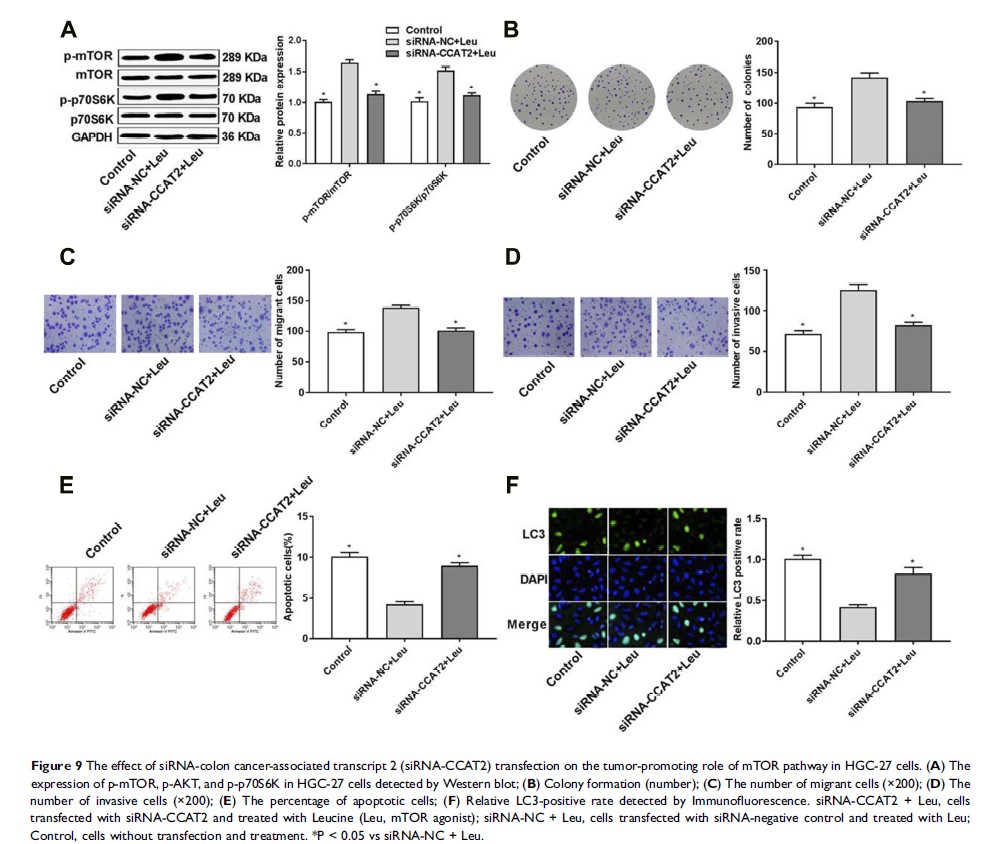
Methods: The expression of CCAT2 was detected in GC tissues and cells by quantitative real-time PCR (qRT-PCR), and its relation with the pathologic characteristics of GC patients was analyzed. HGC-27 and SGC-7901 cells were transfected with siRNA-CCAT2 to silence CCAT2, and HGC-27 cells were then treated with an mTOR agonist Leucine (Leu) to activate mTOR signaling. The cell proliferation was evaluated by cell viability and colony formation. The cell cycle and apoptosis, and the migration and invasion abilities were detected by Flow cytometry, and Transwell assay, respectively. The expression of PCNA (proliferation marker), Snail, N-cadherin, E-cadherin (invasion markers), P53, Caspase-8, Bcl-2 (apoptosis markers), LC3-II/LC3-I, ATG3, p62 (autophagy makers), phosphorylated mTOR (p-mTOR), p-AKT, and p-p70S6K (mTOR signaling markers) were detected by Western blot.
Results: CCAT2 was upregulated in GC tissues and cells, and positively associated with the maximum tumor diameter, lymphatic metastasis, TNM staging, and low overall survival rate (P < 0.05). siRNA-CCAT2 transfection significantly inhibited the viability, colony formation, and migration and invasion abilities, blocked the cell cycle in G0/G1 phase, and promoted the apoptosis and autophagy of SGC-7901 and HGC-27 cells (P < 0.05). In addition, siRNA-CCAT2 transfection significantly upregulated P53, Caspase-8, LC3-II/LC3-I and ATG3, and downregulated PCNA, Bcl-2, p62, p-mTOR, p-AKT and p-p70S6K in SGC-7901 and HGC-27 cells (P < 0.05). siRNA-CCAT2 reversed the tumor-promoting effect of mTOR signaling activation on HGC-27 cells (P < 0.05).
Conclusion: Silencing of CCAT2 inhibited the proliferation, migration and invasion, and promoted the apoptosis and autophagy of GC cells through blocking mTOR signaling.
Keywords: colon cancer-associated transcript 2, gastric cancer, mammalian target of rapamycin, apoptosis, autophagy