117518
论文已发表
注册即可获取德孚的最新动态
IF 收录期刊
- 3.6 Breast Cancer (Dove Med Press)
- 4.3 Clin Epidemiol
- 2.6 Cancer Manag Res
- 3.2 Infect Drug Resist
- 4.1 Clin Interv Aging
- 6.1 Drug Des Dev Ther
- 4.1 Int J Chronic Obstr
- 8.7 Int J Nanomed
- 2.5 Int J Women's Health
- 3.2 Neuropsych Dis Treat
- 2.4 OncoTargets Ther
- 2.6 Patient Prefer Adher
- 2.6 Ther Clin Risk Manag
- 3.1 J Pain Res
- 3.5 Diabet Metab Synd Ob
- 4.5 Psychol Res Behav Ma
- 3.4 Nat Sci Sleep
- 2.4 Pharmgenomics Pers Med
- 2.6 Risk Manag Healthc Policy
- 4.6 J Inflamm Res
- 2.3 Int J Gen Med
- 3.9 J Hepatocell Carcinoma
- 3.3 J Asthma Allergy
- 2.5 Clin Cosmet Investig Dermatol
- 3.0 J Multidiscip Healthc

发现一种新的苯甲磺酰胺类似物,以抑制针对卵巢癌 OVCAR-8 细胞的增殖和转移
Authors Jia Y, Li M, Cao Y, Feng W, Li X, Xue W, Shi H
Received 29 July 2019
Accepted for publication 5 December 2019
Published 15 January 2020 Volume 2020:14 Pages 207—216
DOI https://doi.org/10.2147/DDDT.S225201
Checked for plagiarism Yes
Review by Single-blind
Peer reviewer comments 2
Editor who approved publication: Dr Yan Zhu
Background: Ovarian cancer has been a salient public health concern in the world. It is necessary to develop novel antitumor drugs to treat ovarian cancer.
Purpose: This study investigated the synthesis, antiproliferation ability, antitumor mechanisms in vitro and in vivo of a novel benzenesulfonamide derivative.
Methods: The novel benzenesulfonamide-1,2,3-triazole hybrid 7c was synthesized from 4-fluorobenzenesulfonyl chloride, prop-2-yn-1-amine and 1-(azidomethyl)-3-phenoxybenzene. The structure of this benzenesulfonamide-1,2,3-triazole hybrid 7c was confirmed by 13C NMR, and 1H NMR. Compound 7c was evaluated for its antitumor effects in vitro and in vivo against ovarian cancer OVCAR-8 cells.
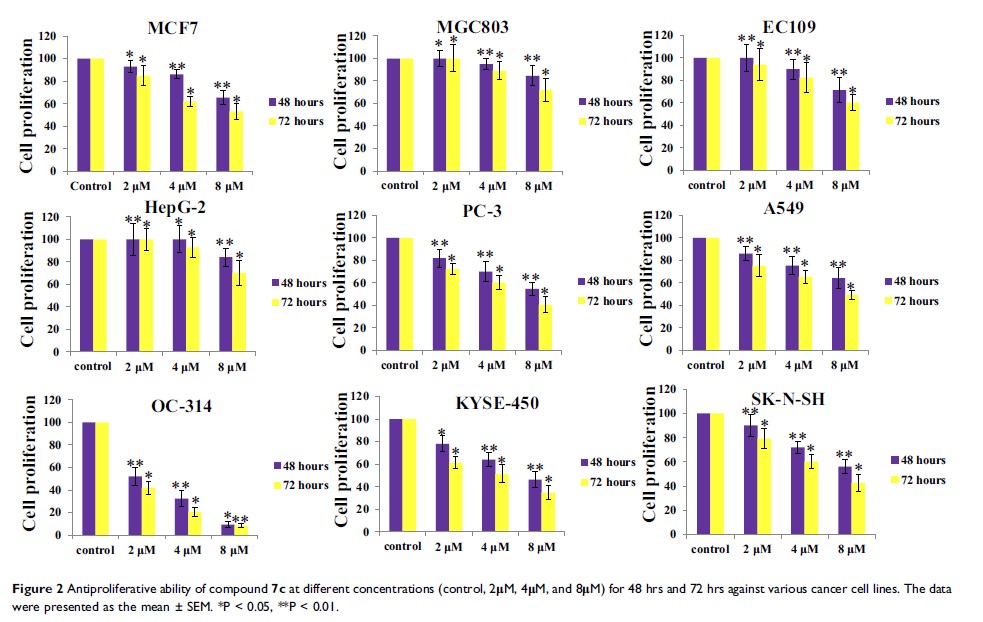
Results: We discovered that the benzenesulfonamide hybrid 7c potently inhibited cell proliferation against ovarian cancer. Especially, it inhibited cell proliferation with an IC 50 value of 0.54μM against OVCAR-8 cells. It could inhibit migration and invasion against OVCAR-8 cells in a concentration-dependent and time-dependent manner. In addition, compound 7c affected the Wnt/β-catenin/GSK3β pathway against ovarian cancer OVCAR-8 cells. In vivo study suggested that compound 7c inhibited tumor growth remarkably without obvious toxicity.
Conclusion: In conclusion, benzenesulfonamide hybrid 7c could be a lead compound for further antitumor drug discovery to treat ovarian cancer.
Keywords: benzenesulfonamide, proliferation, migration, invasion, in vivo