117518
论文已发表
注册即可获取德孚的最新动态
IF 收录期刊
- 3.6 Breast Cancer (Dove Med Press)
- 4.3 Clin Epidemiol
- 2.6 Cancer Manag Res
- 3.2 Infect Drug Resist
- 4.1 Clin Interv Aging
- 6.1 Drug Des Dev Ther
- 4.1 Int J Chronic Obstr
- 8.7 Int J Nanomed
- 2.5 Int J Women's Health
- 3.2 Neuropsych Dis Treat
- 2.4 OncoTargets Ther
- 2.6 Patient Prefer Adher
- 2.6 Ther Clin Risk Manag
- 3.1 J Pain Res
- 3.5 Diabet Metab Synd Ob
- 4.5 Psychol Res Behav Ma
- 3.4 Nat Sci Sleep
- 2.4 Pharmgenomics Pers Med
- 2.6 Risk Manag Healthc Policy
- 4.6 J Inflamm Res
- 2.3 Int J Gen Med
- 3.9 J Hepatocell Carcinoma
- 3.3 J Asthma Allergy
- 2.5 Clin Cosmet Investig Dermatol
- 3.0 J Multidiscip Healthc

高尔基体支架蛋白 PAQR3 的表征及其对肿瘤抑制和代谢途径的区室化的作用
Authors Lei L, Ling ZN, Chen XL, Hong LL, Ling ZQ
Received 2 April 2019
Accepted for publication 2 August 2019
Published 16 January 2020 Volume 2020:12 Pages 353—362
DOI https://doi.org/10.2147/CMAR.S210919
Checked for plagiarism Yes
Review by Single-blind
Peer reviewer comments 2
Editor who approved publication: Dr Beicheng Sun
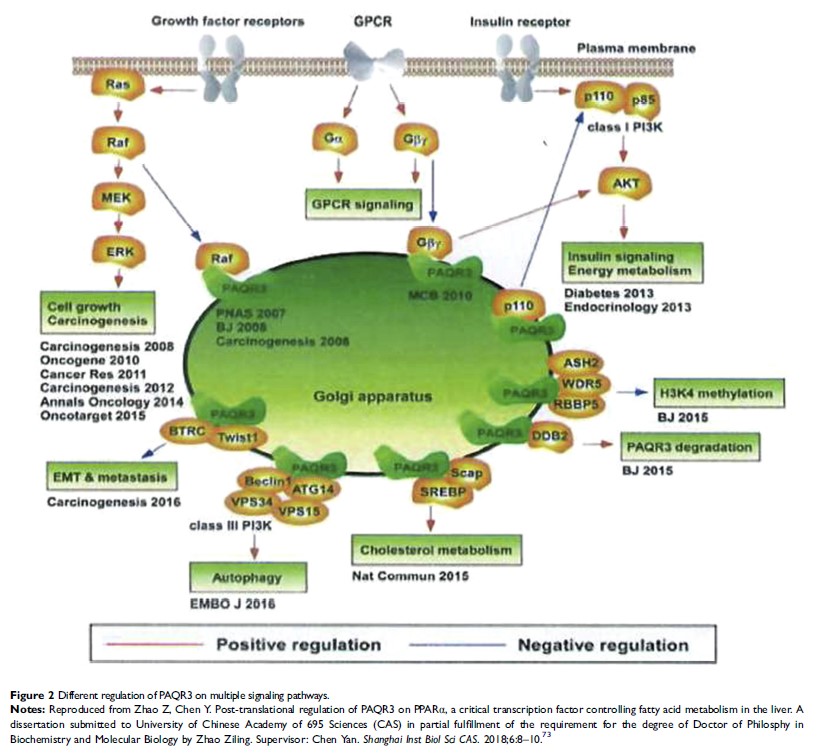
Abstract: The Golgi apparatus is critical in the compartmentalization of signaling cascades originating from the cytoplasmic membrane and various organelles. Scaffold proteins, such as progestin and adipoQ receptor (PAQR)3, specifically regulate this process, and have recently been identified in the Golgi apparatus. PAQR3 belongs to the PAQR family, and was recently described as a tumor suppressor. Accumulating evidence demonstrates PAQR3 is downregulated in different cancers to suppress its inhibitory effects on malignant potential. PAQR3 functions biologically through the pathological regulation of altered signaling pathways. Significant cell proliferation networks, including Ras proto-oncogene (Ras)/mitogen-activated protein kinase (MAPK), phosphatidylinositol 3-kinase (PI3K)/protein kinase B (Akt), insulin, and vascular endothelial growth factor, are closely controlled by PAQR3 for physiologically relevant effects. Meanwhile, genetic/epigenetic susceptibility and environmental factors, may have functions in the downregulation of PAQR3 in human cancers. This study aimed to assess the subcellular localization of PAQR3 and determine its topological features and functional domains, summarizing its effects on cell signaling compartmentalization. The pathophysiological functions of PAQR3 in cancer pathogenesis, metabolic diseases, and developmental ailments were also highlighted.
Keywords: cell signaling, Golgi apparatus, metabolic regulation, metastasis, PAQR3, tumor suppressor