117518
论文已发表
注册即可获取德孚的最新动态
IF 收录期刊
- 3.6 Breast Cancer (Dove Med Press)
- 4.3 Clin Epidemiol
- 2.6 Cancer Manag Res
- 3.2 Infect Drug Resist
- 4.1 Clin Interv Aging
- 6.1 Drug Des Dev Ther
- 4.1 Int J Chronic Obstr
- 8.7 Int J Nanomed
- 2.5 Int J Women's Health
- 3.2 Neuropsych Dis Treat
- 2.4 OncoTargets Ther
- 2.6 Patient Prefer Adher
- 2.6 Ther Clin Risk Manag
- 3.1 J Pain Res
- 3.5 Diabet Metab Synd Ob
- 4.5 Psychol Res Behav Ma
- 3.4 Nat Sci Sleep
- 2.4 Pharmgenomics Pers Med
- 2.6 Risk Manag Healthc Policy
- 4.6 J Inflamm Res
- 2.3 Int J Gen Med
- 3.9 J Hepatocell Carcinoma
- 3.3 J Asthma Allergy
- 2.5 Clin Cosmet Investig Dermatol
- 3.0 J Multidiscip Healthc

中国东部社区获得性患者产毒型艰难梭菌基因型对大环内酯-林可酰胺-链霉菌素 B 的高水平耐药性
Authors Zhao L, Luo Y, Bian Q, Wang L, Ye J, Song X, Jiang J, Tang YW, Wang X, Jin D
Received 16 November 2019
Accepted for publication 26 December 2019
Published 17 January 2020 Volume 2020:13 Pages 171—181
DOI https://doi.org/10.2147/IDR.S238916
Checked for plagiarism Yes
Review by Single-blind
Peer reviewer comments 2
Editor who approved publication: Professor Suresh Antony
Background: Clostridioides difficile resistant to macrolide-lincosamide-streptogramin B (MLSB) has not been reported in China.
Methods: In a cross-sectional study in two tertiary hospitals, C. difficile isolates from stool specimens from community-onset, hospital-associated diarrheal patients were analyzed for toxin genes, genotype, and antibiotic resistance, and the patients’ clinical charts were reviewed.
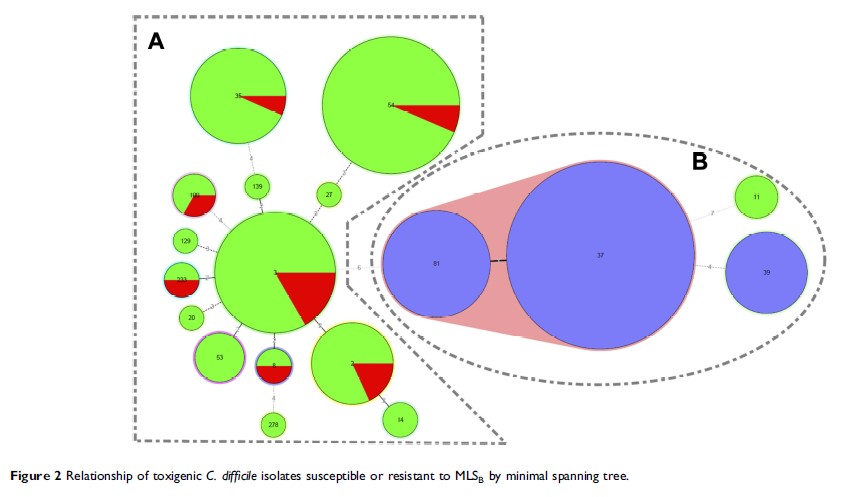
Results: A total of 190 (15.2%) isolates (102 A+B+ and 88 A−B+) from 1250 community acquired (CA) patients were recovered and all were susceptible to vancomycin and metronidazole. High-level resistance (minimum inhibitory concentration > 128 mg/L) to erythromycin and clindamycin was recorded in 77.9% and 88.4% of the tested isolates, respectively. Furthermore, 89.3% (159/178) of the isolates resistant to MLSB carried the erythromycin resistance methylase gene (ermB ). The statistically significant factors associated with C. difficile infection (CDI) induced by A−B+ isolates with MLSB resistance included a severity score of > 2 (odds ratio [95% confidence interval], 7.43 [2.31– 23.87]) and platelet count (cells × 10 9 cells/L) < 100 [5.19 (1.58– 17.04)]. The proportion of A−B+ increased with enhanced CDI severity (x 2 = 21.62, P < 0.001), which was significantly higher than that of ermB -positive A+B+ in severity score of 4 (x 2 = 8.61, P = 0.003). The average severity score of ermB -positive isolates was significantly higher than that of ermB -negative isolates in A−B+ (Z = − 2.41, P = 0.016).
Conclusion: The ermB -positive A−B+ C. difficile with MLSB resistance is described for the first time as a potential epidemic clone inducing severe CDI in CA diarrheal patients in Eastern China.
Keywords: Clostridioides difficile , molecular characteristic, macrolide-lincosamide-streptogramin B resistance