117518
论文已发表
注册即可获取德孚的最新动态
IF 收录期刊
- 3.6 Breast Cancer (Dove Med Press)
- 4.3 Clin Epidemiol
- 2.6 Cancer Manag Res
- 3.2 Infect Drug Resist
- 4.1 Clin Interv Aging
- 6.1 Drug Des Dev Ther
- 4.1 Int J Chronic Obstr
- 8.7 Int J Nanomed
- 2.5 Int J Women's Health
- 3.2 Neuropsych Dis Treat
- 2.4 OncoTargets Ther
- 2.6 Patient Prefer Adher
- 2.6 Ther Clin Risk Manag
- 3.1 J Pain Res
- 3.5 Diabet Metab Synd Ob
- 4.5 Psychol Res Behav Ma
- 3.4 Nat Sci Sleep
- 2.4 Pharmgenomics Pers Med
- 2.6 Risk Manag Healthc Policy
- 4.6 J Inflamm Res
- 2.3 Int J Gen Med
- 3.9 J Hepatocell Carcinoma
- 3.3 J Asthma Allergy
- 2.5 Clin Cosmet Investig Dermatol
- 3.0 J Multidiscip Healthc

通过生物信息学分析鉴定的血浆信使 RNA 是新颖的、非侵入性的前列腺癌生物标记物
Authors Wang R, Wu Y, Yu J, Yang G, Yi H, Xu B
Received 29 June 2019
Accepted for publication 7 November 2019
Published 17 January 2020 Volume 2020:13 Pages 541—548
DOI https://doi.org/10.2147/OTT.S221276
Checked for plagiarism Yes
Review by Single-blind
Peer reviewer comments 2
Editor who approved publication: Dr Carlos E Vigil
Aim: To identify new biomarkers of prostate cancer (PCa) for the diagnosis and prediction of clinical outcomes.
Materials and Methods: Existing microarray data of PCa tissues in the Oncomine database were analyzed and candidate differentially expressed genes (DEGs) that may be novel and noninvasive biomarkers were obtained. On this basis, plasma mRNA was extracted from PCa patients and healthy donors. Furthermore, plasma mRNA expression of DEGs was evaluated by qRT-PCR. Finally, the diagnostic power of the biomarkers was evaluated in comparison to the clinical characteristics of the patients.
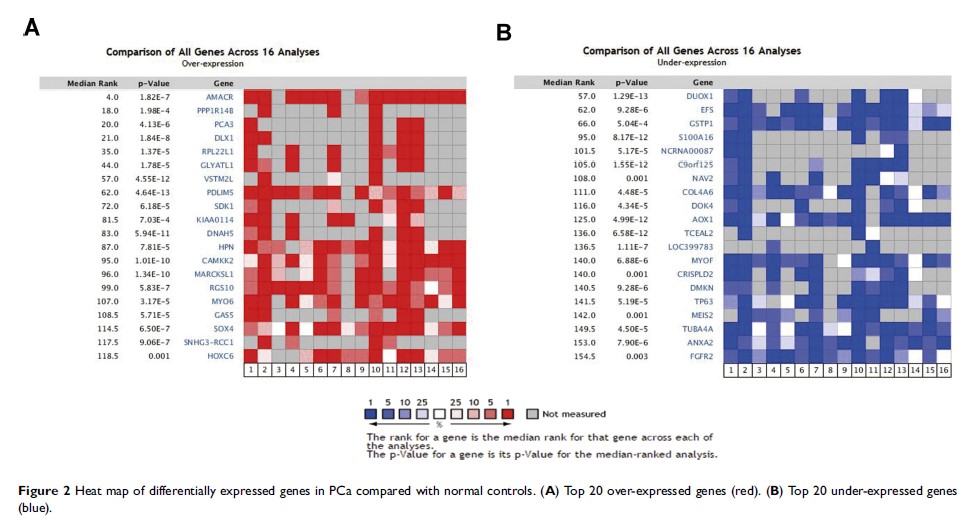
Results: In this study, the top five significantly overexpressed mRNA (AMACR, PPP1R14b, PCA3, DLX1, and RPL22L1) and the top five significantly underexpressed mRNA (DUOX1, EFS, GSTP1, S100A16, and NCRNA00087) were selected for further validation in PCa patients and healthy donors by qRT-PCR. The results showed that AMACR, DLX1, PCA3, DUOX1, and GSTP1 mRNA were stably amplified in plasma. Additionally, DLX1, PCA3, DUOX1, and GSTP1 mRNA expression was significantly different between PCa circulating free mRNA samples and healthy donors. These mRNAs may be useful biomarkers for PCa diagnosis.
Conclusion: Analysis of the expression of genes in the Oncomine database showed that DLX1, PCA3, and DUOX1 expressions have a cancer specific pattern in PCa. Collectively, DLX1, PCA3, and DUOX1 may be useful candidate biomarkers for PCa diagnosis.
Keywords: prostate cancer, PCA3, DLX1, GSTP1, DUOX1