117518
论文已发表
注册即可获取德孚的最新动态
IF 收录期刊
- 3.6 Breast Cancer (Dove Med Press)
- 4.3 Clin Epidemiol
- 2.6 Cancer Manag Res
- 3.2 Infect Drug Resist
- 4.1 Clin Interv Aging
- 6.1 Drug Des Dev Ther
- 4.1 Int J Chronic Obstr
- 8.7 Int J Nanomed
- 2.5 Int J Women's Health
- 3.2 Neuropsych Dis Treat
- 2.4 OncoTargets Ther
- 2.6 Patient Prefer Adher
- 2.6 Ther Clin Risk Manag
- 3.1 J Pain Res
- 3.5 Diabet Metab Synd Ob
- 4.5 Psychol Res Behav Ma
- 3.4 Nat Sci Sleep
- 2.4 Pharmgenomics Pers Med
- 2.6 Risk Manag Healthc Policy
- 4.6 J Inflamm Res
- 2.3 Int J Gen Med
- 3.9 J Hepatocell Carcinoma
- 3.3 J Asthma Allergy
- 2.5 Clin Cosmet Investig Dermatol
- 3.0 J Multidiscip Healthc

中国ER阳性乳腺癌中 ESR1 突变的患病率
Authors Zhu W, Ren C, Wang Y, Wen L, Zhang G, Liao N
Received 7 October 2019
Accepted for publication 19 December 2019
Published 21 January 2020 Volume 2020:13 Pages 615—621
DOI https://doi.org/10.2147/OTT.S233662
Checked for plagiarism Yes
Review by Single-blind
Peer reviewer comments 2
Editor who approved publication: Dr XuYu Yang
Background: ESR1 mutation and its possible relation to endocrine therapy resistance in ER-positive breast cancers have been studied with respect to genetic sequencing data from Western patients but rarely from Chinese patients. This study aimed to investigate the prevalence of ESR1 mutation in Chinese primary and metastatic ER-positive breast cancer.
Methods: Tumor samples from 297 primary breast cancer (PBC) patients and blood samples from 43 metastatic breast cancer (MBC) patients were obtained to perform whole exon sequencing of the ESR1 gene through next-generation sequencing (NGS). Clinicopathological features of MBC patients were listed and grouped to explore potential factors in ESR1 mutations.
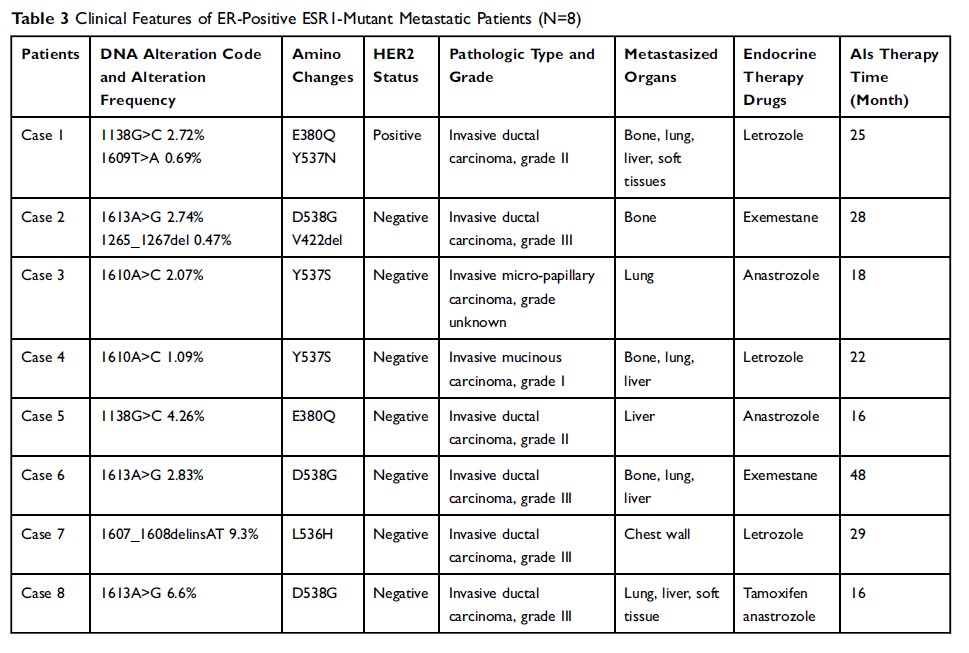
Results: A total of 15 ESR1 variations, including 11 point mutations, 1 in-frame deletion mutation, 1 synonymous mutation, and 2 amplifications were identified in 13 patients. The ESR1 mutation rate was 1% (3/297) in PBC patients and 18.6% (8/43) in MBC patients. All ESR1 point mutations occurred in the estrogen receptor ligand-binding domain. Six (54.5%) of the 11 point mutations were hotspot mutations. Among all MBC patients, the ESR1 mutation rate in those who had a treatment history using aromatase inhibitors (AI) was significantly higher than those who did not (25.8% versus 0%, P=0.015). Moreover, the ESR1 mutation rate in those who received AI treatment over a period of 12 months was significantly higher than in those whose treatment lasted less than 12 months [36.3% versus 0%, P< 0.001].
Conclusion: ESR1 mutations were more frequently observed in the circulating cell-free DNA of MBC patients than in PBC patients among the Chinese cohort, and higher among those pretreated with AI, suggesting that such mutations may undergo selection during AI treatment.
Keywords: breast cancer, ESR1 mutation, endocrine therapy resistance, NGS, aromatase inhibitors