117518
论文已发表
注册即可获取德孚的最新动态
IF 收录期刊
- 3.6 Breast Cancer (Dove Med Press)
- 4.3 Clin Epidemiol
- 2.6 Cancer Manag Res
- 3.2 Infect Drug Resist
- 4.1 Clin Interv Aging
- 6.1 Drug Des Dev Ther
- 4.1 Int J Chronic Obstr
- 8.7 Int J Nanomed
- 2.5 Int J Women's Health
- 3.2 Neuropsych Dis Treat
- 2.4 OncoTargets Ther
- 2.6 Patient Prefer Adher
- 2.6 Ther Clin Risk Manag
- 3.1 J Pain Res
- 3.5 Diabet Metab Synd Ob
- 4.5 Psychol Res Behav Ma
- 3.4 Nat Sci Sleep
- 2.4 Pharmgenomics Pers Med
- 2.6 Risk Manag Healthc Policy
- 4.6 J Inflamm Res
- 2.3 Int J Gen Med
- 3.9 J Hepatocell Carcinoma
- 3.3 J Asthma Allergy
- 2.5 Clin Cosmet Investig Dermatol
- 3.0 J Multidiscip Healthc

远程缺血预处理对缺血性卒中脑血流动力学的影响
Authors Qin C, Yan X, Jin H, Zhang R, He Y, Sun X, Zhang Y, Guo ZN, Yang Y
Received 21 September 2019
Accepted for publication 16 December 2019
Published 23 January 2020 Volume 2020:16 Pages 283—299
DOI https://doi.org/10.2147/NDT.S231944
Checked for plagiarism Yes
Review by Single-blind
Peer reviewer comments 2
Editor who approved publication: Professor Yuping Ning
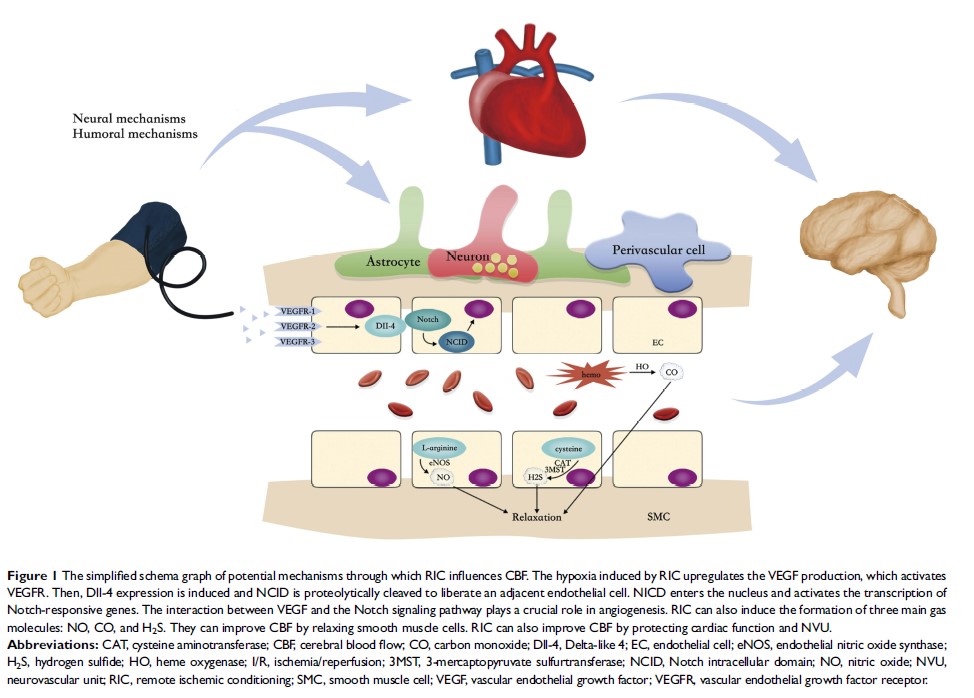
Abstract: Ischemic stroke is one of the most common cerebrovascular diseases and is the leading cause of disability all over the world. It is well known that cerebral blood flow (CBF) is disturbed or even disrupted when ischemic stroke happens. The imbalance between demand and shortage of blood supply makes ischemic stroke take place or worsen. The search for treatments that can preserve CBF, especially during the acute phase of ischemic stroke, has become a research hotspot. Animal and clinical experiments have proven that remote ischemic conditioning (RIC) is a beneficial therapeutic strategy for the treatment of ischemic stroke. However, the mechanism by which RIC affects CBF has not been fully understood. This review aims to discuss several possible mechanisms of RIC on the cerebral hemodynamics in ischemic stroke, such as the improvement of cardiac function and collateral circulation of cerebral vessels, the protection of neurovascular units, the formation of gas molecules, the effect on the function of vascular endothelial cells and the nervous system. RIC has the potential to become a therapeutic treatment to improve CBF in ischemic stroke. Future studies are needed to highlight our understanding of RIC as well as accelerate its clinical translation.
Keywords: remote ischemic conditioning, cerebral hemodynamics, ischemic stroke, cerebral blood flow