117745
论文已发表
注册即可获取德孚的最新动态
IF 收录期刊
- 3.6 Breast Cancer (Dove Med Press)
- 4.3 Clin Epidemiol
- 2.6 Cancer Manag Res
- 3.2 Infect Drug Resist
- 4.1 Clin Interv Aging
- 6.1 Drug Des Dev Ther
- 4.1 Int J Chronic Obstr
- 8.7 Int J Nanomed
- 2.5 Int J Women's Health
- 3.2 Neuropsych Dis Treat
- 2.4 OncoTargets Ther
- 2.6 Patient Prefer Adher
- 2.6 Ther Clin Risk Manag
- 3.1 J Pain Res
- 3.5 Diabet Metab Synd Ob
- 4.5 Psychol Res Behav Ma
- 3.4 Nat Sci Sleep
- 2.4 Pharmgenomics Pers Med
- 2.6 Risk Manag Healthc Policy
- 4.6 J Inflamm Res
- 2.3 Int J Gen Med
- 3.9 J Hepatocell Carcinoma
- 3.3 J Asthma Allergy
- 2.5 Clin Cosmet Investig Dermatol
- 3.0 J Multidiscip Healthc

RSK4 对胃癌生物学特性的影响
Authors Hu C, Dai J, Lin X, Meng Y, Liang H
Received 11 November 2019
Accepted for publication 15 January 2020
Published 28 January 2020 Volume 2020:12 Pages 611—619
DOI https://doi.org/10.2147/CMAR.S238132
Checked for plagiarism Yes
Review by Single-blind
Peer reviewer comments 2
Editor who approved publication: Dr Chien-Feng Li
Purpose: Gastric cancer is one of the most common cancers with high mortality. Emerging evidences show that ribosomal s6 kinase4 (RSK4) may be an anti-oncogene in several types of cancers, while its function in GC is still unclear. In the present study, we investigated the role of RSK4 in GC progression using MGC-803 and HGC-27 cell lines in vitro and in vivo.
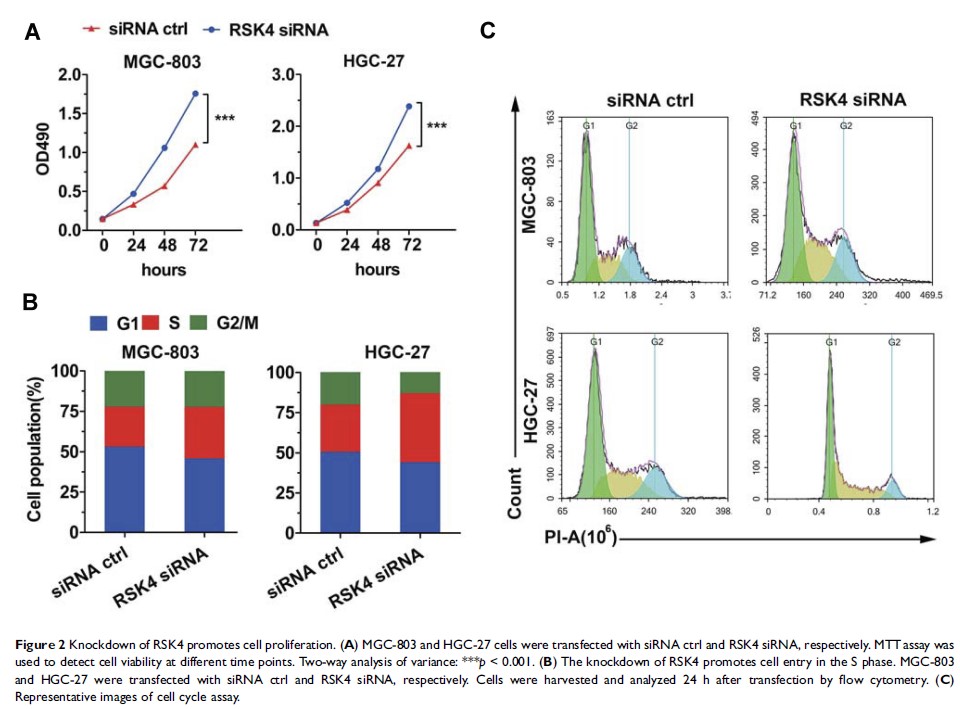
Methods: The expression of RSK4 in gastric cancer cells was evaluated using RT-qPCR and Western blot analysis. We transfected cells with RSK4 siRNA to reduce the expression of RSK4 and then evaluated the effect of RSK4 on cellular function. MTT and cell cycle assays were used to study its effect on cell growth. Flow cytometry was used to evaluate cell apoptosis. Wound healing and Transwell assays were performed to investigate metastasis. Stable cell lines with or without RSK4 knockdown were constructed with lentivirus and tumor-bearing mice were used to investigate the effect of RSK4 on cancer progression.
Results: The results revealed that reduction of RSK4 expression inhibited cell apoptosis and promoted cell proliferation, migration, and invasion. Additionally, RSK4 knockdown promoted tumorigenesis in vivo.
Conclusion: Our study demonstrated that RSK4 serves as a tumor suppressor in GC.
Keywords: gastric cancer, RSK4, proliferation, apoptosis, migration, invasion