114900
论文已发表
注册即可获取德孚的最新动态
IF 收录期刊
- 3.4 Breast Cancer (Dove Med Press)
- 3.2 Clin Epidemiol
- 2.6 Cancer Manag Res
- 2.9 Infect Drug Resist
- 3.7 Clin Interv Aging
- 5.1 Drug Des Dev Ther
- 3.1 Int J Chronic Obstr
- 6.6 Int J Nanomed
- 2.6 Int J Women's Health
- 2.9 Neuropsych Dis Treat
- 2.8 OncoTargets Ther
- 2.0 Patient Prefer Adher
- 2.2 Ther Clin Risk Manag
- 2.5 J Pain Res
- 3.0 Diabet Metab Synd Ob
- 3.2 Psychol Res Behav Ma
- 3.4 Nat Sci Sleep
- 1.8 Pharmgenomics Pers Med
- 2.0 Risk Manag Healthc Policy
- 4.1 J Inflamm Res
- 2.0 Int J Gen Med
- 3.4 J Hepatocell Carcinoma
- 3.0 J Asthma Allergy
- 2.2 Clin Cosmet Investig Dermatol
- 2.4 J Multidiscip Healthc

长非编码 RNA PART1 通过使 miR-190a-3p 海绵化和 PTEN/AKT 信号通路失活而在胶质瘤中发挥肿瘤抑制功能
Authors Jin Z, Piao L, Sun G, Lv C, Jing Y, Jin R
Received 29 September 2019
Accepted for publication 11 December 2019
Published 4 February 2020 Volume 2020:13 Pages 1073—1086
DOI https://doi.org/10.2147/OTT.S232848
Checked for plagiarism Yes
Review by Single-blind
Peer reviewer comments 2
Editor who approved publication: Dr Sanjeev Srivastava
Background: Glioma is the most commonly diagnosed primary brain tumor. Dysregulation of long non-coding RNA (lncRNA) is associated with initiation and development of various cancer types including glioma.
Methods: The relative expression of lncRNA was analyzed by real time-quantitative polymerase chain reaction (RT-qPCR). Cell counting kit (CCK-8) and flow cytometry analysis were applied to explore the role of prostate androgen-regulated transcript 1 (PART1) in glioma cell lines. Luciferase reporter assay, Western blotting and RT-qPCR were used to investigate the association between PART1, miR-190a-3p and phosphatase and tensin homolog deleted on chromosome ten (PTEN) in glioma cell lines.
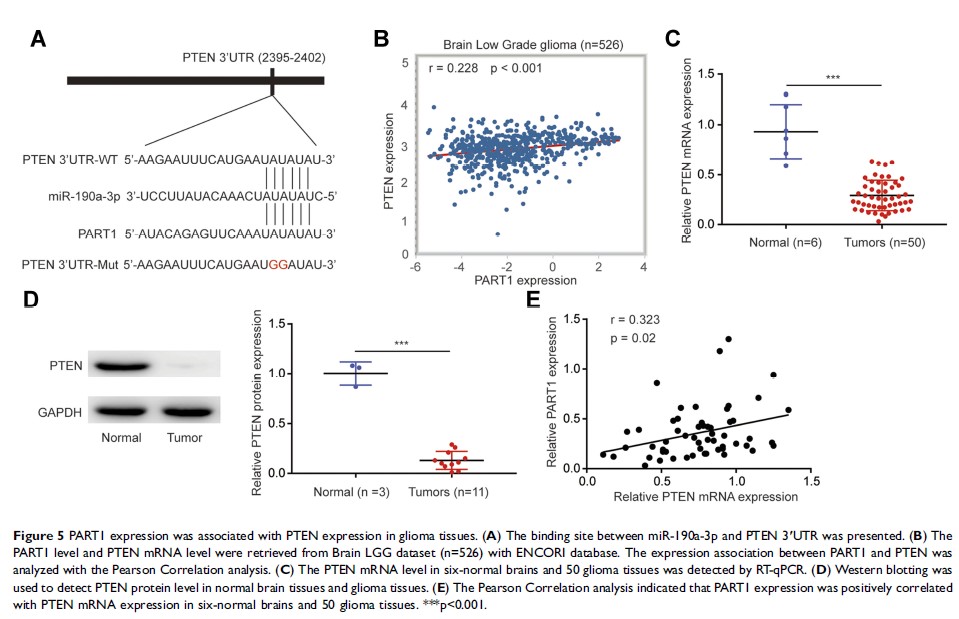
Results: In the present study, we elucidated a pivotal role and molecular mechanism of lncRNA PART1 in glioma cell lines. It was found that PART1 was significantly downregulated in glioma tissues compared to normal tissues according to TCGA data and our RT-qPCR results. The cell-based assays showed that PART1 suppressed cell proliferation and triggered cell apoptosis in glioma cell lines. PART1 inactivated PI3K/AKT cascade in glioma cell lines. Transfection of constitutively activated AKT (Myr-AKT) reversed PART1 induced cell apoptosis and cell growth arrest. The bioinformatic analysis suggested that miR-190a-3p might bind to PART1. In the dual luciferase reporter assay, we validated that PART1 directly bound to miR-190a-3p in glioma cell lines. Furthermore, there was a reciprocal repression between PART1 and miR-190-3p. In addition, PART1 upregulated PTEN and inactivated PI3K/AKT pathway in glioma cell lines. Moreover, silencing of PTEN reversed PART1 overexpression induced cell growth arrest and apoptosis. In glioma tissues, the Pearson Correlation analysis showed that there was a strong-positive correlation between PART1 level and PTEN mRNA level.
Conclusion: Taken together, the current study revealed a PART1/miR-190a-3p/PTEN/PI3K/AKT axis in glioma and provided novel insights for understanding the complex lncRNA-miRNA network in glioma.
Keywords: prostate androgen-regulated transcript 1, microRNA-190a-3p, PI3K/AKT signaling, glioma