114900
论文已发表
注册即可获取德孚的最新动态
IF 收录期刊
- 3.4 Breast Cancer (Dove Med Press)
- 3.2 Clin Epidemiol
- 2.6 Cancer Manag Res
- 2.9 Infect Drug Resist
- 3.7 Clin Interv Aging
- 5.1 Drug Des Dev Ther
- 3.1 Int J Chronic Obstr
- 6.6 Int J Nanomed
- 2.6 Int J Women's Health
- 2.9 Neuropsych Dis Treat
- 2.8 OncoTargets Ther
- 2.0 Patient Prefer Adher
- 2.2 Ther Clin Risk Manag
- 2.5 J Pain Res
- 3.0 Diabet Metab Synd Ob
- 3.2 Psychol Res Behav Ma
- 3.4 Nat Sci Sleep
- 1.8 Pharmgenomics Pers Med
- 2.0 Risk Manag Healthc Policy
- 4.1 J Inflamm Res
- 2.0 Int J Gen Med
- 3.4 J Hepatocell Carcinoma
- 3.0 J Asthma Allergy
- 2.2 Clin Cosmet Investig Dermatol
- 2.4 J Multidiscip Healthc

微血管减压术结合感觉根部分切断术与否对三叉神经痛治疗长期疗效和预测因素的比较
Authors Liu R, Deng Z, Zhang L, Liu Y, Wang Z, Yu Y
Received 30 July 2019
Accepted for publication 17 January 2020
Published 5 February 2020 Volume 2020:13 Pages 301—312
DOI https://doi.org/10.2147/JPR.S225188
Checked for plagiarism Yes
Review by Single-blind
Peer reviewer comments 2
Editor who approved publication: Dr Michael E Schatman
Purpose: Microvascular decompression (MVD) and MVD combined with partial sensory rhizotomy (PSR) are effective surgical treatments for idiopathic trigeminal neuralgia (TN). The aim of this study was to compare the long-term outcomes of both MVD and MVD+PSR for the treatment of TN and to identify the factors that may influence the long-term outcomes after MVD or MVD+PSR.
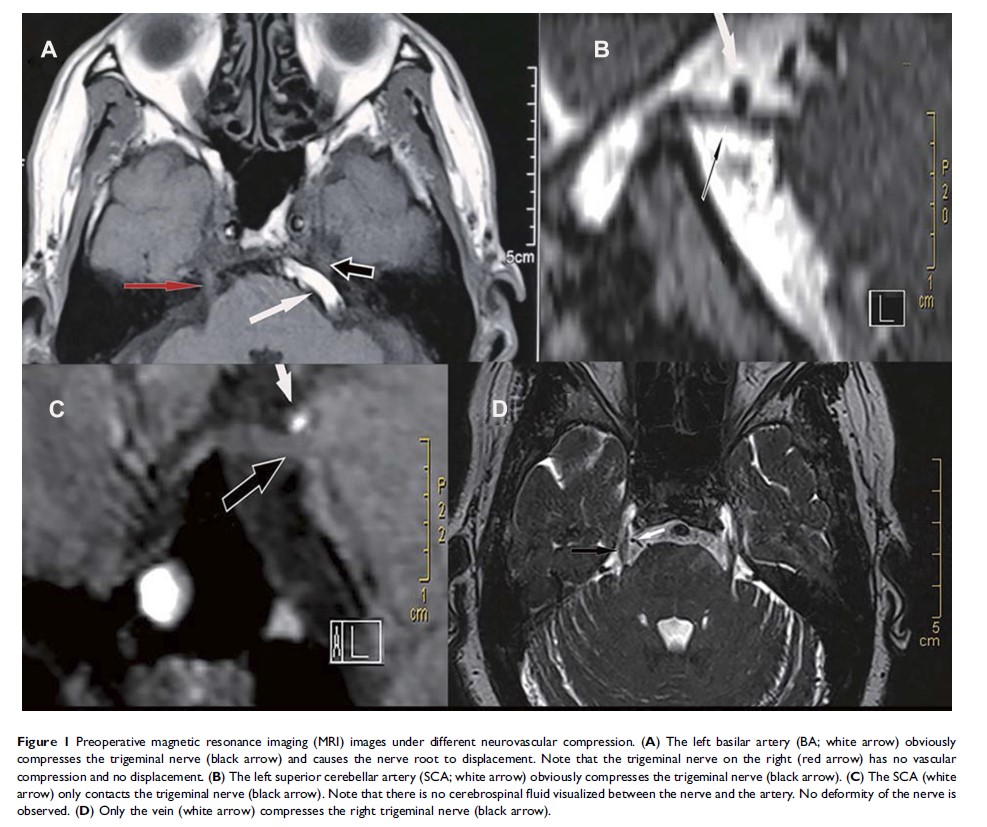
Patients and Methods: From March 2009 to December 2017, 99 patients with idiopathic TN who underwent MVD or MVD+PSR in our hospital (40 MVD, 59 MVD+PSR) were included in the study. The indications for MVD+PSR were as follows: vessels only contacted the nerve root, absence of arterial conflict, or failing to completely decompress from the arteries or veins. All patients were treated by one neurosurgeon and were followed up for at least 1 year. The outcomes were assessed with the Barrow Neurological Institute (BNI) Pain Intensity Scale.
Results: The average follow-up duration was 63.0 months (range, 13.2– 118.8 months). Patients in the MVD group were younger than those in the MVD+PSR group (55.1 years and 60.5 years, respectively, P=0.012). A total of 62.5% of the patients in the MVD group and 69.5% of the patients in the MVD+PSR group had favorable long-term outcomes. The Kaplan-Meier survival analysis showed no significant difference in long-term outcomes between the two groups (P=0.202). No factors were associated with long-term outcomes after MVD. For MVD+PSR, a long duration of the disease (odds ratio (OR) 6.967, P=0.016) was associated with unfavorable long-term outcomes, whereas pure arterial compression (OR 0.131, P=0.013) was associated with favorable long-term outcomes.
Conclusion: For patients who are not suitable to undergo pure MVD, MVD+PSR can be used as an effective alternative. For MVD+PSR, patients with a long duration of symptoms may have poor long-term outcomes, while patients with pure arterial compression may have favorable long-term outcomes.
Keywords: trigeminal neuralgia, microvascular decompression, partial sensory rhizotomy, long-term outcome, factors