114900
论文已发表
注册即可获取德孚的最新动态
IF 收录期刊
- 3.4 Breast Cancer (Dove Med Press)
- 3.2 Clin Epidemiol
- 2.6 Cancer Manag Res
- 2.9 Infect Drug Resist
- 3.7 Clin Interv Aging
- 5.1 Drug Des Dev Ther
- 3.1 Int J Chronic Obstr
- 6.6 Int J Nanomed
- 2.6 Int J Women's Health
- 2.9 Neuropsych Dis Treat
- 2.8 OncoTargets Ther
- 2.0 Patient Prefer Adher
- 2.2 Ther Clin Risk Manag
- 2.5 J Pain Res
- 3.0 Diabet Metab Synd Ob
- 3.2 Psychol Res Behav Ma
- 3.4 Nat Sci Sleep
- 1.8 Pharmgenomics Pers Med
- 2.0 Risk Manag Healthc Policy
- 4.1 J Inflamm Res
- 2.0 Int J Gen Med
- 3.4 J Hepatocell Carcinoma
- 3.0 J Asthma Allergy
- 2.2 Clin Cosmet Investig Dermatol
- 2.4 J Multidiscip Healthc

IFI30 是一种新型的与免疫相关的靶标,对于胶质母细胞瘤的预后和治疗反应有预测价值
Authors Zhu C, Chen X, Guan G, Zou C, Guo Q, Cheng P, Cheng W, Wu A
Received 3 November 2019
Accepted for publication 19 December 2019
Published 5 February 2020 Volume 2020:13 Pages 1129—1143
DOI https://doi.org/10.2147/OTT.S237162
Checked for plagiarism Yes
Review by Single-blind
Peer reviewer comments 2
Editor who approved publication: Dr XuYu Yang
Purpose: As a crucial part of anti-tumor immunotherapy, interferon-α/β (IFN-α/β) treatment has been broadly applied to clinical trials of glioma. However, less is known about implement of interferon-γ (IFN-γ) in glioma. Further investigating the valuable hub molecular of IFN-γ family might provide us a novel guidance for glioma therapy.
Methods: This study carried out an analysis on glioma patients from the Chinese Glioma Genome Atlas (CGGA) and The Cancer Genome Atlas (TCGA) cohorts. The analyses were performed by GraphPad Prism 8 and R language. All the validated experiments were performed three times independently.
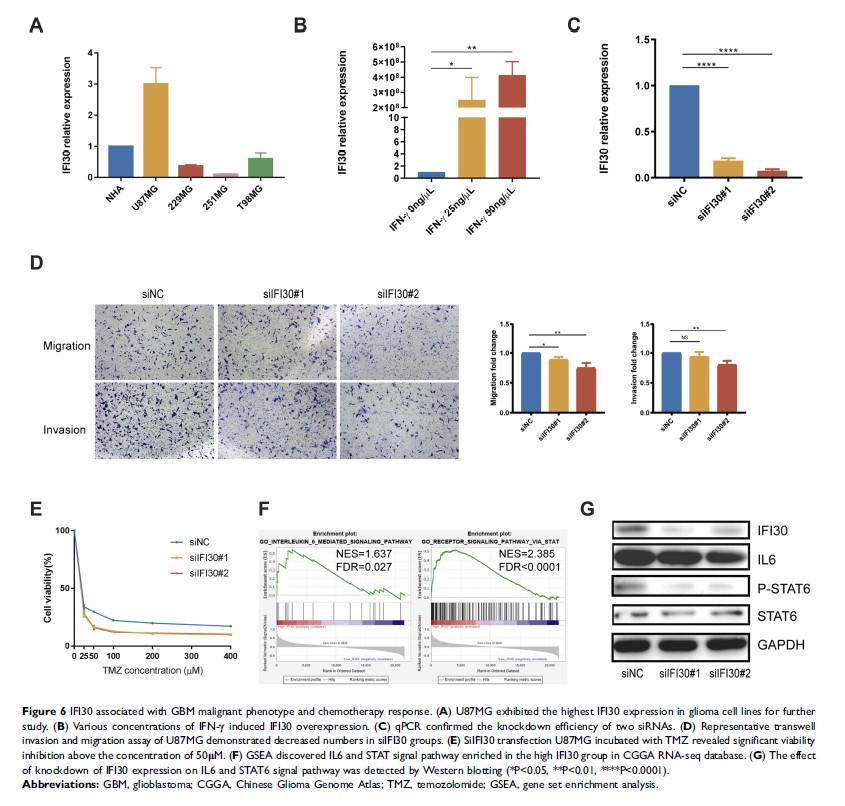
Results: We identified IFI30 as the most stable independent prognostic gene among 20 classical IFN-γ stimulated genes (ISGs) in glioma patients. Furthermore, we found that IFI30 highly expressed in malignant subtypes of glioma and associated with chemotherapy response. We also found IFI30 could activate IL6-STAT6 signal pathway to decline the glioma cells’ chemotherapy sensitivity by performing experiments. Gene ontology (GO) analysis showed IFI30 associated with enhanced leucocyte mediated immune and inflammatory response. Microenvironment analysis referred that high IFI30 expression accompanied with more infiltration of M2 type macrophages.
Conclusion: IFI30 is involved in the malignant progression and chemotherapy response of glioblastoma, which can be a potential target for treatment in glioblastoma patients.
Keywords: glioblastoma, IFI30, prognosis, microenvironment, temozolomide