114900
论文已发表
注册即可获取德孚的最新动态
IF 收录期刊
- 3.4 Breast Cancer (Dove Med Press)
- 3.2 Clin Epidemiol
- 2.6 Cancer Manag Res
- 2.9 Infect Drug Resist
- 3.7 Clin Interv Aging
- 5.1 Drug Des Dev Ther
- 3.1 Int J Chronic Obstr
- 6.6 Int J Nanomed
- 2.6 Int J Women's Health
- 2.9 Neuropsych Dis Treat
- 2.8 OncoTargets Ther
- 2.0 Patient Prefer Adher
- 2.2 Ther Clin Risk Manag
- 2.5 J Pain Res
- 3.0 Diabet Metab Synd Ob
- 3.2 Psychol Res Behav Ma
- 3.4 Nat Sci Sleep
- 1.8 Pharmgenomics Pers Med
- 2.0 Risk Manag Healthc Policy
- 4.1 J Inflamm Res
- 2.0 Int J Gen Med
- 3.4 J Hepatocell Carcinoma
- 3.0 J Asthma Allergy
- 2.2 Clin Cosmet Investig Dermatol
- 2.4 J Multidiscip Healthc

Thinking well beyond diagnosis: a four-year evaluation of a cognitive changes education for breast cancer survivors
Authors Vo JB, Gisiger-Camata S, Lewis KA, Nolan TS, Bail JR, Hendricks BA, Vance DE, Meneses K
Received 18 December 2018
Accepted for publication 14 February 2019
Published 5 July 2019 Volume 2019:9 Pages 21—29
DOI https://doi.org/10.2147/NRR.S197778
Checked for plagiarism Yes
Review by Single-blind
Peer reviewer comments 2
Editor who approved publication: Dr Cindy Hudson
Purpose: Cognitive changes affect up to 75% of breast cancer survivors during treatment and 35% after treatment. There remains a paucity of cognitive change-focused education programs for breast cancer survivors. The Think Well: Healthy Living to Improve Cognitive Function program was developed to address cognitive changes in Alabama breast cancer survivors. The purpose of this article is to report program development and expansion over four years and attendees’ program satisfaction.
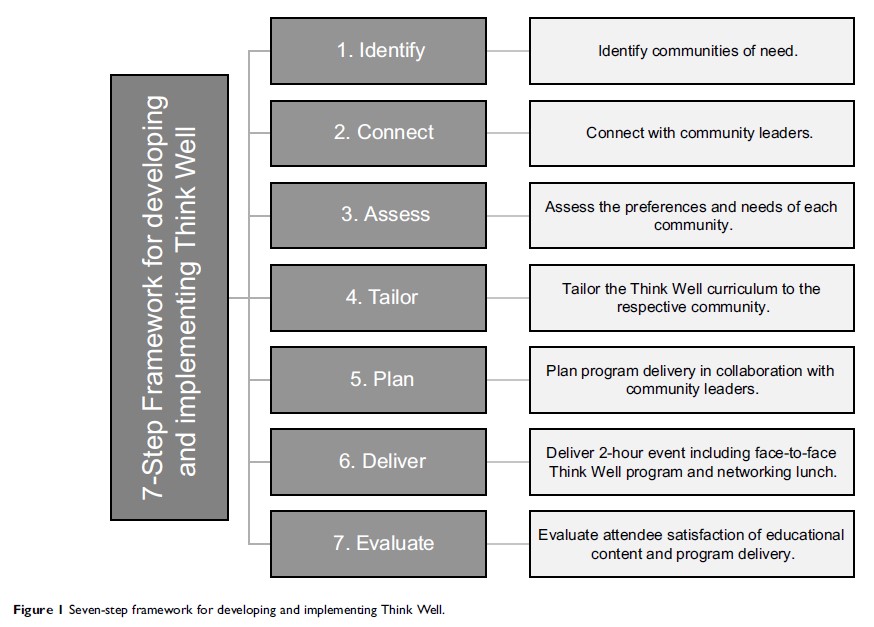
Methods: A seven-step framework (identify, connect, assess, tailor, plan, deliver, and evaluate) was used to develop and implement the Think Well program. The 2-h seminars, tailored to each respective community, consisted of face-to-face lecture-style education grounded on an evidence-based curriculum. Seminars were assessed using surveys that focused on attendees’ satisfaction and were delivered at the end of each Think Well seminar. The surveys were summarized using descriptive statistics.
Results: Over four years, 17 Think Well seminars were delivered to a total of 666 attendees, and 515 (77% response rate) completed a survey. Of which, 151 reported to be breast cancer survivors, 209 family and friends, and 155 others. Think Well received mostly “good” or “excellent” ratings on all educational program components in the evaluation. After receiving feedback from attendees, the Think Well program was also adapted to create an interactive website.
Conclusion: Think Well seminars were well-received and provided cognitive change-focused cancer education for an underserved and diverse population. Implications include disseminating Think Well to a multi-state or national platform, implementing Think Well education using social media engagement, and collaborating with health-care professionals to provide cognitive change information.
Keywords: survivorship, community-based program, breast cancer, cognitive changes, chemo-brain, cancer education