114900
论文已发表
注册即可获取德孚的最新动态
IF 收录期刊
- 3.4 Breast Cancer (Dove Med Press)
- 3.2 Clin Epidemiol
- 2.6 Cancer Manag Res
- 2.9 Infect Drug Resist
- 3.7 Clin Interv Aging
- 5.1 Drug Des Dev Ther
- 3.1 Int J Chronic Obstr
- 6.6 Int J Nanomed
- 2.6 Int J Women's Health
- 2.9 Neuropsych Dis Treat
- 2.8 OncoTargets Ther
- 2.0 Patient Prefer Adher
- 2.2 Ther Clin Risk Manag
- 2.5 J Pain Res
- 3.0 Diabet Metab Synd Ob
- 3.2 Psychol Res Behav Ma
- 3.4 Nat Sci Sleep
- 1.8 Pharmgenomics Pers Med
- 2.0 Risk Manag Healthc Policy
- 4.1 J Inflamm Res
- 2.0 Int J Gen Med
- 3.4 J Hepatocell Carcinoma
- 3.0 J Asthma Allergy
- 2.2 Clin Cosmet Investig Dermatol
- 2.4 J Multidiscip Healthc

一个基于早期术后 NLR 的新诺模图,用于预测胃切除术后的感染并发症
Authors Wang C, Huang H, He Y, Yu Y, Zhou Q, Wang R, He J, Han S
Received 14 November 2019
Accepted for publication 10 January 2020
Published 7 February 2020 Volume 2020:12 Pages 881—889
DOI https://doi.org/10.2147/CMAR.S238530
Checked for plagiarism Yes
Review by Single-blind
Peer reviewer comments 2
Editor who approved publication: Dr Antonella D'Anneo
Purpose: Our study aimed to construct a visible model to evaluate the risk of infectious complications after gastrectomy.
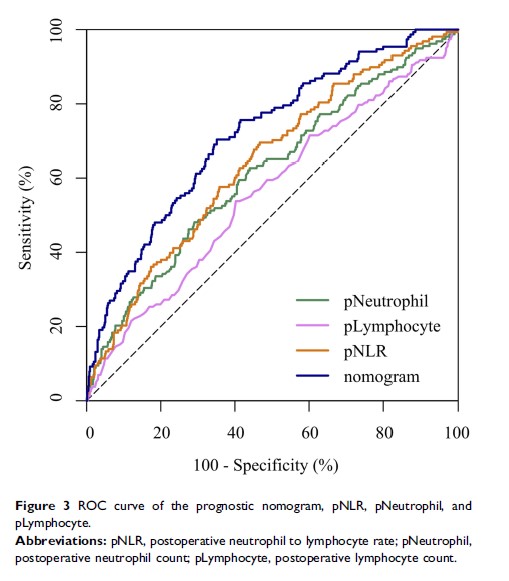
Methods: The clinical data of 856 patients who underwent gastrectomy were used to retrieve medical records. Univariate and multivariate analyses were performed to correlate early postoperative NLR and operative variables with postoperative complications, and the construction of the nomogram was based on logistic regression. The concordance index and receiver operating characteristic curves were used to evaluate the model performance.
Results: The postoperative infectious and noninfectious complication rates after gastrectomy were 18.5% (158/856 cases) and 12.3% (105/856 cases) respectively. Postoperative NLR (within 24 h) independently predicted the development of postoperative infectious complication. Multivariate analysis revealed that age, diabetes, body mass index (BMI), intraoperative blood transfusion and postoperative NLR were independent risk factors. The nomogram model showed a good performance in terms of predicting infectious complications after gastrectomy (concordance index=0.718).
Conclusion: Age, diabetes, BMI, intraoperative blood transfusion and postoperative NLR were independent risk factors of postoperative infectious complications after gastrectomy, and a novel nomogram based on these results can be used to predict postoperative infection and has the advantages of simple application and easy access.
Keywords: gastrectomy, infectious complication, nomogram, prediction, risk model