108384
论文已发表
注册即可获取德孚的最新动态
IF 收录期刊
- 3.4 Breast Cancer (Dove Med Press)
- 3.2 Clin Epidemiol
- 2.6 Cancer Manag Res
- 2.9 Infect Drug Resist
- 3.7 Clin Interv Aging
- 5.1 Drug Des Dev Ther
- 3.1 Int J Chronic Obstr
- 6.6 Int J Nanomed
- 2.6 Int J Women's Health
- 2.9 Neuropsych Dis Treat
- 2.8 OncoTargets Ther
- 2.0 Patient Prefer Adher
- 2.2 Ther Clin Risk Manag
- 2.5 J Pain Res
- 3.0 Diabet Metab Synd Ob
- 3.2 Psychol Res Behav Ma
- 3.4 Nat Sci Sleep
- 1.8 Pharmgenomics Pers Med
- 2.0 Risk Manag Healthc Policy
- 4.1 J Inflamm Res
- 2.0 Int J Gen Med
- 3.4 J Hepatocell Carcinoma
- 3.0 J Asthma Allergy
- 2.2 Clin Cosmet Investig Dermatol
- 2.4 J Multidiscip Healthc

lncRNA WT1-AS 通过海绵状 miR-330-5p 调节 p53 的表达来抑制宫颈癌细胞的侵袭性
Authors Cui LJ, Nai MM, Zhang K, Li L, Li RM
Received 6 June 2018
Accepted for publication 27 September 2018
Published 11 January 2019 Volume 2019:11 Pages 651—667
DOI https://doi.org/10.2147/CMAR.S176525
Checked for plagiarism Yes
Review by Single-blind
Peer reviewers approved by Dr Amy Norman
Peer reviewer comments 3
Editor who approved publication: Professor Nakshatri
Background: Emerging
evidences have demonstrated that lncRNAs play vital roles in various
pathological processes, including cancer. The lncRNA WT1 antisense RNA (WT1-AS)
serves as a tumor suppressor in various cancers. Nevertheless, the expression and
precise function of WT1-AS in cervical carcinoma still remain not yet
investigated. The objective of our study was to explore the expression of
WT1-AS and its biological roles in cervical cancer.
Methods: Differences
in the lncRNA expression profiles between cervical cancer and adjacent normal
tissues were assessed by lncRNA expression microarray analysis. The expression
of p53 in cervical cancer cell was assessed by qRT-PCR and immunofluorescence
assay. Loss-of-function studies were used to explore the effect of lncRNA
WT1-AS on the growth and metastasis of cervical cancer cell in vitro and in
vivo.
Results: Our
results demonstrated that WT1-AS was remarkably down-regulated in cervical
carcinoma. Functional assays proved that up-regulation of WT1-AS significantly
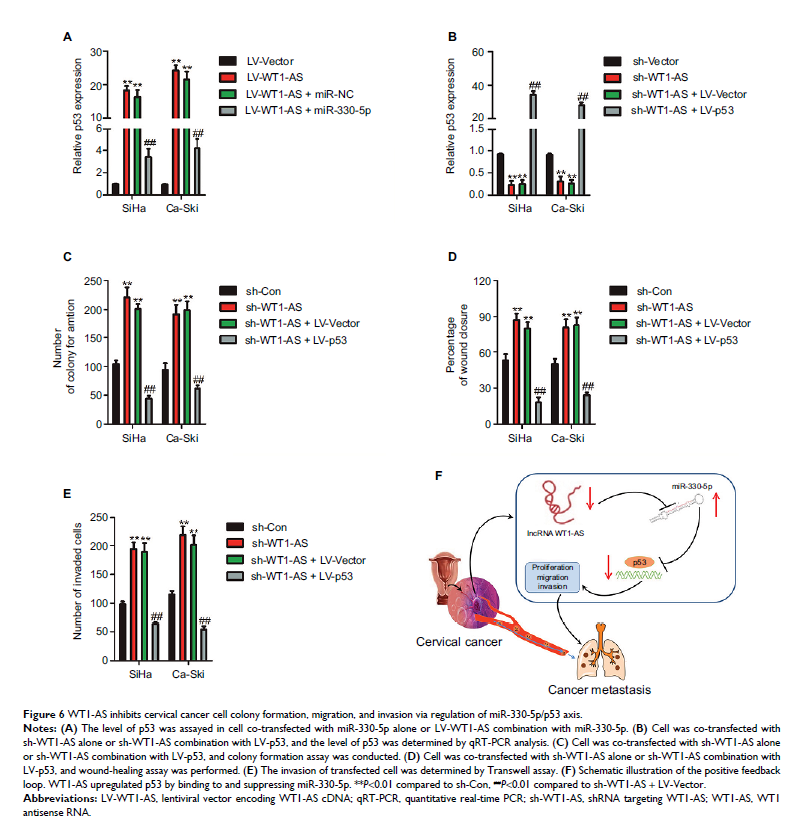
suppressed cervical cancer cell proliferation, migration and invasion. In
addition, the luciferase reporter assay identified that miR-330-5p was the
target of WT1-AS. Moreover, tumor suppressor p53 was identified as the direct
target of miR-330-5p and alternation of miR-330-5p/p53 axis reversed the
effects of WT1-AS in cervical cancer cell.
Conclusion: Altogether,
our findings suggested that WT1-AS was down-regulated in cervical carcinoma and
WT1-AS suppressed cervical carcinoma cell- proliferation, migration and
invasion through regulating the miR-330-5p/p53 axis.
Keywords: cervical
cancer, WT1-AS, miR-330-5p, p53, metastasis