108384
论文已发表
注册即可获取德孚的最新动态
IF 收录期刊
- 3.4 Breast Cancer (Dove Med Press)
- 3.2 Clin Epidemiol
- 2.6 Cancer Manag Res
- 2.9 Infect Drug Resist
- 3.7 Clin Interv Aging
- 5.1 Drug Des Dev Ther
- 3.1 Int J Chronic Obstr
- 6.6 Int J Nanomed
- 2.6 Int J Women's Health
- 2.9 Neuropsych Dis Treat
- 2.8 OncoTargets Ther
- 2.0 Patient Prefer Adher
- 2.2 Ther Clin Risk Manag
- 2.5 J Pain Res
- 3.0 Diabet Metab Synd Ob
- 3.2 Psychol Res Behav Ma
- 3.4 Nat Sci Sleep
- 1.8 Pharmgenomics Pers Med
- 2.0 Risk Manag Healthc Policy
- 4.1 J Inflamm Res
- 2.0 Int J Gen Med
- 3.4 J Hepatocell Carcinoma
- 3.0 J Asthma Allergy
- 2.2 Clin Cosmet Investig Dermatol
- 2.4 J Multidiscip Healthc

玻璃体内注射皮质类固醇植入物与玻璃体内注射雷珠单抗治疗黄斑水肿的对比: 随机对照试验的一项综合分析
Authors Wei Q, Chen R, Lou Q, Yu J
Received 19 August 2018
Accepted for publication 19 December 2018
Published 11 January 2019 Volume 2019:13 Pages 301—307
DOI https://doi.org/10.2147/DDDT.S184520
Checked for plagiarism Yes
Review by Single-blind
Peer reviewers approved by Dr Amy Norman
Peer reviewer comments 2
Editor who approved publication: Dr Qiongyu Guo
Purpose: The purpose of
this meta-analysis was to compare the efficacy and safety of corticosteroid
implant and intravitreal ranibizumab for the treatment of macular edema (ME).
Materials and methods: PubMed, Embase,
Web of Science, and the Cochrane Central Register of Controlled Trials were
comprehensively searched for studies comparing dexamethasone implant with
ranibizumab in patients with ME. Best-corrected visual acuity (BCVA), central
subfield thickness (CST), and adverse events were extracted from the final
eligible studies. RevMan 5.3 software was used to analyze the data, and the
modified Jadad assessment tool was used to access the quality of outcomes.
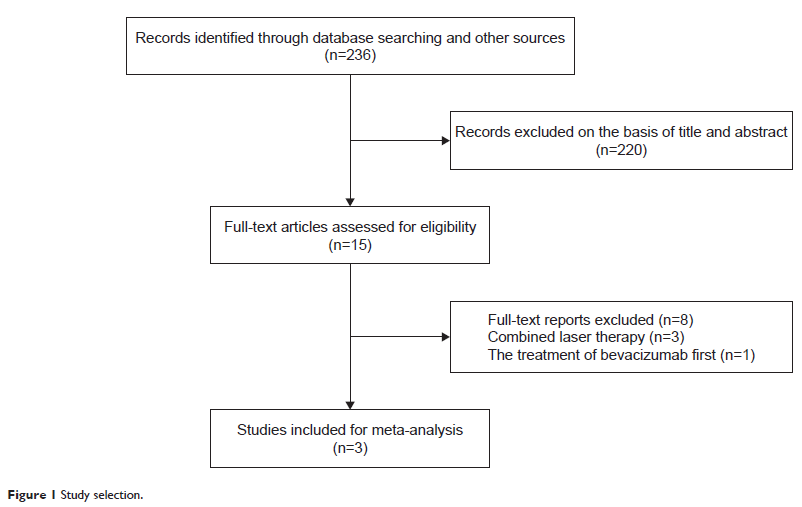
Results: Three
randomized controlled trials (RCTs) were included in our analysis. The types of
causes of ME include central retinal vein occlusion (CRVO), branch retinal vein
occlusion (BRVO), and diabetic retinopathy (DR). The ranibizumab treatment group
had significantly better BCVA compared with the corticosteroid treatment group
(standard mean difference [SMD] -0.80; 95% CI -1.08, -0.53; P <0.00001). The
ranibizumab treatment group also had higher CST reduction compared with the
corticosteroid treatment group, and there was a significant difference
(weighted mean difference [WMD] 167.58; 95% CI 125.21–209.95; P <0.00001).
There was no significant difference in serious adverse effects between the two
groups (SMD 1.67; 95% CI 0.69, 4.05; P =0.26). However, the use of corticosteroid implant
had a higher risk of intraocular pressure (IOP) (OR 6.88; 95% CI
4.53–10.44; P <0.00001) elevation and cataract (OR 3.98; 95% CI
1.89–8.37; P =0.0003)
than ranibizumab treatment and fewer injections.
Conclusions: Compared with
ranibizumab, corticosteroid implant did not have greater improved BCVA, but
corticosteroid implant had less CST reduction. The advantages of
corticosteroids are fewer injections, while the advantages of ranibizumab
include fewer side effects.
Keywords: macular edema,
dexamethasone implant, ranibizumab, meta-analysis