115195
论文已发表
注册即可获取德孚的最新动态
IF 收录期刊
- 3.6 Breast Cancer (Dove Med Press)
- 4.3 Clin Epidemiol
- 2.6 Cancer Manag Res
- 3.2 Infect Drug Resist
- 4.1 Clin Interv Aging
- 6.1 Drug Des Dev Ther
- 4.1 Int J Chronic Obstr
- 8.7 Int J Nanomed
- 2.5 Int J Women's Health
- 3.2 Neuropsych Dis Treat
- 2.4 OncoTargets Ther
- 2.6 Patient Prefer Adher
- 2.6 Ther Clin Risk Manag
- 3.1 J Pain Res
- 3.5 Diabet Metab Synd Ob
- 4.5 Psychol Res Behav Ma
- 3.4 Nat Sci Sleep
- 2.4 Pharmgenomics Pers Med
- 2.6 Risk Manag Healthc Policy
- 4.6 J Inflamm Res
- 2.3 Int J Gen Med
- 3.9 J Hepatocell Carcinoma
- 3.3 J Asthma Allergy
- 2.5 Clin Cosmet Investig Dermatol
- 3.0 J Multidiscip Healthc

2 型糖尿病患者的运动阶段预测:对计划行为扩展理论的测试
Authors Gao M, Chen X, Sun X, Wang F, Fan L, Sun X
Received 31 October 2019
Accepted for publication 1 January 2020
Published 14 February 2020 Volume 2020:14 Pages 277—285
DOI https://doi.org/10.2147/PPA.S236813
Checked for plagiarism Yes
Review by Single-blind
Peer reviewer comments 2
Editor who approved publication: Dr Naifeng Liu
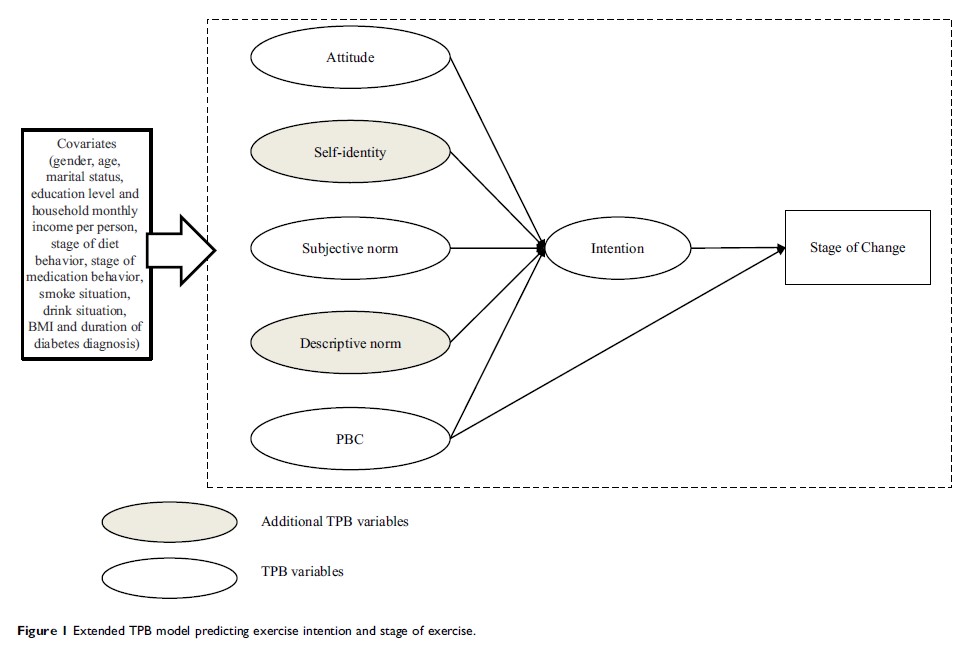
Purpose: This study aimed to predict stage of exercise among Chinese patients with type 2 diabetes by using an extended theory of planned behavior model (TPB) incorporating descriptive norm and self-identity.
Patients and Methods: Participants (N =791) were included in a cross-sectional study. Structural equation modeling was used to explain how the extended TPB could predict the stage of exercise.
Results: The model accounted for 41% of the variance in stage of exercise and 81.1% of the variance in intention. Intention (β=0.359, P < 0.01) and self-identity (β=0.236, P < 0.001) had a direct effect on stage of exercise. Self-identity (β=0.261, P < 0.001), descriptive norm (β=0.035, P < 0.05) and PBC (β=0.683, P < 0.001) were strong predicators of intention. The effects of self-identity and PBC on behavior were significantly mediated via intention. Age, BMI and stage of diet behavior were found to be significantly related to intention and behavior.
Conclusion: This study has tested the usefulness of the extended TPB for explaining exercise in Chinese diabetic patients. To promote patients to start or continue exercising, interventions should target self-identity and controllability for physical activity.
Keywords: theory of planned behavior, stage of change, exercise, descriptive norm, self-identity