115195
论文已发表
注册即可获取德孚的最新动态
IF 收录期刊
- 3.6 Breast Cancer (Dove Med Press)
- 4.3 Clin Epidemiol
- 2.6 Cancer Manag Res
- 3.2 Infect Drug Resist
- 4.1 Clin Interv Aging
- 6.1 Drug Des Dev Ther
- 4.1 Int J Chronic Obstr
- 8.7 Int J Nanomed
- 2.5 Int J Women's Health
- 3.2 Neuropsych Dis Treat
- 2.4 OncoTargets Ther
- 2.6 Patient Prefer Adher
- 2.6 Ther Clin Risk Manag
- 3.1 J Pain Res
- 3.5 Diabet Metab Synd Ob
- 4.5 Psychol Res Behav Ma
- 3.4 Nat Sci Sleep
- 2.4 Pharmgenomics Pers Med
- 2.6 Risk Manag Healthc Policy
- 4.6 J Inflamm Res
- 2.3 Int J Gen Med
- 3.9 J Hepatocell Carcinoma
- 3.3 J Asthma Allergy
- 2.5 Clin Cosmet Investig Dermatol
- 3.0 J Multidiscip Healthc

硫化氢可通过激活 PI3K/Akt/eNOS 信号通路防止高糖诱导的人脐静脉内皮细胞损伤
Authors Lin F, Yang Y, Wei S, Huang X, Peng Z, Ke X, Zeng Z, Song Y
Received 16 December 2019
Accepted for publication 5 February 2020
Published 14 February 2020 Volume 2020:14 Pages 621—633
DOI https://doi.org/10.2147/DDDT.S242521
Checked for plagiarism Yes
Review by Single-blind
Peer reviewer comments 4
Editor who approved publication: Dr Anastasios Lymperopoulos
Purpose: Dysfunction of endothelial cells plays a key role in the pathogenesis of diabetic atherosclerosis. High glucose (HG) has been found as a key factor in the progression of diabetic complications, including atherosclerosis. PI3K/Akt/eNOS signaling pathway has been shown to involve in HG-induced vascular injuries. Hydrogen sulfide (H2S) has been found to exhibit protective effects on HG-induced vascular injuries. Moreover, H2S activates PI3K/Akt/eNOS pathway in endothelial cells. Thus, the present study aimed to determine if H2S exerts protective effects against HG-induced injuries of human umbilical vein endothelial cells (HUVECs) via activating PI3K/Akt/eNOS signaling.
Materials and Methods: The endothelial protective effects of H2S were evaluated and compared to the controlled groups. Cell viability, cell migration and tube formation were determined by in vitro functional assays; protein levels were evaluated by Western blot assay and ELISA; cell apoptosis was determined by Hoechst 33258 nuclear staining; Reactive oxygen species (ROS) production was evaluated by the ROS detection kit.
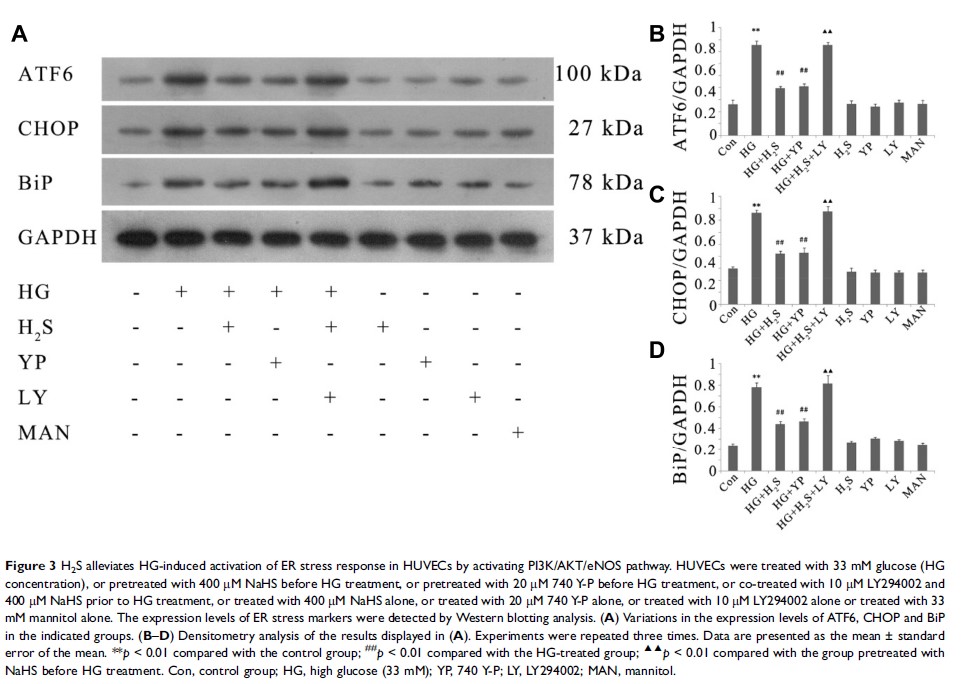
Results: HG treatment significantly inhibited PI3K/Akt/eNOS signaling in HUVECs, which was partially reversed by the H2S treatment. HG treatment inhibited cell viability of HUVECs, which were markedly prevented by H2S or PI3K agonist Y-P 740. HG treatment also induced HUVEC cell apoptosis by increasing the protein levels of cleaved caspase 3, Bax and Bcl-2, which were significantly attenuated by H2S or 740 Y-P. ROS production and gp91phox protein level were increased by HG treatment in HUVECs and this effect can be blocked by the treatment with H2S or Y-P 740. Moreover, HG treatment increased the protein levels of pro-inflammatory cytokines, caspase-1 and phosphorylated JNK, which was significantly attenuated by H2S or Y-P 740. Importantly, the cytoprotective effect of H2S against HG-induced injury was inhibited by LY294002 (an inhibitor of PI3K/Akt/eNOS signaling pathway).
Conclusion: The present study demonstrated that exogenous H2S protects endothelial cells against HG-induced injuries by activating PI3K/Akt/eNOS pathway. Based on the above findings, we proposed that reduced endogenous H2S levels and the subsequent PI3K/Akt/eNOS signaling impairment may be the important pathophysiological mechanism underlying hyperglycemia-induced vascular injuries.
Keywords: endothelial cells, hydrogen sulfide, high glucose, injury, PI3K/Akt/eNOS