115195
论文已发表
注册即可获取德孚的最新动态
IF 收录期刊
- 3.6 Breast Cancer (Dove Med Press)
- 4.3 Clin Epidemiol
- 2.6 Cancer Manag Res
- 3.2 Infect Drug Resist
- 4.1 Clin Interv Aging
- 6.1 Drug Des Dev Ther
- 4.1 Int J Chronic Obstr
- 8.7 Int J Nanomed
- 2.5 Int J Women's Health
- 3.2 Neuropsych Dis Treat
- 2.4 OncoTargets Ther
- 2.6 Patient Prefer Adher
- 2.6 Ther Clin Risk Manag
- 3.1 J Pain Res
- 3.5 Diabet Metab Synd Ob
- 4.5 Psychol Res Behav Ma
- 3.4 Nat Sci Sleep
- 2.4 Pharmgenomics Pers Med
- 2.6 Risk Manag Healthc Policy
- 4.6 J Inflamm Res
- 2.3 Int J Gen Med
- 3.9 J Hepatocell Carcinoma
- 3.3 J Asthma Allergy
- 2.5 Clin Cosmet Investig Dermatol
- 3.0 J Multidiscip Healthc

中国住院心血管患者对自我管理的态度:一项定性研究
Authors Qiu R, Schick-Makaroff K, Tang L, Wang X, Zhang Q, Ye Z
Received 30 October 2019
Accepted for publication 1 February 2020
Published 17 February 2020 Volume 2020:14 Pages 287—300
DOI https://doi.org/10.2147/PPA.S236348
Checked for plagiarism Yes
Review by Single-blind
Peer reviewer comments 2
Editor who approved publication: Dr Naifeng Liu
Purpose: This study is aiming to investigate cardiovascular patients’ attitudes towards self-management during hospitalization in China.
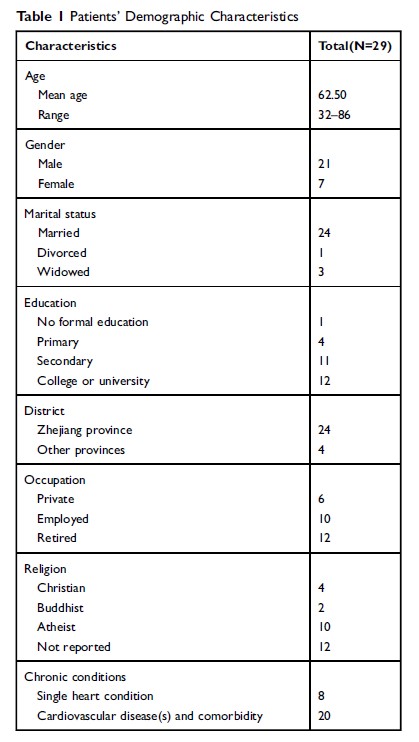
Patients and Methods: Twenty-nine individuals living with cardiovascular disease from one designated Cardiology Department in Hangzhou, China, were recruited through a purposive sampling procedure. A qualitative descriptive methodology was used. Semi-structured interviews were also used to gain attitudes toward self-management. The interviews were audio-recorded, transcribed and analyzed by thematic analysis to develop the results.
Results: Four themes were identified from the qualitative data: (1): Responsibilities of self-management; (2): Reflections on self-management; (3): Acknowledgement of self-management support; (4): Challenges in implementing and adherence to self-management. Additionally, interview data were also given to illustrate these main themes emerging during the analysis. Patients gradually took their responsibilities to manage chronic symptoms. During their self-management process, they did reflections to help correct their regiments through supportive interactions. Health system responsiveness, health disparities, social capital, and cultural setting were the main external factors influencing better self-management implementation and adherence.
Conclusion: This study revealed the hospitalized cardiovascular patients’ attitudes towards self-management in China. These findings emphasized the importance of patients’ responsibility, reflections, and various social support receiving and pointed out specific external factors influencing the health outcomes and their quality of life. This study also proves the guide for the policymakers and health system better instructions to develop individually and culturally tailored advanced self-management interventions and programs.
Keywords: attitude, hospitalization, cardiovascular disease, self-management, qualitative research