115195
论文已发表
注册即可获取德孚的最新动态
IF 收录期刊
- 3.6 Breast Cancer (Dove Med Press)
- 4.3 Clin Epidemiol
- 2.6 Cancer Manag Res
- 3.2 Infect Drug Resist
- 4.1 Clin Interv Aging
- 6.1 Drug Des Dev Ther
- 4.1 Int J Chronic Obstr
- 8.7 Int J Nanomed
- 2.5 Int J Women's Health
- 3.2 Neuropsych Dis Treat
- 2.4 OncoTargets Ther
- 2.6 Patient Prefer Adher
- 2.6 Ther Clin Risk Manag
- 3.1 J Pain Res
- 3.5 Diabet Metab Synd Ob
- 4.5 Psychol Res Behav Ma
- 3.4 Nat Sci Sleep
- 2.4 Pharmgenomics Pers Med
- 2.6 Risk Manag Healthc Policy
- 4.6 J Inflamm Res
- 2.3 Int J Gen Med
- 3.9 J Hepatocell Carcinoma
- 3.3 J Asthma Allergy
- 2.5 Clin Cosmet Investig Dermatol
- 3.0 J Multidiscip Healthc

利用 CRISPR/Cas9 技术敲除胃癌 BGC823 细胞的 SST 基因可增强 SEMA5A 和 KLF2 的迁移、侵袭和表达
Authors Chen W, Ding R, Tang J, Li H, Chen C, Zhang Y, Zhang Q, Zhu X
Received 28 October 2019
Accepted for publication 22 January 2020
Published 20 February 2020 Volume 2020:12 Pages 1313—1321
DOI https://doi.org/10.2147/CMAR.S236374
Checked for plagiarism Yes
Review by Single-blind
Peer reviewer comments 2
Editor who approved publication: Dr Eileen O'Reilly
Background: The impact and potential molecular mechanisms of SST in the occurrence and development of GC have not been determined.
Materials and Methods: Two pairs of sgRNA and reporter were designed according to targeting sequence of SST gene for double-nicking. Plasmids were transfected into 293T for selecting sgRNA with higher cutting efficiency. The subline which has knocked-out SST gene were selected by FACS and verified by sequencing and expression level. Moreover, the migration and invasion ability was evaluated by wound healing and transwell after knocking out SST. Besides, the protein expression of SEMA5A and KLF2 were observed by Western blotting and LSCM. Last, we detected the expression levels of SST, SEMA5A, and KLF2 in GC tissues by Western blotting.
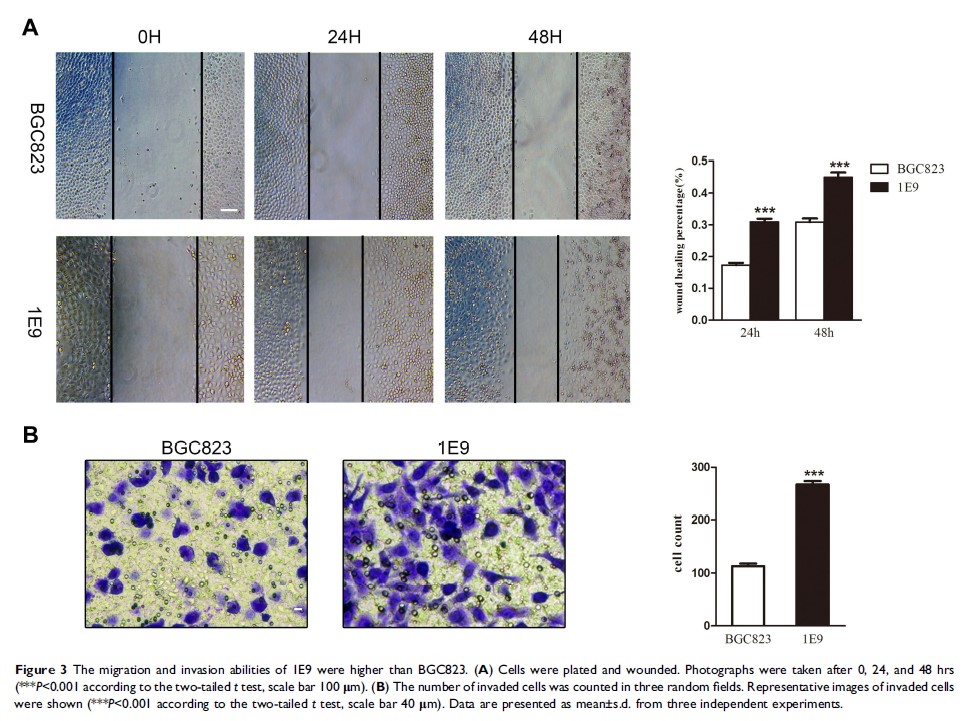
Results: The results revealed that the new subline 1E9, which had knocked out SST gene, was established by CRISPR/Cas9. In addition, the knockout of SST in GC cells markedly increased migration and invasion ability. The results also demonstrated that the knockout of SST increased the expression of SEMA5A and KLF2. The expression level of SST was decreased in GC tissues, and its decrease was associated with overexpression of SEMA5A and KLF2.
Conclusion: SST plays an inhibitory role in the migration and invasion of GC cell BGC823. The protein expression levels of SEMA5A and KLF2 were enhanced in GC cells and tissues lacking SST expression.
Keywords: somatostatin, CRISPR/Cas9, gastric cancer, migration, invasion