115195
论文已发表
注册即可获取德孚的最新动态
IF 收录期刊
- 3.6 Breast Cancer (Dove Med Press)
- 4.3 Clin Epidemiol
- 2.6 Cancer Manag Res
- 3.2 Infect Drug Resist
- 4.1 Clin Interv Aging
- 6.1 Drug Des Dev Ther
- 4.1 Int J Chronic Obstr
- 8.7 Int J Nanomed
- 2.5 Int J Women's Health
- 3.2 Neuropsych Dis Treat
- 2.4 OncoTargets Ther
- 2.6 Patient Prefer Adher
- 2.6 Ther Clin Risk Manag
- 3.1 J Pain Res
- 3.5 Diabet Metab Synd Ob
- 4.5 Psychol Res Behav Ma
- 3.4 Nat Sci Sleep
- 2.4 Pharmgenomics Pers Med
- 2.6 Risk Manag Healthc Policy
- 4.6 J Inflamm Res
- 2.3 Int J Gen Med
- 3.9 J Hepatocell Carcinoma
- 3.3 J Asthma Allergy
- 2.5 Clin Cosmet Investig Dermatol
- 3.0 J Multidiscip Healthc

食管癌根治性切除术后阴性淋巴结的意义:一项回顾性队列研究
Authors Mo J, Chen D, Li C, Chen M
Received 29 September 2019
Accepted for publication 16 January 2020
Published 20 February 2020 Volume 2020:12 Pages 1269—1279
DOI https://doi.org/10.2147/CMAR.S232856
Checked for plagiarism Yes
Review by Single-blind
Peer reviewer comments 2
Editor who approved publication: Dr Yong Teng
Objective: The impact of negative lymph nodes (NLNs) count on prognosis in esophageal cancer (EC) was analyzed using two institutions surgical database.
Methods: We conducted a retrospective study of 768 EC patients treated by surgical resection between January 2010 and December 2012. The effects of the NLNs count on prognosis was analyzed. Cox regression model was conducted to determine the significant prognostic elements.
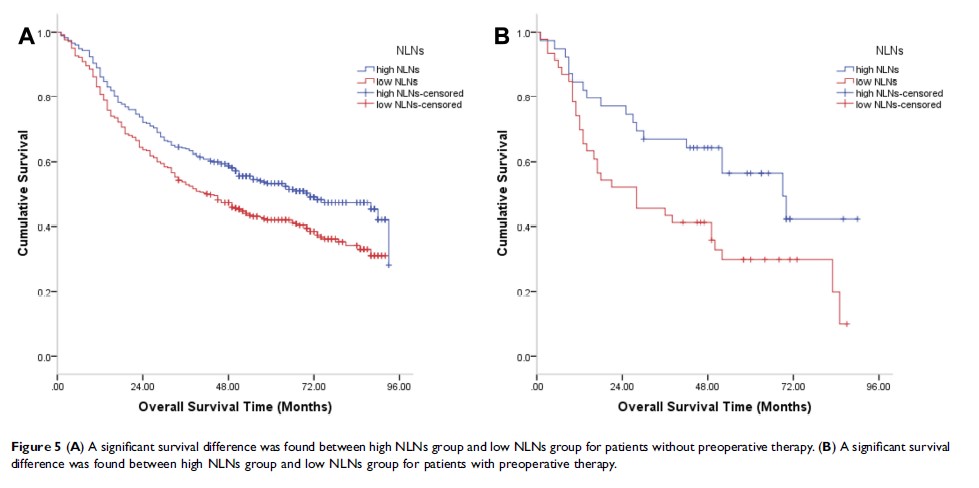
Results: The number of NLNs was studied as a categorical variable based on the quartiles (Q1: ≤ 15, Q2: 16– 21, Q3: 22– 30, Q4: ≥ 31). And a better overall survival (OS) was observed with increasing number of NLNs (HR= 0.762; 95% CI, 0.596– 0.974 for Q2, HR= 0.666; 95% CI, 0.516– 0.860 for Q3 and HR= 0.588; 95% CI, 0.450– 0.768 for Q4) (all P < 0.05). Multivariate regression analysis revealed that the NLNs count was an independent prognostic factor. Besides, for patients in T2 or T3 stage, a high number of NLNs was found to be significantly associated with a favorable OS (log rank P < 0.001).
Conclusion: A higher number of NLNs is independently related to the better OS in EC patients after surgical resection.
Keywords: esophageal cancer, negative lymph node, prognostic factor