115195
论文已发表
注册即可获取德孚的最新动态
IF 收录期刊
- 3.6 Breast Cancer (Dove Med Press)
- 4.3 Clin Epidemiol
- 2.6 Cancer Manag Res
- 3.2 Infect Drug Resist
- 4.1 Clin Interv Aging
- 6.1 Drug Des Dev Ther
- 4.1 Int J Chronic Obstr
- 8.7 Int J Nanomed
- 2.5 Int J Women's Health
- 3.2 Neuropsych Dis Treat
- 2.4 OncoTargets Ther
- 2.6 Patient Prefer Adher
- 2.6 Ther Clin Risk Manag
- 3.1 J Pain Res
- 3.5 Diabet Metab Synd Ob
- 4.5 Psychol Res Behav Ma
- 3.4 Nat Sci Sleep
- 2.4 Pharmgenomics Pers Med
- 2.6 Risk Manag Healthc Policy
- 4.6 J Inflamm Res
- 2.3 Int J Gen Med
- 3.9 J Hepatocell Carcinoma
- 3.3 J Asthma Allergy
- 2.5 Clin Cosmet Investig Dermatol
- 3.0 J Multidiscip Healthc

妊娠合并卵巢恶性生殖细胞肿瘤的临床病理特征和治疗结果
Authors Zong X, Yang JX, Zhang Y, Cao DY, Shen K
Received 2 December 2019
Accepted for publication 13 February 2020
Published 24 February 2020 Volume 2020:12 Pages 1347—1354
DOI https://doi.org/10.2147/CMAR.S240793
Checked for plagiarism Yes
Review by Single-blind
Peer reviewer comments 2
Editor who approved publication: Professor Rudolph Navari
Purpose: This study aimed to analyze the clinicopathological features, treatment, and feto-maternal outcomes of pregnancy complicated by malignant ovarian germ cell tumors (MOGCTs), to increase the awareness on this condition.
Patients and Methods: We retrospectively reviewed the medical records of patients diagnosed with MOGCTs during pregnancy, who were treated and followed-up at Peking Union Medical College Hospital from January 2000 to December 2017. The demographic characteristics, pathological features, treatment and prognosis were analyzed.
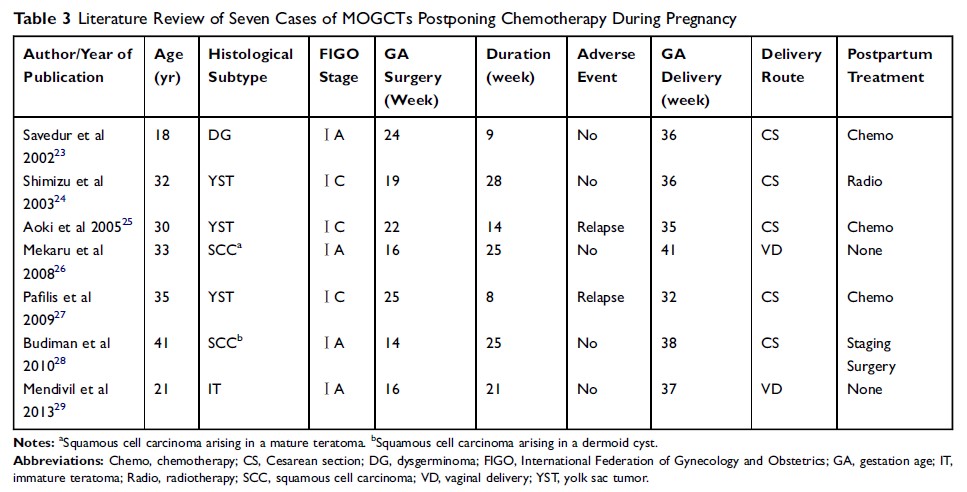
Results: The histological subtypes varied in 14 patients (dysgerminoma, n=1; immature teratoma, n=4; yolk sac tumor, n=6; and mixed germ cell tumors, n=3). Ten (71.4%) patients, including three who opted for conservative therapy until childbirth, one who only received salvage chemotherapy during pregnancy, and six who underwent cystectomy or unilateral salpingo-oophorectomy during pregnancy, desired fetal preservation. After undergoing surgery, four patients chose surveillance instead of timely adjuvant chemotherapy. Eight patients delivered their babies, and the preterm delivery rate was 50.0%. One newborn died of premature birth. The median follow-up period was 44 (range: 13 to 86) months. During the current study period, 12 patients had survived and did not report any diseases. However, two died due to disease progression.
Conclusion: Pregnant women with MOGCTs had favorable outcomes. However, when a malignant tumor is suspected, surgery cannot be avoided. Thus, instead of timely postoperative adjuvant chemotherapy, close surveillance may be an acceptable alternative for pregnant women with low-risk MOGCTs.
Keywords: pregnancy, germ cell tumor, expectant management, retrospective studies