115195
论文已发表
注册即可获取德孚的最新动态
IF 收录期刊
- 3.6 Breast Cancer (Dove Med Press)
- 4.3 Clin Epidemiol
- 2.6 Cancer Manag Res
- 3.2 Infect Drug Resist
- 4.1 Clin Interv Aging
- 6.1 Drug Des Dev Ther
- 4.1 Int J Chronic Obstr
- 8.7 Int J Nanomed
- 2.5 Int J Women's Health
- 3.2 Neuropsych Dis Treat
- 2.4 OncoTargets Ther
- 2.6 Patient Prefer Adher
- 2.6 Ther Clin Risk Manag
- 3.1 J Pain Res
- 3.5 Diabet Metab Synd Ob
- 4.5 Psychol Res Behav Ma
- 3.4 Nat Sci Sleep
- 2.4 Pharmgenomics Pers Med
- 2.6 Risk Manag Healthc Policy
- 4.6 J Inflamm Res
- 2.3 Int J Gen Med
- 3.9 J Hepatocell Carcinoma
- 3.3 J Asthma Allergy
- 2.5 Clin Cosmet Investig Dermatol
- 3.0 J Multidiscip Healthc

大学新生的夜间进食综合征和抑郁症状:青少年健身改善策略(FITYou)项目
Authors Guo F, Tian Y, Cui Y, Huang C
Received 9 October 2019
Accepted for publication 5 February 2020
Published 24 February 2020 Volume 2020:13 Pages 185—191
DOI https://doi.org/10.2147/PRBM.S234025
Checked for plagiarism Yes
Review by Single-blind
Peer reviewer comments 2
Editor who approved publication: Professor Igor Elman
Background: Emerging evidence has shown that night-eating syndrome is correlated to depressive symptoms. However, these studies were mainly small-scale investigations.
Purpose: This study aimed to examine the association of night-eating syndrome with depressive symptoms among college students using a large-scale sample.
Methods: A cross-sectional study, which was a part of the Fitness Improvement Tactics in Youth Project, was conducted in 2017. The current study included 3278 college freshmen from Shenyang, China. They completed self-administered questionnaires and provided their sociodemographic and lifestyle information. Night-eating syndrome was assessed using the night-eating questionnaire (NEQ). Depressive symptoms were measured using the Self-rating Depression Scale (SDS).
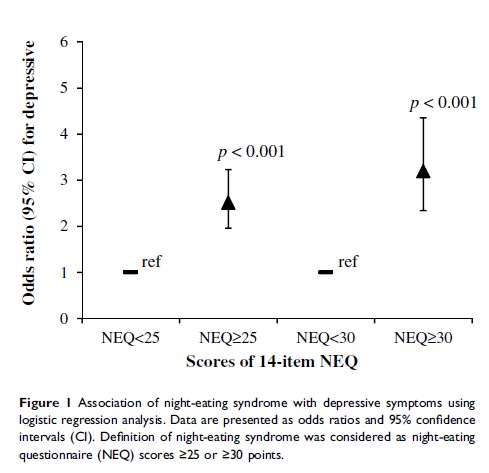
Results: Of participants, 5.4% had night-eating syndrome (NEQ score ≥ 30), and 21.3% had depressive symptoms (SDS score ≥ 53). Prevalence of night-eating syndrome was higher in male than female students (p = 0.006). Logistic regression analysis indicated that students with night-eating syndrome had a higher prevalence of depressive symptoms than those without the syndrome after adjusting covariates (odds ratios [95% CI]: 3.28 [2.40, 4.48], p < 0.001). Consistent results were found when night-eating syndrome was defined as NEQ score ≥ 25. In addition, analysis of covariance showed a significant association between NEQ quartiles and SDS score (mean [95% CI]: Q1, 44.4 [43.8, 45.0]; Q2, 43.4 [42.7, 44.0]; Q3, 44.4 [43.7, 45.1]; Q4, 47.5 [46.9, 48.2], p < 0.001 for linear and quadratic trend).
Conclusion: This study showed an association between night-eating syndrome and depressive symptoms among Chinese college freshmen.
Keywords: night eating, eating behaviors, depressive symptoms, college students, youth