115195
论文已发表
注册即可获取德孚的最新动态
IF 收录期刊
- 3.6 Breast Cancer (Dove Med Press)
- 4.3 Clin Epidemiol
- 2.6 Cancer Manag Res
- 3.2 Infect Drug Resist
- 4.1 Clin Interv Aging
- 6.1 Drug Des Dev Ther
- 4.1 Int J Chronic Obstr
- 8.7 Int J Nanomed
- 2.5 Int J Women's Health
- 3.2 Neuropsych Dis Treat
- 2.4 OncoTargets Ther
- 2.6 Patient Prefer Adher
- 2.6 Ther Clin Risk Manag
- 3.1 J Pain Res
- 3.5 Diabet Metab Synd Ob
- 4.5 Psychol Res Behav Ma
- 3.4 Nat Sci Sleep
- 2.4 Pharmgenomics Pers Med
- 2.6 Risk Manag Healthc Policy
- 4.6 J Inflamm Res
- 2.3 Int J Gen Med
- 3.9 J Hepatocell Carcinoma
- 3.3 J Asthma Allergy
- 2.5 Clin Cosmet Investig Dermatol
- 3.0 J Multidiscip Healthc

基于行为经济学的患者遵循医生建议的简要度量框架
Authors Lin S, Ma Y, Zou H
Received 19 August 2019
Accepted for publication 19 January 2020
Published 25 February 2020 Volume 2020:14 Pages 371—381
DOI https://doi.org/10.2147/PPA.S227829
Checked for plagiarism Yes
Review by Single-blind
Peer reviewer comments 2
Editor who approved publication: Dr Naifeng Liu
Purpose: This study tried to establish a metric framework of patient adherence to doctor’s advice based on the expected utility and prospect theories, and it explained why the key to patient adherence to doctor’s advice is patients’ perceptions.
Methods: Our framework is primarily based on two mature theories: expected utility theory and prospect theory. We started with a basic assumption: the doctor is rational and cares for patient’s health utility. We analyzed the expected utility of therapy with a definite diagnosis. Then, we considered the impacts of the accuracy of diagnostic techniques. After that, we explored the patient’s response to the doctors’ advices based on behavioral economics. In addition, we launched a discrete choice experiment to test our main point: perception is the key to patients’ adherence. A total of 200 undergraduate students participated in the discrete choice experiment.
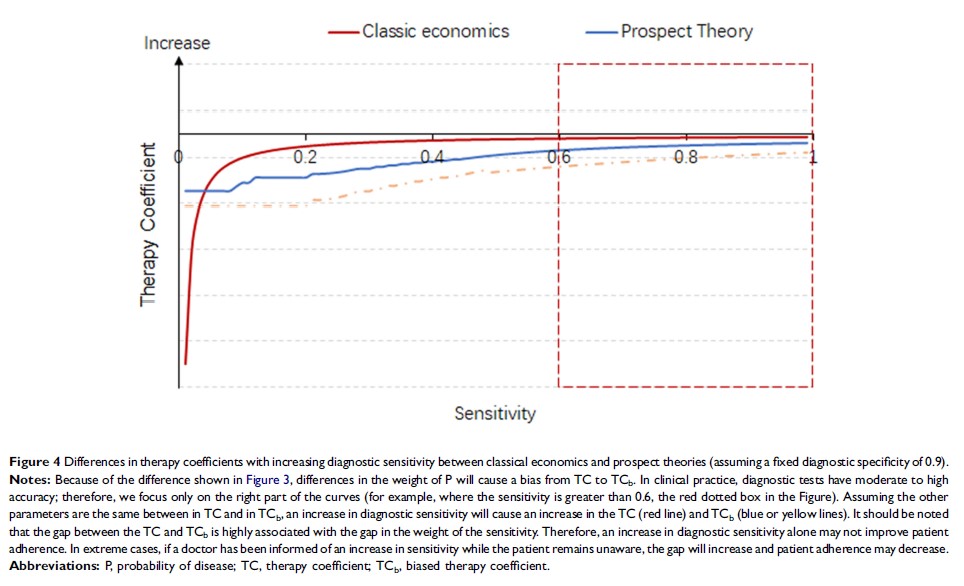
Results: Three main factors might impact a rational clinical decision: the therapeutic and side effects of the treatment, patient’s true disease risk, and diagnostic accuracy. However, another factor, patient’s individual percepion, was crucial for patient’s adherence since it may bias the patient’s estimations regarding the above three factors. As a result, doctors and patients would have a cognitive gap in the estimation of the disease and the treatment.
Conclusion: The results indicate that without the necessary information, better clinical techniques may not help to improve patient adherence, which support our theoretical reasoning forcefully. Therefore, improving patient adherence should be more of a process of empathy and communication rather than a promotion of medical technology.
Keywords: patient adherence, behavioral economics, discrete choice experiment