115195
论文已发表
注册即可获取德孚的最新动态
IF 收录期刊
- 3.6 Breast Cancer (Dove Med Press)
- 4.3 Clin Epidemiol
- 2.6 Cancer Manag Res
- 3.2 Infect Drug Resist
- 4.1 Clin Interv Aging
- 6.1 Drug Des Dev Ther
- 4.1 Int J Chronic Obstr
- 8.7 Int J Nanomed
- 2.5 Int J Women's Health
- 3.2 Neuropsych Dis Treat
- 2.4 OncoTargets Ther
- 2.6 Patient Prefer Adher
- 2.6 Ther Clin Risk Manag
- 3.1 J Pain Res
- 3.5 Diabet Metab Synd Ob
- 4.5 Psychol Res Behav Ma
- 3.4 Nat Sci Sleep
- 2.4 Pharmgenomics Pers Med
- 2.6 Risk Manag Healthc Policy
- 4.6 J Inflamm Res
- 2.3 Int J Gen Med
- 3.9 J Hepatocell Carcinoma
- 3.3 J Asthma Allergy
- 2.5 Clin Cosmet Investig Dermatol
- 3.0 J Multidiscip Healthc

超声引导下星状神经节阻滞治疗中风后疼痛:病例报告和回顾
Authors Liu Q, Zhong Q, Tang G, Ye L
Received 2 November 2019
Accepted for publication 20 February 2020
Published 26 February 2020 Volume 2020:13 Pages 461—464
DOI https://doi.org/10.2147/JPR.S236812
Checked for plagiarism Yes
Review by Single-blind
Peer reviewer comments 2
Editor who approved publication: Dr Michael A Überall
Background: Central post-stroke pain (CPSP) is refractory to pharmacotherapy (eg, NSAIDs, opioids, antidepressants, and anticonvulsants), and may require transcranial or deep brain stimulation.
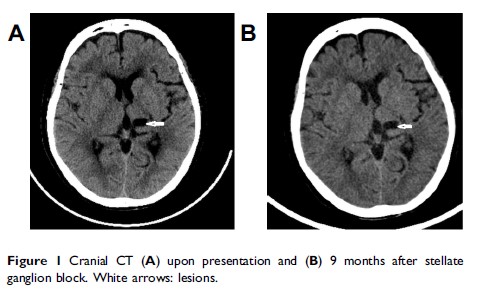
Case Presentation: A 67-year-old woman presented with severe paroxysmal cramp-like pain on the right side, including the head and both upper and lower extremities. The pain started 5 years earlier, was initially mild and occasional, but gradually intensified to an unbearable degree with an average of 10– 15 daily episodes, each lasting for 5– 10 mins. The patient disclosed “hemorrhagic stroke” 10 years ago that resulted in hemiplegia on the right side. CT examination verified the lesion. The patient received daily injection of 2-mL 2% lidocaine under ultrasound guidance to block the stellate ganglion. Pain subsided rapidly in both intensity and frequency. On the seventh day, the patient no longer had pain episodes. At the last follow-up, 9 months later, the patient was free from pain.
Conclusion: Ultrasound-guided stellate ganglion block is a viable alternative for CPSP that is refractory to pharmacotherapy.
Keywords: central post-stroke pain, cramp-like pain, ultrasound, stroke, stellate ganglion block