115195
论文已发表
注册即可获取德孚的最新动态
IF 收录期刊
- 3.6 Breast Cancer (Dove Med Press)
- 4.3 Clin Epidemiol
- 2.6 Cancer Manag Res
- 3.2 Infect Drug Resist
- 4.1 Clin Interv Aging
- 6.1 Drug Des Dev Ther
- 4.1 Int J Chronic Obstr
- 8.7 Int J Nanomed
- 2.5 Int J Women's Health
- 3.2 Neuropsych Dis Treat
- 2.4 OncoTargets Ther
- 2.6 Patient Prefer Adher
- 2.6 Ther Clin Risk Manag
- 3.1 J Pain Res
- 3.5 Diabet Metab Synd Ob
- 4.5 Psychol Res Behav Ma
- 3.4 Nat Sci Sleep
- 2.4 Pharmgenomics Pers Med
- 2.6 Risk Manag Healthc Policy
- 4.6 J Inflamm Res
- 2.3 Int J Gen Med
- 3.9 J Hepatocell Carcinoma
- 3.3 J Asthma Allergy
- 2.5 Clin Cosmet Investig Dermatol
- 3.0 J Multidiscip Healthc

具有 PD-L1 阳性和微卫星不稳定性的不可手术切除的局部晚期胃癌,单剂量抗 PD-1 联合化疗作为一线治疗后的病理学完全缓解
Authors Jin H, Li P, Mao C, Zhu K, Chen H, Gao Y, Yu J
Received 21 December 2019
Accepted for publication 16 January 2020
Published 26 February 2020 Volume 2020:13 Pages 1751—1756
DOI https://doi.org/10.2147/OTT.S243298
Checked for plagiarism Yes
Review by Single-blind
Peer reviewer comments 2
Editor who approved publication: Dr Federico Perche
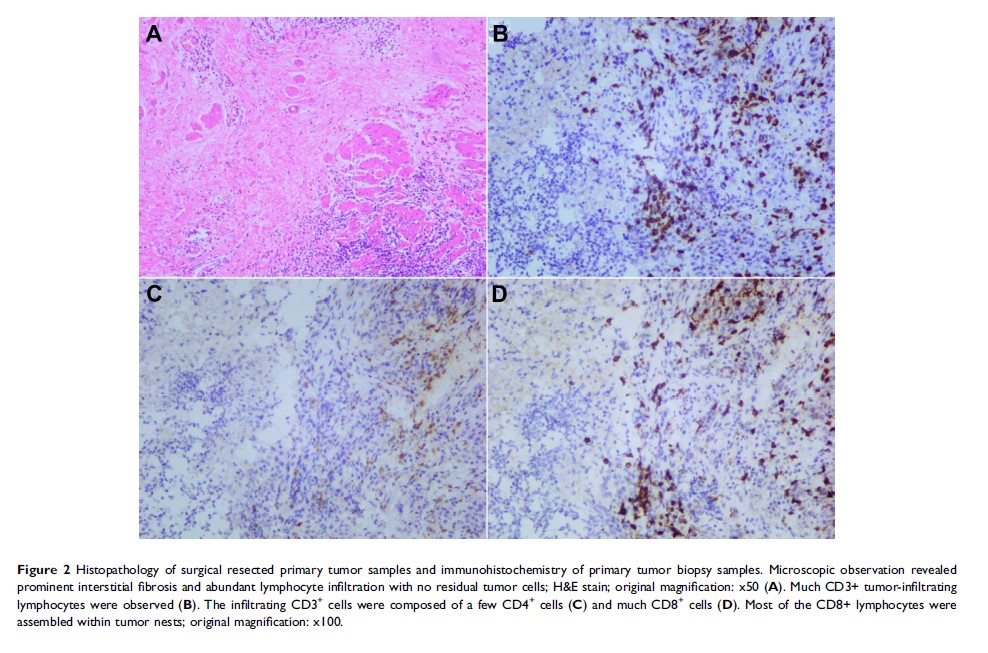
Abstract: Programmed cell death-1 (PD-1) immune checkpoint inhibitors have exhibited promising efficacy in various types of tumors. Here, we report an unresectable locally advanced gastric cancer (GC) with programmed cell death ligand-1 (PD-L1) positive and microsatellite instability (MSI), which exhibiting an unexpected efficacy of pathological complete response (pCR) after a single dose of anti-PD-1 therapy in combination with chemotherapy as a first-line setting. A 66-year-old man diagnosed with gastric cancer and was clinically staged as cT4aN+M0. After one cycle treatment (oxaliplatin plus capecitabine plus anti-PD-1antibody), repeated computed tomography (CT) showed tumor shrinkage and the plasma carcinoembryonic antigen decreased dramatically. Curative distal gastrectomy with D2+ lymphadenectomy was performed and the pathological staging was pT0N0M0. Immunohistochemistry and polymerase chain reaction-based method revealed that the patient had a PD-L1 positive and MSI-high GC, while the Epstein-Barr virus was absent. Furthermore, much CD8+ tumor-infiltrating lymphocytes (TILs) were observed within the tumor and invasion front, which were responsible for tumor shrinkage, due to the recognition of abundant tumor neoantigens and their corresponding immune checkpoints. Our case report indicates that a combination of immunotherapy plus chemotherapy as a first-line treatment might offer a promising treatment option for locally advanced gastric adenocarcinoma with PD-L1 positive and MSI-high.
Keywords: gastric cancer, immune checkpoint inhibitor, programmed cell death-1, microsatellite instability, chemotherapy