115195
论文已发表
注册即可获取德孚的最新动态
IF 收录期刊
- 3.6 Breast Cancer (Dove Med Press)
- 4.3 Clin Epidemiol
- 2.6 Cancer Manag Res
- 3.2 Infect Drug Resist
- 4.1 Clin Interv Aging
- 6.1 Drug Des Dev Ther
- 4.1 Int J Chronic Obstr
- 8.7 Int J Nanomed
- 2.5 Int J Women's Health
- 3.2 Neuropsych Dis Treat
- 2.4 OncoTargets Ther
- 2.6 Patient Prefer Adher
- 2.6 Ther Clin Risk Manag
- 3.1 J Pain Res
- 3.5 Diabet Metab Synd Ob
- 4.5 Psychol Res Behav Ma
- 3.4 Nat Sci Sleep
- 2.4 Pharmgenomics Pers Med
- 2.6 Risk Manag Healthc Policy
- 4.6 J Inflamm Res
- 2.3 Int J Gen Med
- 3.9 J Hepatocell Carcinoma
- 3.3 J Asthma Allergy
- 2.5 Clin Cosmet Investig Dermatol
- 3.0 J Multidiscip Healthc

MAGE-A11 表达可预测头颈部鳞状细胞癌的患者预后
Authors Jia S, Zhang M, Li Y, Zhang L, Dai W
Received 8 November 2019
Accepted for publication 11 February 2020
Published 26 February 2020 Volume 2020:12 Pages 1427—1435
DOI https://doi.org/10.2147/CMAR.S237867
Checked for plagiarism Yes
Review by Single-blind
Peer reviewer comments 3
Editor who approved publication: Dr Eileen O'Reilly
Background: Head and neck squamous cell carcinomas (HNSCCs) are the sixth most common cancer worldwide. Growing evidence showed that Melanoma-associated antigen-A11 (MAGE-A11) was abnormally expressed in various malignancies, but MAGE-A11 expression and its biological roles in HNSCC had not been reported in detail. The aim of the study was to investigate the association between MAGE-A11 signatures and clinicopathological features of HNSCC patients and uncover its potential mechanisms in HNSCC patients.
Methods: In the present study, we analyzed the expression of MAGE-A11 gene and evaluated the impact of MAGE-A11 genes expression on clinical outcome from the Cancer Genome Atlas (TCGA) database. MAGE-A11 expression was assessed in a well-characterized series of HNSCC (N = 75) with long-term follow-up and 10 cases of adjacent non-cancerous tissues, which were diagnosed between 2013 and 2014, by using immunohistochemistry. The correlation between MAGE-A11 expression and clinicopathological factors was analyzed. Kaplan–Meier and Cox regression analyses were used to assess the prognostic significance of MAGE-A11 expression among HNSCC patients.
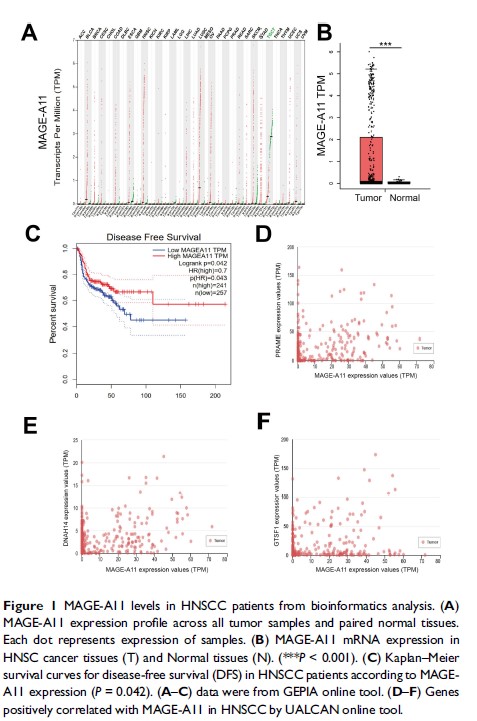
Results: The results showed that MAGE-A11 mRNA expression was increased in HNSCC tissues compared to “normal” tissues (P < 10− 12). MAGE-A11 protein expression was not correlated with lymph node status, relapse, age, gender, histological grade, differentiation, clinical stage, tumor size, radiotherapy or chemotherapy. The patients with high MAGE-A11 expression had lower 5-year overall survival (OS) rates than those with low MAGE-A11 expression as determined using the Kaplan–Meier method. The univariate and multivariate analyses confirmed that elevated MAGE-A11 was an independent prognostic factor for the OS of HNSCC patients.
Conclusion: These findings indicate that MAGE-A11 may be a valuable diagnostic or prognostic marker as well as a potential molecular therapy target for HNSCC patients.
Keywords: Melanoma-associated antigen-A11, immunohistochemistry, head and neck squamous cell carcinoma, prognosis