115195
论文已发表
注册即可获取德孚的最新动态
IF 收录期刊
- 3.6 Breast Cancer (Dove Med Press)
- 4.3 Clin Epidemiol
- 2.6 Cancer Manag Res
- 3.2 Infect Drug Resist
- 4.1 Clin Interv Aging
- 6.1 Drug Des Dev Ther
- 4.1 Int J Chronic Obstr
- 8.7 Int J Nanomed
- 2.5 Int J Women's Health
- 3.2 Neuropsych Dis Treat
- 2.4 OncoTargets Ther
- 2.6 Patient Prefer Adher
- 2.6 Ther Clin Risk Manag
- 3.1 J Pain Res
- 3.5 Diabet Metab Synd Ob
- 4.5 Psychol Res Behav Ma
- 3.4 Nat Sci Sleep
- 2.4 Pharmgenomics Pers Med
- 2.6 Risk Manag Healthc Policy
- 4.6 J Inflamm Res
- 2.3 Int J Gen Med
- 3.9 J Hepatocell Carcinoma
- 3.3 J Asthma Allergy
- 2.5 Clin Cosmet Investig Dermatol
- 3.0 J Multidiscip Healthc

SRPX2 通过调节 Hippo 信号通路促进骨肉瘤的细胞增殖和侵袭
Authors Wu Z, Wang C, Chen Y, Sun Z, Yan W
Received 1 August 2019
Accepted for publication 15 November 2019
Published 26 February 2020 Volume 2020:13 Pages 1737—1749
DOI https://doi.org/10.2147/OTT.S225602
Checked for plagiarism Yes
Review by Single-blind
Peer reviewer comments 2
Editor who approved publication: Prof. Dr. Nicola Silvestris
Background/Purpose: Osteosarcoma (OS), a primary bone malignancy, is characterized by a high rate of metastasis. It has been found that Sushi repeat containing protein X-linked 2 (SRPX2) is involved in tumor cell proliferation, adhesion, invasion and migration. The current work aimed to explore the effect of SRPX2 on OS cell invasion and proliferation.
Methods: Immunohistochemistry (IHC), Western blotting and reverse transcription-polymerase chain reaction (RT-PCR) were used to detect the expression of the associated protein in OS tissues and cell lines. Cell counting kit-8 (CCK8), transwell and colony formation assays were used to determine cell viability, invasion, and proliferation, respectively. The in vivo tumorigenic ability of SRPX2 gene was determined using nude mouse tumorigenesis test.
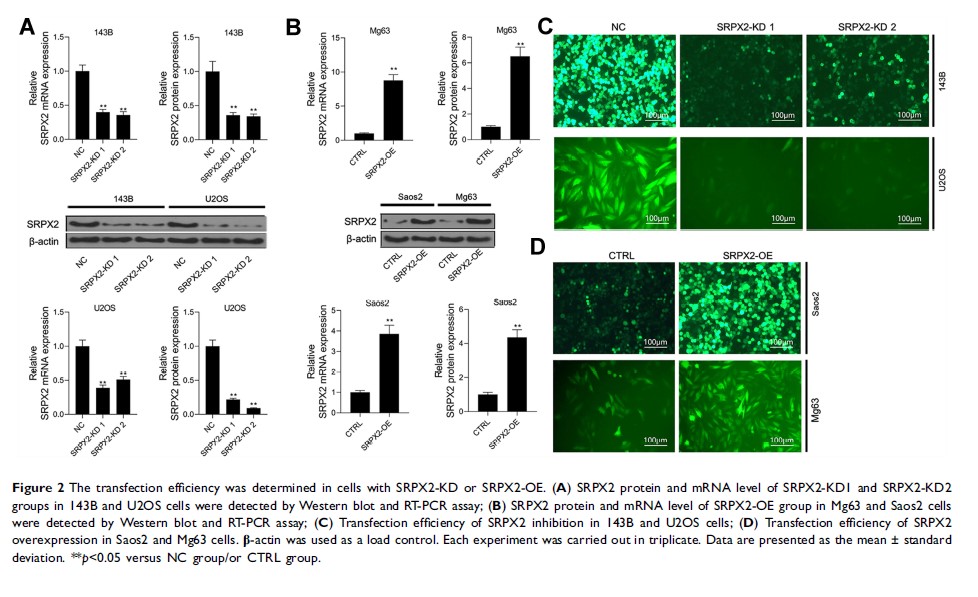
Results: SRPX2 knockdown suppressed the viability, while SRPX2 overexpression increased the invasion and colony formation ability of the cells in vitro. In vivo experiments demonstrated that SRPX2 knockdown inhibited tumor growth and invasion as evidenced by decreased Ki67 and N-cadherin levels, and increased E-cadherin level. Downregulation of SRPX2 increased YAP phosphorylation resulting in reduced nuclear translocation to activate Hippo signaling pathway. The promotion of cell viability, colony-forming ability, and invasion, and the inhibition of CTGF, Cyr61, and Birc5 levels promoted by SRPX2 overexpression were reversed by YAP inhibition.
Conclusion: SRPX2 increased cell proliferation and invasion in osteosarcoma by activating Hippo signaling pathway.
Keywords: osteosarcoma, SRPX2, proliferation, invasion, Hippo signaling pathway