115195
论文已发表
注册即可获取德孚的最新动态
IF 收录期刊
- 3.6 Breast Cancer (Dove Med Press)
- 4.3 Clin Epidemiol
- 2.6 Cancer Manag Res
- 3.2 Infect Drug Resist
- 4.1 Clin Interv Aging
- 6.1 Drug Des Dev Ther
- 4.1 Int J Chronic Obstr
- 8.7 Int J Nanomed
- 2.5 Int J Women's Health
- 3.2 Neuropsych Dis Treat
- 2.4 OncoTargets Ther
- 2.6 Patient Prefer Adher
- 2.6 Ther Clin Risk Manag
- 3.1 J Pain Res
- 3.5 Diabet Metab Synd Ob
- 4.5 Psychol Res Behav Ma
- 3.4 Nat Sci Sleep
- 2.4 Pharmgenomics Pers Med
- 2.6 Risk Manag Healthc Policy
- 4.6 J Inflamm Res
- 2.3 Int J Gen Med
- 3.9 J Hepatocell Carcinoma
- 3.3 J Asthma Allergy
- 2.5 Clin Cosmet Investig Dermatol
- 3.0 J Multidiscip Healthc

高灵敏度 C-反应蛋白导致女性(并非男性)自我报告的代谢综合征增加:对中国人群历时五年的随访研究
Authors Hong G, Gao P, Chen Y, Xia Y, Ke X, Shao X, Xiong C, Chen H, Xiao H, Ning J, Zou H
Received 12 December 2019
Accepted for publication 15 February 2020
Published 28 February 2020 Volume 2020:13 Pages 581—590
DOI https://doi.org/10.2147/DMSO.S241774
Checked for plagiarism Yes
Review by Single-blind
Peer reviewer comments 2
Editor who approved publication: Prof. Dr. Juei-Tang Cheng
Purpose: Metabolic syndrome (MetS), characterized by a constellation of insulin resistance, central obesity, hypertension, and hyperlipidemia, is a global health threat. High-sensitivity C-reactive protein (hs-CRP) has been shown to be associated with type 2 diabetes and cardiovascular disease; however, its association with incident MetS is less known. Therefore, the aim of this study was to examine the prospective association between hs-CRP and MetS among a Chinese population in a 5-year follow-up study.
Patients and Methods: The levels of hs-CRP were measured using serum samples collected at baseline recruitment in 2012 from 886 participants without MetS. Follow-up interviews were conducted in 2018, and MetS was diagnosed by 2017 criteria from the Chinese Diabetes Society. Multivariate logistic regression models were used to assess the overall and sex-specific associations between hs-CRP and incident MetS. The odds ratios (ORs) and corresponding 95% confidence intervals (CIs) were computed with adjustment for demographic, socioeconomic, clinical, and lifestyle factors.
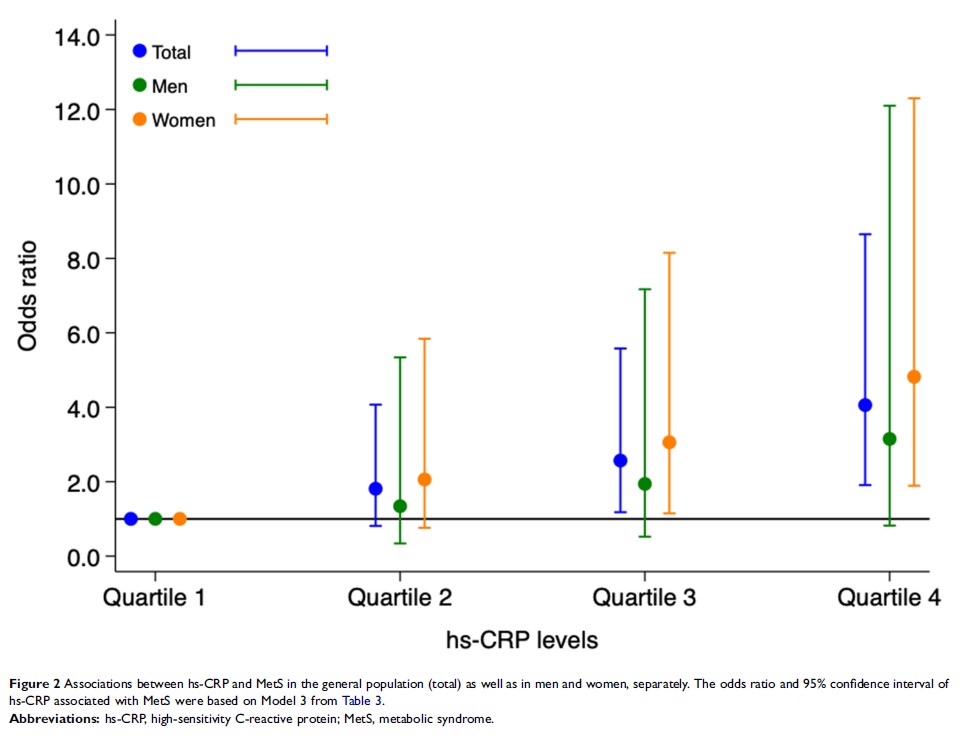
Results: After a mean follow-up duration of 5.40 ± 0.56 years, 116 (13.3%) participants developed MetS. In the total study population, increased hs-CRP levels were associated with a higher risk of MetS (OR comparing extreme quartiles of hs-CRP: 4.06 [95% CI: 1.91– 8.65]) in the fully-adjusted model. When stratified by sex, the positive association was only observed in women (OR: 4.82 [1.89– 12.3]) but not in men (OR: 3.15 [0.82– 12.1]; P -interaction = 0.039).
Conclusion: In this study of a Chinese population, a positive association between hs-CRP and incident MetS was found only in women and not in men. Sex-specific prediction and intervention of MetS using hs-CRP as a target should be further evaluated.
Keywords: inflammation, high-sensitivity C-reactive protein, metabolic syndrome, cohort study, follow up