115195
论文已发表
注册即可获取德孚的最新动态
IF 收录期刊
- 3.6 Breast Cancer (Dove Med Press)
- 4.3 Clin Epidemiol
- 2.6 Cancer Manag Res
- 3.2 Infect Drug Resist
- 4.1 Clin Interv Aging
- 6.1 Drug Des Dev Ther
- 4.1 Int J Chronic Obstr
- 8.7 Int J Nanomed
- 2.5 Int J Women's Health
- 3.2 Neuropsych Dis Treat
- 2.4 OncoTargets Ther
- 2.6 Patient Prefer Adher
- 2.6 Ther Clin Risk Manag
- 3.1 J Pain Res
- 3.5 Diabet Metab Synd Ob
- 4.5 Psychol Res Behav Ma
- 3.4 Nat Sci Sleep
- 2.4 Pharmgenomics Pers Med
- 2.6 Risk Manag Healthc Policy
- 4.6 J Inflamm Res
- 2.3 Int J Gen Med
- 3.9 J Hepatocell Carcinoma
- 3.3 J Asthma Allergy
- 2.5 Clin Cosmet Investig Dermatol
- 3.0 J Multidiscip Healthc

一种中药复方 GRS,可缓解血脑屏障功能障碍
Authors Zhang Y, Hu Y, Li M, Wang J, Guo G, Li F, Yu B, Kou J
Received 30 August 2019
Accepted for publication 10 February 2020
Published 28 February 2020 Volume 2020:14 Pages 933—947
DOI https://doi.org/10.2147/DDDT.S229302
Checked for plagiarism Yes
Review by Single-blind
Peer reviewer comments 4
Editor who approved publication: Dr Yan Zhu
Introduction: Traditional Chinese medicine (TCM) provides unique advantages for treatment of ischemic stroke, an aging-related vascular disease. Shengmai powder (GRS) is composed of three active components, specifically, ginsenoside Rb1, ruscogenin and schisandrin A, at a ratio of 6:0.75:6. The main objective of this study was to evaluate the effects of GRS on blood–brain barrier (BBB) dysfunction under conditions of middle cerebral artery occlusion/reperfusion (MCAO/R).
Methods: C57BL/6J mice subjected to MCAO/R were used as a model to assess the protective effects of varying doses of GRS (6.4, 12.8, and 19.2 mg/kg) on BBB dysfunction.
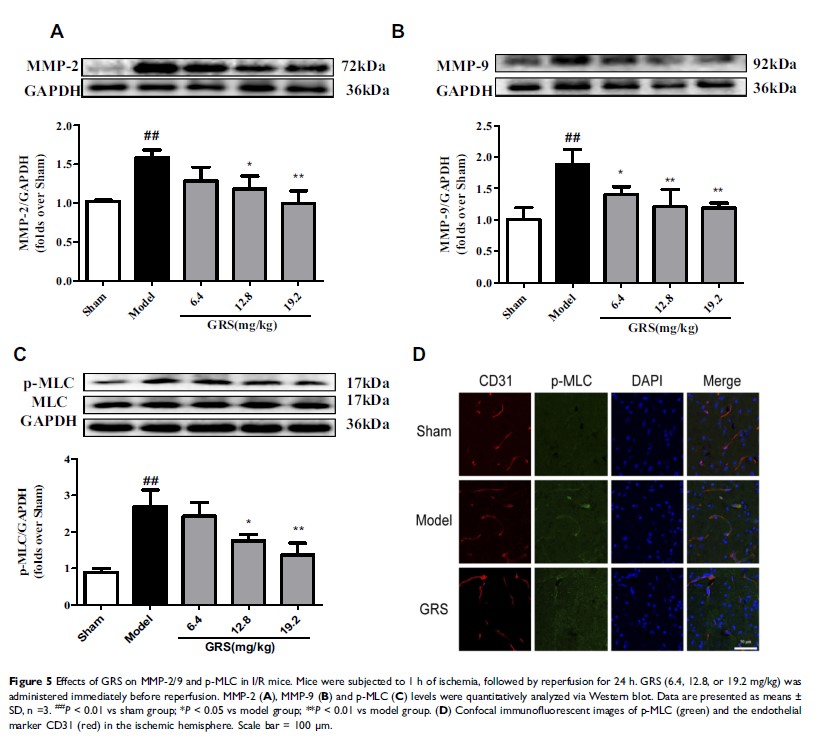
Results: GRS reduced cerebral infarct volume and degree of brain tissue damage, improved behavioral scores, decreased water content and BBB permeability, and restored cerebral blood flow. Moreover, GRS promoted expression of zona occludens-1 (ZO-1) and claudin-5 while inhibiting matrix metalloproteinase 2/9 (MMP-2/9) expression and myosin light chain (MLC) phosphorylation. In vitro, GRS (1, 10, and 100 ng/mL) enhanced the viability of bEnd.3 cells subjected to oxygen glucose deprivation/reoxygenation (OGD/R) and decreased sodium fluorescein permeability.
Conclusion: Consistent with in vivo findings, ZO-1 and claudin-5 were significantly upregulated by GRS in bEnd.3 cells under OGD/R and MMP-2/9 levels and MLC phosphorylation reduced through the Rho-associated coil-forming protein kinase (ROCK)/cofilin signaling pathway. Based on the collective findings, we propose that the TCM compound, GRS, plays a protective role against I/R-induced BBB dysfunction.
Keywords: GRS, ischemic stroke, blood–brain barrier, endothelial, tight junctions, ROCK/cofilin