115195
论文已发表
注册即可获取德孚的最新动态
IF 收录期刊
- 3.6 Breast Cancer (Dove Med Press)
- 4.3 Clin Epidemiol
- 2.6 Cancer Manag Res
- 3.2 Infect Drug Resist
- 4.1 Clin Interv Aging
- 6.1 Drug Des Dev Ther
- 4.1 Int J Chronic Obstr
- 8.7 Int J Nanomed
- 2.5 Int J Women's Health
- 3.2 Neuropsych Dis Treat
- 2.4 OncoTargets Ther
- 2.6 Patient Prefer Adher
- 2.6 Ther Clin Risk Manag
- 3.1 J Pain Res
- 3.5 Diabet Metab Synd Ob
- 4.5 Psychol Res Behav Ma
- 3.4 Nat Sci Sleep
- 2.4 Pharmgenomics Pers Med
- 2.6 Risk Manag Healthc Policy
- 4.6 J Inflamm Res
- 2.3 Int J Gen Med
- 3.9 J Hepatocell Carcinoma
- 3.3 J Asthma Allergy
- 2.5 Clin Cosmet Investig Dermatol
- 3.0 J Multidiscip Healthc

氧化锌纳米粒子通过改变组蛋白的甲基化状态对膀胱癌细胞的抗癌作用
Authors Zhang T, Du E, Liu Y, Cheng J, Zhang Z, Xu Y, Qi S, Chen Y
Received 28 August 2019
Accepted for publication 15 January 2020
Published 5 March 2020 Volume 2020:15 Pages 1457—1468
DOI https://doi.org/10.2147/IJN.S228839
Checked for plagiarism Yes
Review by Single-blind
Peer reviewer comments 2
Editor who approved publication: Dr Thomas J Webster
Purpose: Zinc oxide nanoparticles (nZnO) have been widely used in the medicine field. Numerous mechanistic studies for nZnO’s anticancer effects are merely performed under high concentration exposure. However, possible anticancer mechanisms of epigenetic dysregulation induced by low doses of nZnO are unclear.
Methods: nZnO were characterized and bladder cancer T24 cells were treated with nZnO for 48 hrs at different exposure concentrations. Cell cycle, apoptosis, cell migration and invasion were determined. We performed qRT-PCR, Western blot and chromatin immunoprecipitation to detect the mRNA and protein levels of signaling pathway cascades for histone modification.
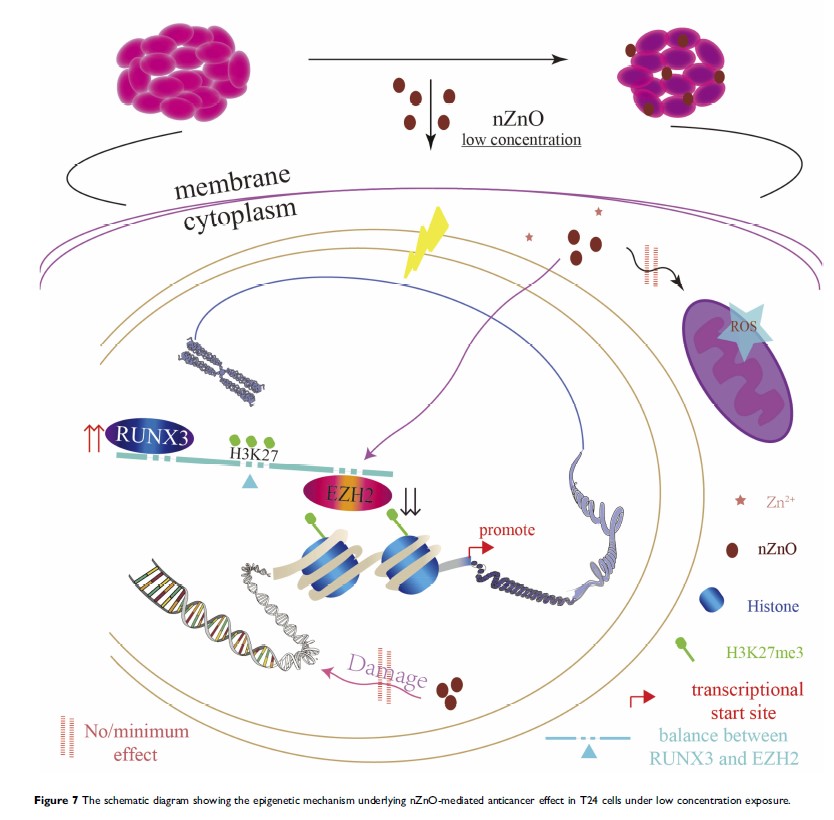
Results: In this study, we investigated the potential anticancer effects and mechanisms of nZnO on histone modifications in bladder cancer T24 cells upon low-dose exposure. Our findings showed that low concentrations of nZnO resulted in cell cycle arrest at S phase, facilitated cellular late apoptosis, repressed cell invasion and migration after 48 hrs exposure. These anticancer effects could be attributed to increased RUNX3 levels resulting from reduced H3K27me3 occupancy on the RUNX3 promoter, as well as decreased contents of histone methyltransferase EZH2 and the trimethylation of histone H3K27. Our findings reveal that nZnO are able to enter into the cytoplasm and nucleus of T24 cells. Additionally, both particles and ions from nZnO may jointly contribute to the alteration of histone methylation. Moreover, sublethal nZnO-conducted anticancer effects and epigenetic mechanisms were not associated with oxidative stress or DNA damage.
Conclusion: We reveal a novel epigenetic mechanism for anticancer effects of nZnO in bladder cancer cells under low-dose exposure. This study will provide experimental basis for the toxicology and cancer therapy of nanomaterials.
Keywords: zinc oxide nanoparticles, epigenetics, histone modification, methylation, EZH2, RUNX3