115195
论文已发表
注册即可获取德孚的最新动态
IF 收录期刊
- 3.6 Breast Cancer (Dove Med Press)
- 4.3 Clin Epidemiol
- 2.6 Cancer Manag Res
- 3.2 Infect Drug Resist
- 4.1 Clin Interv Aging
- 6.1 Drug Des Dev Ther
- 4.1 Int J Chronic Obstr
- 8.7 Int J Nanomed
- 2.5 Int J Women's Health
- 3.2 Neuropsych Dis Treat
- 2.4 OncoTargets Ther
- 2.6 Patient Prefer Adher
- 2.6 Ther Clin Risk Manag
- 3.1 J Pain Res
- 3.5 Diabet Metab Synd Ob
- 4.5 Psychol Res Behav Ma
- 3.4 Nat Sci Sleep
- 2.4 Pharmgenomics Pers Med
- 2.6 Risk Manag Healthc Policy
- 4.6 J Inflamm Res
- 2.3 Int J Gen Med
- 3.9 J Hepatocell Carcinoma
- 3.3 J Asthma Allergy
- 2.5 Clin Cosmet Investig Dermatol
- 3.0 J Multidiscip Healthc

对比增强计算机断层扫描(CT)和磁共振成像(MRI)在鼻咽癌患者咽后淋巴结转移检测中的作用评估
Authors Chen J, Luo J, He X, Zhu C
Received 29 December 2019
Accepted for publication 21 February 2020
Published 9 March 2020 Volume 2020:12 Pages 1733—1739
DOI https://doi.org/10.2147/CMAR.S244034
Checked for plagiarism Yes
Review by Single-blind
Peer reviewer comments 2
Editor who approved publication: Dr Chien-Feng Li
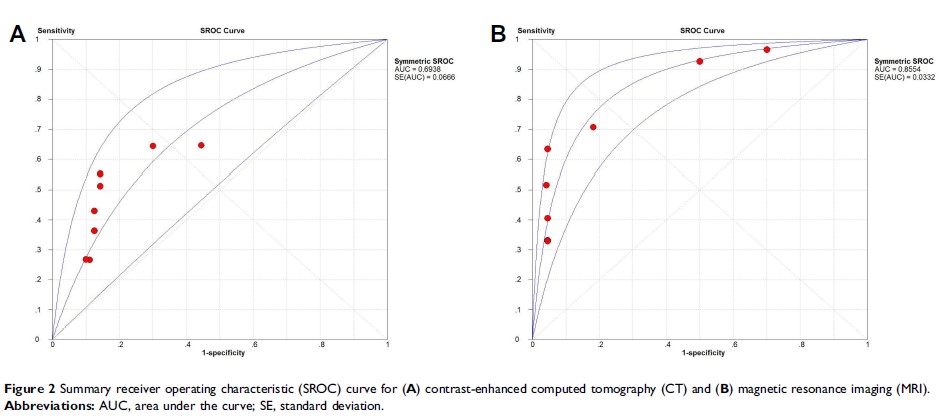
Introduction: We performed this study to explore the diagnostic accuracies and cutoff values of contrast-enhanced computed tomography (CT) and magnetic resonance imaging (MRI) for the detection and diagnosis of metastatic retropharyngeal lymph nodes (RLNs) in patients with nasopharyngeal carcinoma (NPC).
Methods: One hundred and twenty-eight patients with a total of 159 RLNs were included in the study. The sizes of maximal and minimal axial diameters of each node on both contrast-enhanced CT and MRI images were measured. The characteristics of the RLNs (malignant or benign), as well as the survival of patients, were classified based on the results of follow-up MRI.
Results: RLN size cutoffs of 4– 11 mm for minimal axial diameter were used. We found that MRI showed higher sensitivity while CT demonstrated higher specificity. The reasonable criterion for the diagnosis of metastatic RLNs in MRI was a minimal axial diameter of ≥ 6 mm, which yielded a sensitivity, specificity and diagnostic odds ratio (DOR) of 0.71, 0.82 and 10.88.
Conclusion: The radiologic criteria that should be used for the assessment of RLN metastases in NPC patients are nodes with a minimal axial diameter of ≥ 6 mm on MR images.
Keywords: retropharyngeal lymph node, metastasis, nasopharyngeal carcinoma, cutoff, MRI